
Home Technology Science and technology PYY(1–36) vs. PYY(3–36): W...
CIO Bulletin, 20 November, 2026
Author:
CIO Bulletin Team
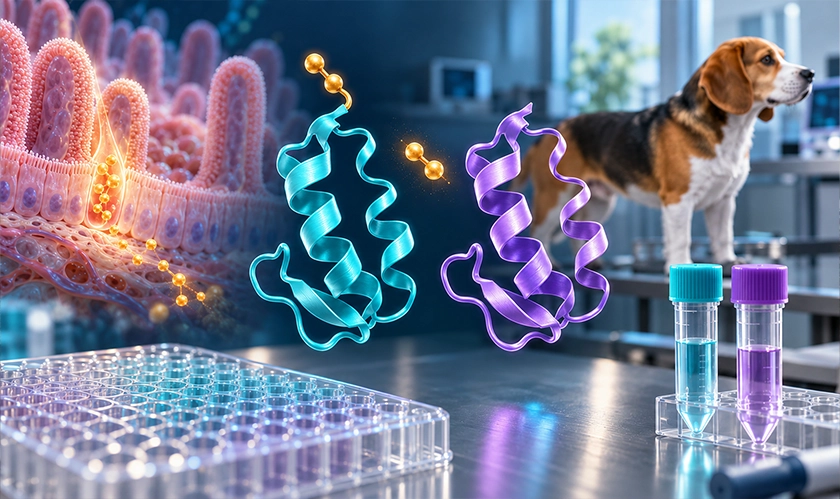
The mucosal wall of the intestine contains enteroendocrine L-cells responsible for producing Peptide YY (PYY), a hormone that signals fullness to the brain. This is why this hormone is often studied to understand canine metabolism, appetite, and gut health. PYY(1–36) and PYY(3–36) are the two main forms of PYY.
PYY(1–36) contains a chain of 36 full amino acids (numbered from 1 to 36). On the other hand, PYY(3–36) contains a chain of 34 amino acids (numbered from 3 to 36).
While cleavage of the first two amino acids seems to be a minor structural change, it completely alters how the hormone acts, which receptors it binds to, and how it must be measured. This is why it is important to understand the distinction between the two forms when designing canine studies and interpreting results.
Peptide YY is a peptide hormone released by L-cells in the intestines after eating food. When it enters the bloodstream, it slows gastric emptying of the stomach and signals the brain to suppress appetite. The body produces the full-length version of the hormone, which contains 36 amino acids linked together in a specific chain.
However, an enzyme called dipeptidyl peptidase-4 (DPP-4) truncates the first two amino acids at the beginning of the chain. Both forms circulate in the body but behave in opposite ways.
PYY interacts with Neuropeptide Y (NPY) receptors, a family of G protein-coupled receptors (GPCRs) found primarily in the central nervous system. Y1 and Y2 are the main receptors involved in appetite regulation.
PYY(1–36) binds strongly to the Y1 receptor. The activation of this receptor stimulates hunger and slows down gut movement.
The molecular structure of the hormone is changed after the first two amino acids are removed. It becomes highly selective for the Y2 receptor. This shuts down the signal that triggers hunger. As a result, PYY (3–36) suppresses appetite and increases the feeling of fullness (satiety).
|
Feature |
PYY (1–36) |
PYY(3–36) |
|
Length |
36 amino acids |
34 amino acids |
|
Origin |
Directly secreted by gut L-cells |
Created when DPP-4 cleaves PYY(1–36) |
|
Target Receptor |
Y1 (and Y2/Y5) |
Y2 (highly selective) |
|
Effect on Appetite |
Stimulates hunger (central effect) |
Suppresses hunger / promotes satiety |
|
Dominant Active Form |
Precursor in blood |
Primary circulating satiety signal |
Obesity, diabetes, and gastrointestinal disorders are very common in dogs. This is why researchers use validated analytical methods and PYY ELISA kits to quantify PYY concentration. Analyzing PYY concentrations helps them understand how diets, drugs, or diseases affect hunger and metabolism in dogs.
However, canine studies face the following three major challenges associated with PYY forms:
Low-cost lab kits such as standard ELISAs or radioimmunoassays use antibodies that measure total PYY in a sample. These assays cannot clearly distinguish between PYY(1–36) and PYY(3–36) forms.
When a sample is obtained from a dog after it eats a meal, its body secretes PYY(1–36). This secretion is rapidly converted to PYY(3–36). Reporting total PYY combines a hunger-stimulating hormone with a fullness-inducing hormone into a single number. This number does not truly reflect the biological realities in the dog’s body. Researchers can draw a valid conclusion only if the assay specifically measures PYY(3–36) or if they isolate both forms using methods like mass spectrometry.
DPP-4 remains active in canine blood. When a blood sample is drawn from a dog, DPP-4 continues to break down PYY(1–36) into PYY(3–36) in the test tube. Researchers must add a DPP-4 inhibitor to the blood collection tube immediately after drawing the sample. Otherwise, the ratio of PYY(1–36) to PYY(3–36) will change. The assay results will show high PYY(3–36) concentrations, leading to unreliable data.
Humans and dogs share gut hormonal similarities. However, canine digestive timing and metabolic rates differ from rodents and primates. Dogs are adapted to eating large, infrequent meals.
The post-meal PYY(3–36) spike in dogs plays a major role in keeping them satisfied between meals. Researchers must track PYY(3–36) when it comes to researching weight-loss drugs and prescription diets.
Researchers must follow a validated protocol to prevent measurement errors and obtain accurate metabolic data.
Add DPP-4 inhibitors in blood collection tubes before collecting a sample to stop in vitro breakdown of PYY(1–36).
Collect the sample when hormone levels are highest.
Use a PYY ELISA kit validated for the form to track PYY(3–36) independently.




















































 consultants ltd.jpg)


Comments