
Home Technology Security Security Window Film vs. Polyc...
CIO Bulletin
,
27 October, 2026
Author:
Guest
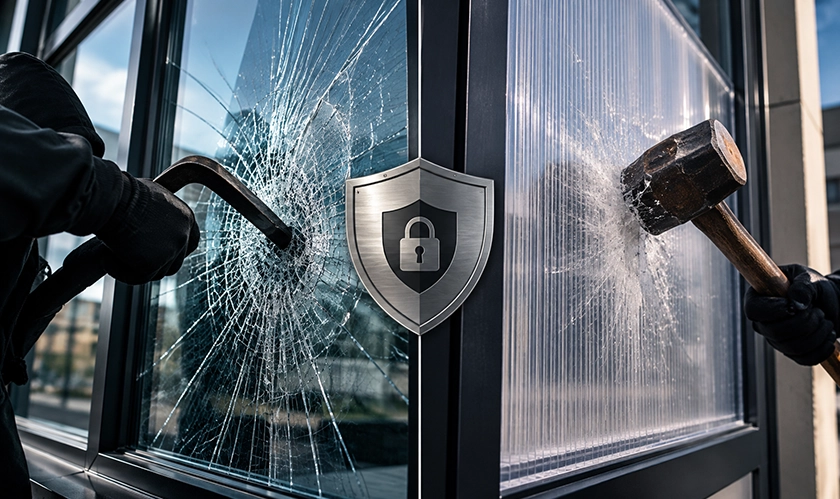
Security window film and polycarbonate glazing overlays both promise to protect windows. That shared promise is where most specification mistakes begin. The two categories are tested under different frameworks, and a quote from a polycarbonate security glazing installer DFW property owners use for storefronts and schools will cite different performance language than a film proposal does. A facility manager comparing the two bids side by side is often comparing ratings that measure different events.
This guide compares both product categories on the axis that should drive the decision, which is forced entry resistance. It covers the ASTM test methods that apply, how each product performs against them, and the building scenarios where one is the better fit.
Forced entry language in a bid document usually traces back to ASTM Committee F12 on Security Systems and Equipment. Two of its test methods matter most for glazing. They measure different attacks and report results in different units.
ASTM F3561 is the Standard Test Method for Forced-Entry-Resistance of Fenestration Systems After Simulated Active Shooter Attack. The current edition is F3561-25. The test first weakens the specimen with a prescribed pattern of 5.56 mm M193 rounds. A mechanically driven impactor then strikes the damaged assembly with horizontal impacts of up to 400 ft-lbf. Results are reported as Levels 1 through 8.
Two details matter in a bid review. The specimen is the entire fenestration assembly along with every device used to resist entry. All tests are run on the exterior surface. An F3561 result therefore belongs to a specific tested assembly. It does not belong to a glazing material on its own.
ASTM F1233 is the Standard Test Method for Security Glazing Materials and Systems. It evaluates resistance to ballistic impact, blunt tool impacts, sharp tool impacts, thermal stress, and chemical deterioration. The physical attack runs in sequence through hand tools, then heat sources such as a propane torch, then chemicals such as gasoline and acetone. Failure is defined by passage. An opening that admits an 8 in by 8 in by 5 in object counts as body passage, and a 1/8 in penetration counts as contraband passage. Power tools, explosives, and tools that need more than two people are excluded.
F1233 is sometimes described as a glass hazard standard. It is a security glazing test that rates how a barrier holds against tools and time. Hazard performance describes how glass fragments behave once the pane breaks. That question falls under separate methods such as ASTM F1642 for airblast loading. Film is most often rated on the hazard side of that line.
Security film is a polyester laminate bonded to the interior face of existing glass. Its main job is fragment retention. When the pane breaks, the film holds the shards together and keeps them in the opening longer than bare glass would. That behavior is what hazard testing measures, and it is where film earns its place in a specification.
Forced entry is a harder test for film. The film adds delay, but the substrate is still glass. Once the glass fractures, the remaining barrier is a thin polymer sheet and whatever holds it to the frame. Daylight-applied film with no attachment can peel out of the glazing pocket as one sheet. Wet-glazed or mechanically attached systems resist that pull-out much better, and they should be the baseline on any film bid tied to a security goal.
If a film supplier cites an F1233 class or an F3561 level, ask for the lab report. Confirm that the tested assembly matches the glass type, glass thickness, attachment method, and frame on your building. A result earned on a lab specimen does not carry over to annealed glass in an aging storefront frame.
Polycarbonate overlays work on a different principle. Rather than holding broken glass together, they add a second barrier that stands on its own. A clear polycarbonate sheet in a retained frame or channel system is mounted over the existing glass. An attacker has to defeat the glass first and then defeat a material with far higher impact resistance than the pane in front of it.
That structure maps closely to how the forced entry methods judge a barrier. Both F1233 and F3561 ask whether an attacker can open a passage through the assembly. A retained polycarbonate sheet is built to deny that opening after the glass is gone. Riot Glass and ArmorPlast-class products sit in this category, and some lines offer bullet-resistant grades for higher threat levels.
Overlays make the most sense where the threat is a person trying to get through the glass. Typical applications include the following.
Street-facing retail glass exposed to smash-and-grab attacks
School entrances, vestibules, and sidelights where delay protects occupants
Houses of worship and public-facing offices that need protection without bars or shutters
Government and public facilities that want a retrofit over existing glass without full replacement
The installer matters as much as the sheet, since the rating belongs to the assembly. Ask for the tested configuration, the anchoring method into the existing frame, and an assessment of whether that frame can carry the load. A strong sheet in a weak frame fails at the frame.
The right choice follows the threat, not the window. Start by naming what you expect to happen to the glass. Then pick the product whose test method measures that event.
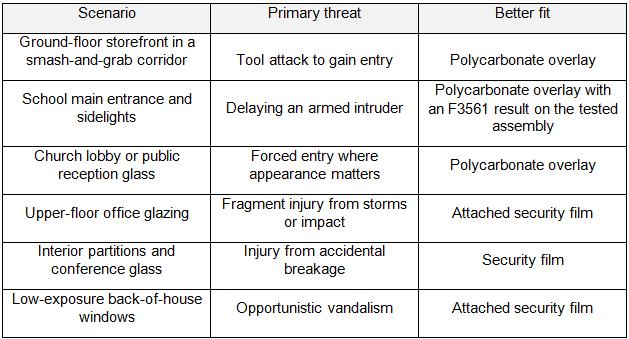
Many buildings need both. A layered plan often puts overlays on the openings an intruder would target first and film on the remaining glass.
Most glazing mistakes come from treating the two categories as grades of the same product. They are not, and the errors run in both directions.
This is the most expensive mistake because it shows up after an incident. A storefront or school entrance gets filmed because the line item was cheaper and the proposal said "security." The film holds the shards, but a determined attacker with a hammer still works through the opening. If the threat assessment names forced entry by a person, film alone rarely meets the intent.
The reverse error wastes budget and disrupts operations. Overlays need frame work, anchoring, and more installation time per opening. On upper floors, interior partitions, or glass with no realistic entry threat, that cost buys protection against an event that is unlikely to occur. Attached film covers the real risk on those openings at lower cost.
A product sheet that cites F3561 or F1233 is only a starting point. The rating applies to the glass, attachment, and frame that were tested. Ask for the report and compare it line by line to your conditions.
A strong airblast hazard rating says the film keeps fragments in place. It says nothing about how long the opening resists a person with tools. Keep the two result types in separate columns when you score bids.
Before signing off on any glazing proposal, confirm a few points in writing.
Which test method backs each performance claim, and which edition
The level or class achieved, and the full assembly that earned it
The attachment or anchoring method and how it ties into your existing frames
Whether the claim describes hazard mitigation, forced entry delay, or both
The installation schedule and how it fits around building operations
A proposal that answers these points clearly is one you can defend to a board or an insurer. A proposal that only says "security" leaves the most important question open.



















































 consultants ltd.jpg)


Comments