
Home Technology Security France Mounts Huge Security Op...
CIO Bulletin
,
24 October, 2026
Author:
Sambhrant Das
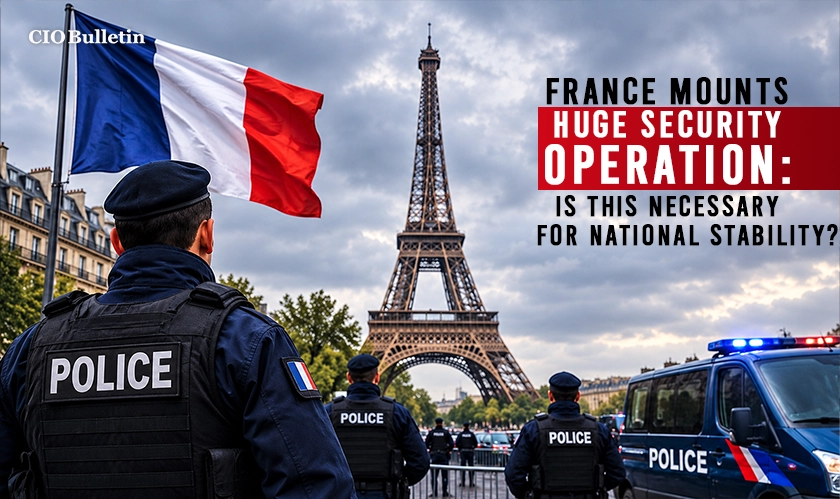
France mounts a massive national security operation involving tens of thousands of police officers and armored units to secure major urban centers, safeguard critical commercial infrastructure, and manage widespread public protests nationwide.
In response to widespread public unrest, corporate disruptions, and civil marches that were planned for the weekend, France is carrying out a large-scale French security operation that includes more than 70,000 police officers and various military units throughout the country. After the earlier protests saw hundreds of thousands of demonstrators assemble in different parts of the nation, the national law enforcement authorities introduced strict security measures, including preemptive bans on certain routes and regional restrictions on movement. The increased presence of security forces is intended for the purpose of protecting key infrastructure, ensuring the safety of commercial areas and avoiding outbreaks of local clashes between the protest groups and the riot troops.
Rapid Security Protocols and Logistics Restructuring
The officials of the Interior Ministry rearranged their tactics for responding in urban areas with a view to avoiding blackouts of public transport and the blocking of commercial districts in important metropolitan areas. They concentrated on improving tactical flexibility while at the same time maintaining strict jurisdictional control over public gatherings.
Specialized mobile units, including those equipped with armored vehicles, water cannons, and tactical support teams, are deployed in the high-risk areas.
There were preemptive bans imposed on unofficial protest routes together with the temporary closure of around forty metro stations.
There is increased surveillance at critical government headquarters, financial districts, and major commercial transport hubs.
Political Leadership Defends Broad Public Order Enforcement
Addressing the tactical shift following initial civil unrest, French Prime Minister Sébastien Lecornu emphasized the government's strict stance on public safety: “Once again, those in power are creating disruption for the marches and impossible deadlines for organisations to reorganize themselves.”
Political opponents strongly disapproved of the last-minute changes to the route, while government officials insisted that mobile containment measures are still necessary if urban property damage is to be avoided and the public transit networks are to be secured.
Economic and Operational Impact on Commercial Transport
The large-scale security operation has caused a great deal of operational difficulty for regional supply chains, urban logistics, and retail businesses. Transport operators had to divert their routes urgently and experienced widespread interruptions to transit, which disrupted commercial activity on weekends in the major metropolitan areas.
The transport of fuel and flammable materials in individual containers is temporarily suspended within municipal areas.
Because of urban roadblocks and security checkpoints, the costs of operation for logistics providers have increased.
Long-Term Regulatory Implications for Urban Infrastructure Security
The fact that tens of thousands of security personnel have been deployed shows how much the government is relying on extensive physical security measures while there is widespread domestic civil unrest. Although maintaining a strict public order helps to ensure commercial stability, long-term spatial restrictions could place a strain on municipal resources and disrupt business operations. According to CIO Bulletin, this situation is a clear indication of the increasing operational risks and security costs involved in managing public infrastructure during times of ongoing civil unrest.
News Source: Reuters, https://www.reuters.com/
Everything you need to know about this news
More than 70,000 security officers were deployed during the nationwide weekend protests in order to avoid violent clashes and to protect the commercial infrastructure.
The move involves about 70,000 police officers and gendarmes together with specialized military units such as the Operation Sentinelle troops.
Severe closures were experienced by urban transport systems, with dozens of metro stations being closed down, together with restrictions on regional freight and commercial deliveries.
The interior authorities changed from having static police cordons to employing more mobile units, using water cannons, armored vehicles, and aerial surveillance.
Government leaders say that the move is necessary for the purpose of protecting infrastructure, whereas critics maintain that the last-minute bans cause unnecessary operational chaos.















































 consultants ltd.jpg)


Comments