
Home Services & Solutions Smart infrastructure Will Uzbekistan’s New Infras...
CIO Bulletin
,
25 June, 2026
Author:
Sambhrant Das
How Uzbekistan’s new engineered sanitary infrastructure turns urban refuse into a profitable engine for green economic growth
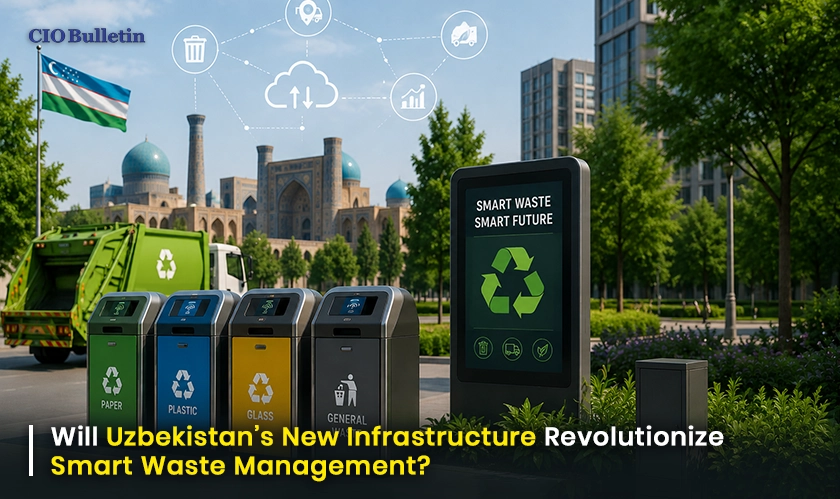
Uzbekistan is aggressively restructuring its municipal sanitation framework to counter severe urbanization pressures. Backed by a 69 million dollar investment from the Asian Development Bank, the country has launched what is described as its first internationally engineered sanitary landfill in Akhangaran as a pilot move. The initiative is aimed at the noticeable surge in Tashkent; where daily refuse generation reportedly jumped by more than 53 percent, going from about 1,950 tonnes in 2019 to nearly 3,000 tonnes in recent years. With this early footprint, the state wants to leave behind primitive open dumping practices and build the urban development strategy around more formal smart waste management routines.
The 30.91-hectare facility relies on containment techniques meant to keep toxins afar and protect nearby ecosystems. The build includes high-density polyethylene liners, clay protective barriers, and anaerobic bioreactors that process around 1,950 tonnes of waste each day.
Leachate capture networks help refeed the liquids in dry months to ensure that decomposition occurs continuously.
Phased containment cells segment daily inputs, maximizing the facility's 6.5 million tonne lifespan.
Biogas collection mechanisms lay the structural groundwork for future municipal waste-to-energy recovery networks.
Data from the report underscores that physical dumps alone cannot solve structural municipal inefficiencies without aggressive collection overhauls. Detailed resource tracking indicates that 43.1 percent of Tashkent's urban refuse comprises organic matter, while plastics, glass, and metals constitute another 29.7 percent. Despite these highly lucrative resource metrics, less than 10 percent of municipal recyclables are successfully recovered due to a systemic lack of automated processing infrastructure.
To move beyond basic storage, the state is shifting its national policy focus toward source segregation, commercial composting, and formalized public-private partnerships. The report also asks policymakers, development partners, and potential investors to expand structural reforms across regional planning areas.
The report suggests a systematic reshuffling, so informal collectors who are currently sidelined can enter institutional supply chains, while agricultural residue can be used to make more valuable bioenergy.
The introduction of engineered landfills marks a permanent shift toward treating refuse as a renewable economic resource rather than an environmental liability. Transitioning to integrated regional sanitation networks allows municipal governments to scale urban density without overwhelming fragile ecosystems or ballooning fiscal maintenance budgets. According to CIO Bulletin, this development demonstrates how targeted international capital can successfully transform emerging municipal liabilities into profitable green growth engines.
Everything you need to know about this news
Located near Tashkent, the Akhangaran facility is Central Asia’s first internationally engineered sanitary landfill. It represents a massive shift toward sustainable urban planning by replacing primitive open dumps with advanced, eco-friendly infrastructure.
This 30.91-hectare landfill is set up to handle roughly 1,950 tonnes per day, and it also has an overall capacity of around 6.5 million tonnes . It uses high-density liners, clay barriers, and automated leachate systems, with the idea of isolating contaminants in a more controlled manner.
The ADB report says 43.1% of Tashkent’s urban waste is organic content, and 29.7% is recyclables such as plastics and metals. At the moment, under 10% of those materials are recovered, so there is an obvious gap where recycling operations could scale up fast.
The landfill leans on anaerobic bioreactor technology, where leachate is collected during wetter seasons and then re-circulated in drier periods. This is described as a process that speeds up decomposition, cuts daily operational expenses a bit, and improves gas generation, which could help later with energy projects.
The study urges moving toward source segregation, commercial composting, and public-private partnerships. It also points out that informal waste pickers should be integrated into institutional supply chains, so green growth can expand without leaving people behind.

















































 consultants ltd.jpg)


Comments