
Home Industry Space Something Is Hiding In Deep Sp...
CIO Bulletin
,
11 June, 2026
Author:
Gayathri Sr
A chilling look into Earth's ancient past reveals how humanity will finally track down hidden cosmic neighbors.
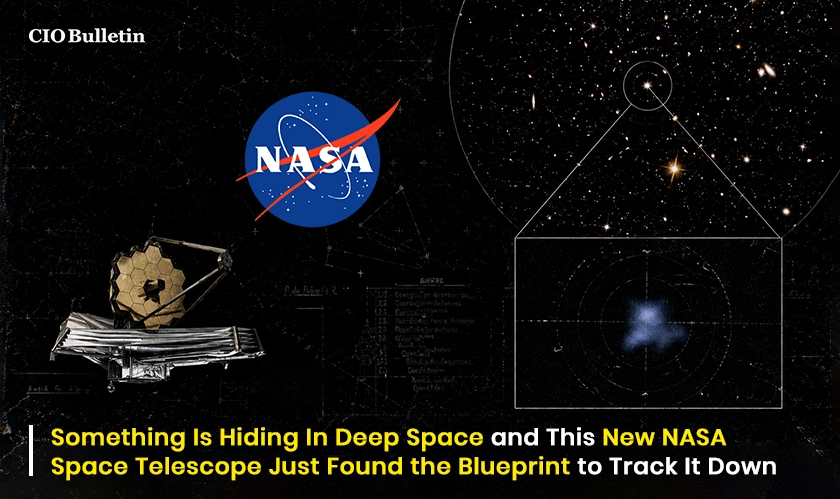
Is humanity truly alone in the universe? A groundbreaking new study has just mapped out exactly how the highly anticipated NASA Space Telescope, known as the Habitable Worlds Observatory (HWO), could confidently answer that timeless question. Scientists are currently decoding how this massive instrument will spy on distant alien worlds by comparing them to an unexpected target: our own ancient Earth.
According to a report analyzed by CIO Bulletin, this flagship observatory is being engineered to do what no previous instrument has ever achieved. It will directly image Earth-like planets orbiting distant stars and dissect the light bouncing off their atmospheres to uncover hidden biosignatures of life.
The magic lies in a concept called spectral resolution, which determines how finely a telescope can separate colors of light to read a planet's atmospheric fingerprint. To see if the instrument could handle the job, researchers modeled what the NASA Space Telescope would see if it looked back in time at Earth’s own geological evolution, from its oxygen-depleted youth to the vibrant, living world we inhabit today.
The findings show that detecting life requires a perfect balance. Too much detail slows the mission down, while too little leaves scientists guessing. Fortunately, the study reveals that the baseline numbers needed to catch oxygen and ozone are well within our current technological reach.
However, distinguishing between a volcanically active dead planet and a thriving ecosystem requires precise infrared tuning. Dr. Shawn Domagal-Goldman, Astrophysics Division Director at NASA Headquarters, noted the ultimate scope of the project during recent development updates:
“Are we alone in the universe? Is an audacious question to answer, but one that our nation is poised to pursue.”
By giving engineers a precise spec sheet for the upcoming mission, this new study ensures that when this mighty NASA Space Telescope finally opens its eyes in the cosmos, it will know exactly what to look for.




















































 consultants ltd.jpg)


