
Home Industry Space Sun Watching Telescope Install...
CIO Bulletin,
28 May, 2026
Author:
Sambhrant Das
Expedition Seventy Four Crew Navigates Mechanical Complications and Freezing Void to Mount Terahertz Solar Radiation Monitoring Hardware on Exterior Station Hull
Expanding our baseline understanding of cosmic radiation and magnetic fluctuations requires moving delicate scientific hardware directly into the vacuum of low Earth orbit. For decades, orbital researchers have faced major challenges tracking the volatile energetic bursts of the sun from behind the distorting layer of our planet's atmosphere. This blind spot leaves our global communication grids vulnerable to sudden, unexpected solar weather changes. To break past this limitation, a highly specialized, cutting-edge sun watching telescope was recently attached to the station's exterior, establishing a continuous lookout point in the terahertz electromagnetic range.
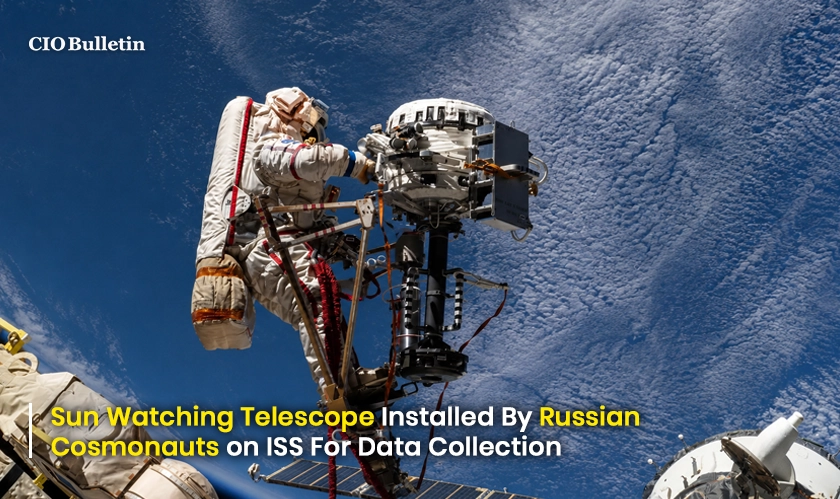
The installation was handled by Expedition 74 commander Sergey Kud-Sverchkov and flight engineer Sergei Mikaev during a demanding six-hour and five-minute extravehicular excursion. Perched on the outer hull of the Zvezda service module, the pair had to navigate tight spaces and harsh conditions to safely anchor the fifty-kilogram Solntse-Teragerts hardware package. The automated instrument suite is uniquely optimized to process extreme cosmic activity through several core operational pipelines:
Terahertz Spectrum Tracking: Scanning the sun within an unexplored frequency band to register the exact micro-instants a high-energy solar flare begins to erupt.
Resilient Infrastructure Architecture: Utilizing robust, passive heat shields to withstand severe temperature changes while maintaining perfect optical alignment.
Centralized Data Integration: Routing high-speed sensor feeds directly into the station's communication lines to give ground crews instant warning signs of approaching magnetic storms.
The demanding orbital mission highlighted the unpredictable nature of working outside the safety of the main station walls. While navigating near the Nauka module on the long European Robotic Arm, the crew ran into unexpected mechanical issues, including losing a pair of pliers and dealing with frozen interior mechanisms. Despite these setbacks, the team successfully adapted their workflow to retrieve long-term vacuum exposure samples before completing their primary assembly tasks. Commenting on the successful completion of the assignment, the Russian space agency Roscosmos noted, “Over six hours and six minutes of work outside the station, they performed a number of tasks under the ISS flight science program.”
Getting this dedicated telescope operational before the current solar cycle peaks gives scientists a massive advantage when shielding critical ground-based technologies. Powerful solar flares can easily scramble global positioning networks, burn out commercial satellite electronics, and overload high-voltage power lines on the surface. Having a continuous, unblurred view of solar radiation allows space weather centers to build much more reliable prediction models, giving utility companies and satellite operators the time they need to activate protective safe modes.
The final scientific footprint of this newborn tracking platform will be measured by its ability to keep civilian networks safe through the next several years of intense solar activity. Proving that complex terahertz sensors can operate flawlessly in the freezing void sets a powerful precedent for future deep-space observation platforms. CIO Bulletin views this development as a profound leap forward for global orbital infrastructure, demonstrating that deploying specialized, continuous solar monitoring arrays is the absolute smartest way to insulate our modern, highly connected society from the volatile whims of space weather.





















 consultants ltd.jpg)


