
Home Industry Supply chain management 4 Best Truck Load Management S...
CIO Bulletin, 13 November, 2026
Author:
CIO Bulletin Team
Managing truckloads efficiently requires more than assigning drivers and tracking deliveries. Carriers must coordinate dispatchers, organize shipment information, monitor truck availability, handle transportation documents, and ensure that every load moves through the delivery process without unnecessary delays. As freight volumes grow, managing these activities through spreadsheets and disconnected systems can create operational bottlenecks.
A truck load management system helps transportation companies centralize these workflows. By connecting load booking, dispatching, driver assignments, shipment tracking, documentation, and invoicing, these platforms make it easier to manage freight operations and maintain visibility across the transportation process.
The best systems offer more than basic load tracking. They help carriers automate repetitive administrative tasks, improve communication between drivers and dispatchers, and make better use of available trucks. Below are four truck load management solutions worth considering in 2026, ranging from platforms for smaller carriers to comprehensive systems for larger transportation businesses.
Choosing the right truck load management system depends on the size of the fleet, the types of freight being transported, and the complexity of daily operations. A small carrier may need straightforward load assignments and invoicing, while a larger transportation company may require advanced dispatching, integrations, and detailed reporting.
Several capabilities are particularly important when comparing providers.
Load management and dispatching. The system should allow dispatchers to create, assign, organize, and monitor loads from one centralized interface. Having a clear overview of available shipments, assigned drivers, and delivery schedules helps teams coordinate transportation activities more efficiently.
Driver and truck management. Carriers need visibility into driver availability, vehicle assignments, schedules, and delivery progress. Driver management features can also simplify communication and ensure that important shipment information reaches the right people.
Shipment tracking. GPS tracking and electronic logging device (ELD) integrations help dispatchers monitor trucks and provide customers with more accurate shipment updates. Automated notifications can also reduce the need for repeated check calls.
Document management. Digital access to bills of lading (BOLs), proof of delivery (POD), and other transportation documents reduces paperwork and administrative delays. Drivers should be able to submit documents directly from their mobile devices.
Invoicing and settlements. Automated billing and driver payment calculations help connect completed loads with financial operations, reducing duplicate data entry and making back-office processes easier to manage.
Integrations and reporting. Connections with accounting software, ELD providers, fuel systems, and other transportation tools help maintain consistent information across platforms. Reporting capabilities also allow managers to monitor costs, revenue, and fleet performance.
The following platforms offer different combinations of these capabilities, making them suitable for carriers with different operational priorities.
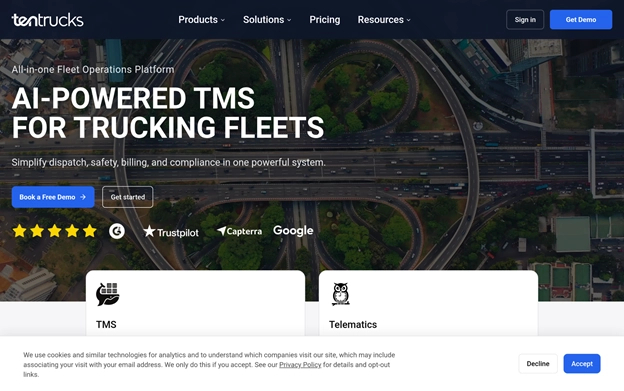
A TMS built for owner-operators and fleets up to 50 trucks, with flat-rate pricing and no setup fees.
Who it fits: Fleets of 1 to 50 trucks; owner-operators and small carriers without dedicated IT staff
Features: Dispatching that catches errors before they post, Automated IFTA reporting, Same-day invoicing, FMCSA-registered ELD compliance, Real-time GPS tracking, Driver mobile app, QuickBooks integration with Motive and Samsara ELD sync. Pricing runs $129/month for 1 to 10 trucks, $239/month for 11 to 20 trucks, and $549/month for 21 to 50 trucks, with enterprise pricing available for 50+. No annual contract and no setup fee, so carriers can cancel anytime.
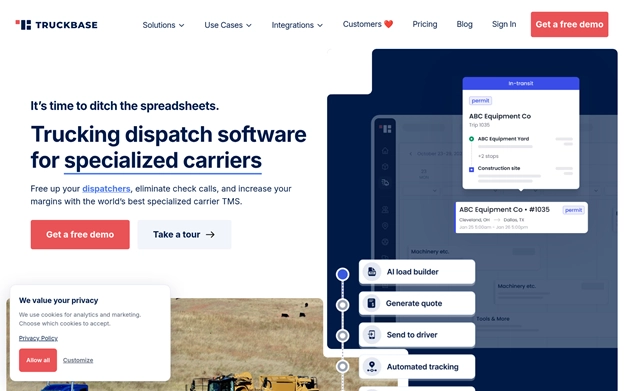
A TMS designed for growing carriers that want fast dispatcher setup and strong dispatch-to-settlement automation.
Who it fits: Long-haul, regional, cross-border, heavy-haul, and LTL carriers; fleets scaling beyond owner-operator size
Features: Load importer, dispatch software, ELD integrations with 30+ providers, instant invoicing, driver settlement software, customer portals, and QuickBooks sync. Dispatchers typically reach working proficiency in roughly 30 minutes, which is unusually fast for a TMS.
Considerations: Intermodal support is listed as coming soon, so intermodal-heavy operations may need a workaround.
Founded in 2021 and based in Oakland, CA, Truckbase has earned Category Leaders recognition on GetApp and customer-support awards on Software Advice.
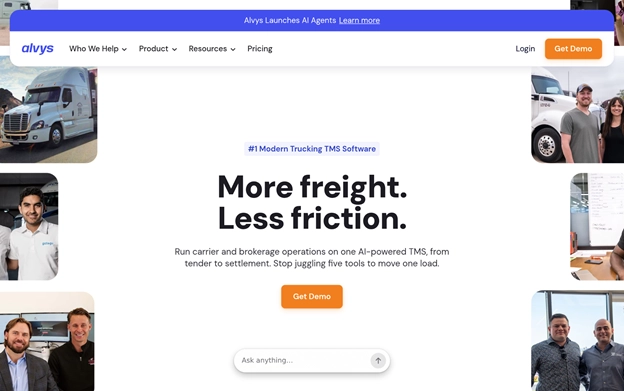
An all-in-one operating system serving carriers, brokers, and hybrid logistics operators that need deep integrations and enterprise-grade automation.
Who it fits: Motor carriers, freight brokers, hybrid operators, and private fleets; 3,000+ motor carriers in the US
Features: Load management with marketplace access, native EDI, document handling and load creation, driver mobile app with scanning and tracking, compliance and safety tools, automated invoicing and settlement, and 120+ integrations. The platform was founded in 2020 by Leo Gorodinski and Nick Darman and now has 150+ employees with a broader enterprise footprint than most TMS competitors.
Considerations: The platform's scale and feature depth may be more than small owner-operators need.
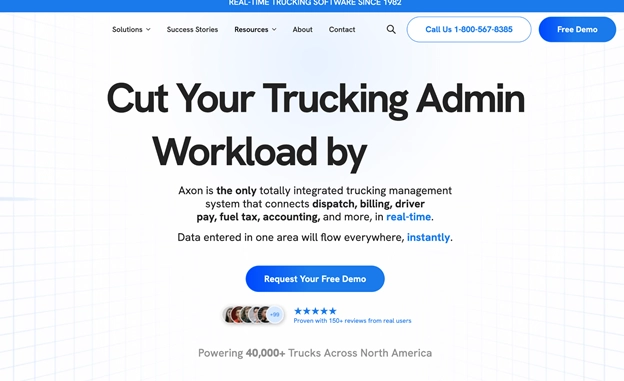
A transportation management system designed specifically for trucking companies, combining dispatching, accounting, fleet management, and load planning in one platform.
Who it fits: Small and mid-sized trucking companies, truckload carriers, owner-operators, and fleets looking to manage transportation and financial operations together.
Features: Load planning and dispatching, automated driver settlements, customer invoicing, accounts payable and receivable, fuel tax reporting, fleet maintenance tracking, driver management, document management, and operational reporting. Axon also offers accounting functionality built specifically for trucking businesses, helping carriers connect load activity with financial records.
Considerations: Axon provides a broad set of transportation and accounting tools, which can be useful for carriers wanting to replace multiple disconnected systems. However, businesses primarily looking for a modern, lightweight dispatching tool may find its wider functionality more than they need.
Axon Software is particularly relevant to trucking companies that want to centralize dispatch, accounting, and fleet administration rather than rely on separate transportation and bookkeeping applications.
Implementing a truck load management system can improve several parts of the transportation process. The biggest benefits usually come from connecting workflows that would otherwise require separate applications, manual records, and constant communication.
Better load planning and truck utilization. Centralized load information helps dispatchers identify available trucks, assign shipments, and organize delivery schedules. More effective planning can reduce unnecessary empty miles and help carriers make better use of their available capacity.
Reduced administrative work. Automated load creation, digital document collection, and integrated invoicing reduce repetitive tasks. Instead of manually transferring information between spreadsheets and applications, employees can manage multiple activities through one system.
Improved shipment visibility. GPS tracking and ELD integrations provide more accurate information about truck locations and delivery progress. Dispatchers can identify delays earlier, coordinate alternative arrangements, and keep customers updated.
Faster financial processing. When load details are connected to invoicing and driver settlements, carriers can reduce the time required to process completed shipments. Digital documentation also makes it easier to prepare and verify billing records.
More informed business decisions. Reporting and analytics provide information about revenue, operating costs, load profitability, and fleet performance. Managers can use these insights to identify inefficient processes and make better decisions about transportation resources.
The extent of these benefits depends on how well the selected system matches the company's existing workflows. Carriers should evaluate the specific features included in each platform rather than assuming that every fleet management or transportation software solution offers the same load management capabilities.
The best truck load management system depends on the size of the fleet, the complexity of transportation operations, and the level of automation a carrier needs.
TenTrucks is worth considering for owner-operators and smaller fleets looking for an integrated solution that combines load management, dispatching, driver settlements, invoicing, compliance, and tracking. Truckbase is another practical option for growing carriers that want to automate load creation, improve driver communication, and simplify back-office processes.
McLeod Software is better suited to established transportation companies with more complex dispatching, financial, and operational requirements. Rose Rocket offers flexible workflows, mobile driver tools, and customer collaboration capabilities for carriers managing more extensive transportation networks.
Before selecting a platform, trucking companies should map their current load management process and identify the areas that consume the most time. Comparing dispatching capabilities, tracking integrations, document management, pricing, and reporting can help ensure that the chosen system supports both current operations and future growth.
A well-matched truck load management system can help carriers reduce administrative overhead, improve truck utilization, and maintain better control over freight operations.




















































 consultants ltd.jpg)


Comments