
Home Services & Solutions Video solutions Is the Rise of the AI Video Ge...
CIO Bulletin
,
25 June, 2026
Author:
Sambhrant Das
How the rapid maturity of the AI Video Generator is completely dismantling legacy post-production pipelines to maximize global enterprise media scalability
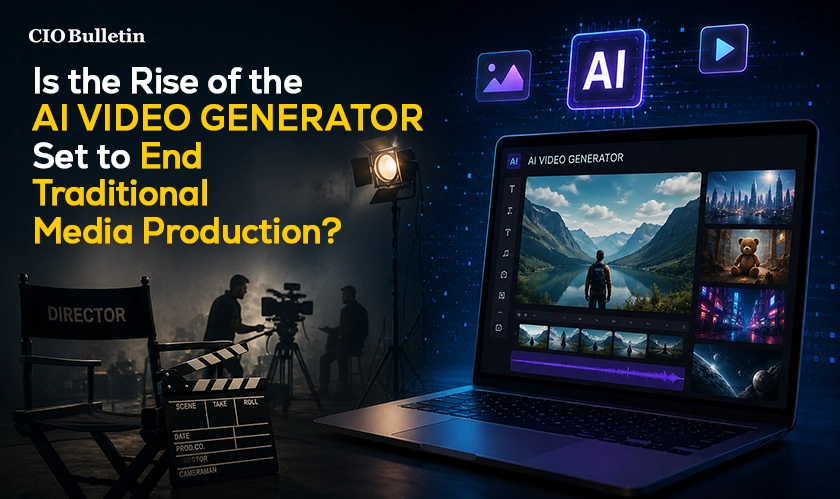
The digital media landscape is undergoing a massive structural shift as automation redefines the baseline parameters of content creation. According to recent market analysis by Allied Market Research, the global sector is transitioning away from resource-intensive manual filming toward highly optimized automated pipelines. Driven by breakthroughs in synthetic media, the industry valuation is projected to skyrocket from 0.6 billion dollars in 2023 to a staggering 9.3 billion dollars by 2033. This exponential surge, maintaining a compound annual growth rate of 30.7 percent, establishes the AI Video Generator as a dominant foundational infrastructure for enterprise communications, marketing agencies, and modern educational institutions.
Modern software suites are rapidly rendering traditional timeline-based editing obsolete by embedding advanced machine learning layers deep within daily operational workflows.
Machine learning algorithms can analyze footage, detect objects, identify scenes, recognize emotions, and automate editing decisions without requiring extensive technical expertise from the operator.
Automated subtitle engines and real-time noise reduction eliminate tedious audio mastering bottlenecks.
Intelligent color correction grids match diverse source clips instantaneously.
Predictive scene detection algorithms generate social media highlight reels in minutes instead of days.
The rapid maturity of text-to-video capabilities enables organizations to bypass physical cameras entirely by turning written scripts directly into complete broadcast-ready files. Modern corporate communications rely heavily on hyper-realistic digital avatars to scale corporate training programs across global offices without increasing logistical overheads. This structural pivot lets mid-market firms roll out complex multi-currency; multi-lingual promo campaigns all at once, thereby helping them overcome the usual localization difficulties.
Cloud native infrastructure now provides scattered enterprise groups coordinate synthetic rendering pipelines at the same time, but still keep rigid version control. When teams synthesize structured data, corporate decks, and raw written drafts into one unified visual narrative, these tools keep tight creative budgets from being caught off-guard by random operational overruns. In practice, this kind of democratization levels the playing field, so newer brands can win premium viewer attention spans that used to be hitherto controlled by huge production houses.
As the market moves deeper into its projected growth cycle, the reliance on specialized physical production hubs will continue to diminish. Corporate ecosystems that fail to integrate intelligent rendering software into their baseline marketing strategy risk being entirely outpaced by agile competitors utilizing real-time rendering. CIO Bulletin views this development as a clear indicator that the future of enterprise visual media belongs exclusively to highly integrated, software-driven platforms that permanently eliminate manual operational friction.
Everything you need to know about this news
This fast expansion is mostly driven by a strong worldwide appetite for automated, low-cost content generation. Marketing agencies, social media operators, and learning institutions are increasingly relying on automated pipelines to produce large quantities of tailored, multi-lingual visual assets.
The space is in a historical upswing, with global valuation projected to climb from 0.6 billion dollars in 2023 up to around 9.3 billion dollars by 2033. This trajectory implies a steep compound annual growth rate (CAGR) of 30.7 percent over the entire ten-year period.
Modern software suites automate the tedious editing actions by interpreting raw footage on the fly. The integrated systems can, in practice, recognize particular human emotions, track objects, detect scenes, draft real-time subtitles, and perform involved color calibration across varied source files, without needing step-by-step manual supervision.
Advanced text-to-video workflows let organizations convert written scripts, raw datasets, or presentation outlines straight into broadcast-ready deliverables. With realistic synthetic avatars, companies can broaden training initiatives and promotional pushes worldwide, while sidestepping the travel logistics expenses and the time pressure that often shows up with traditional camera shoots.
Even with quick enterprise adoption, there are still significant sticking points, especially high computational rendering costs and legal compliance concerns. Engineers, along with business teams, have to navigate shifting regulatory expectations tied to content authenticity reviews. They also need copyright protections, clear ethical usage boundaries, and serious deepfake countermeasures.


















































 consultants ltd.jpg)


Comments