
Home Services & Solutions Video solutions Turn Blog Posts Into Videos: A...
Video Solutions
CIO Bulletin,
11 May, 2026
Author:
Guest
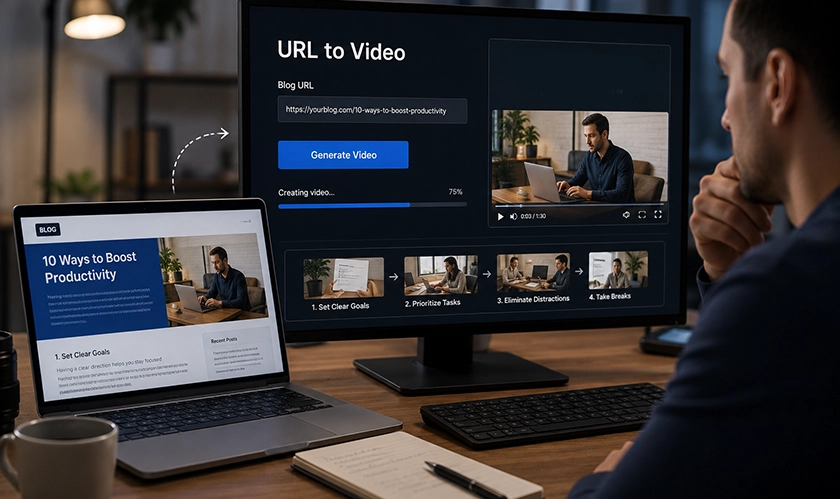
Content repurposing used to mean copying a few sentences from your blog post and slapping them on an Instagram graphic. The tools available now make that approach look like leaving money on the table. URL-to-video technology has matured to the point where a single link can generate a polished, publish-ready video in minutes — and for content teams already producing written material at scale, the implications for reach and ROI are significant.
Most content teams spend the majority of their budget producing written content: articles, guides, case studies, product pages. Video budgets are separate, smaller, and often an afterthought. The result is that written content gets solid SEO distribution but limited social reach, while video slots stay empty or get filled with generic branded material that doesn't drive traffic back to your core content.
URL-to-video tools close that gap. They let the written content team's output feed directly into a video pipeline — no separate production budget, no video editor required.
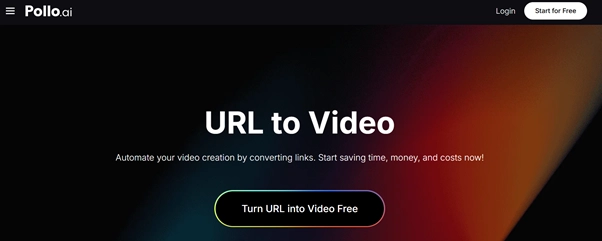
The URL to Video tool on Pollo AI is built specifically for this workflow. Paste a URL, and Pollo AI extracts the key content, generates a visual script, and assembles a video with appropriate pacing and text overlays. The output is a shareable asset that can go to YouTube, Instagram, LinkedIn, or Twitter/X without the overhead of a traditional production process.
For solo creators and lean content teams, this is the kind of capability shift that genuinely changes what's possible — not marginally, but by an order of magnitude in terms of content output per person.
Understanding what happens under the hood helps you prompt the tool better and recognize which source content will produce the strongest videos.
AI extraction prioritizes headline-level claims, subheadings, and the opening and closing sentences of paragraphs — the parts of written content with the highest information density. Body copy that's primarily supporting detail, caveats, or methodology gets deprioritized, which is actually correct for video: viewers want conclusions and key takeaways, not qualifications.
This means your best source content for video is content that's already structured around clear, assertive points. Well-written listicles, how-to guides, and opinion pieces convert better than dense research summaries or heavily qualified analysis. If you want to repurpose a research piece, consider rewriting the abstract or executive summary as your source URL — or summarizing the key findings in a shorter blog post first.
The visual selection logic varies by tool, but most AI video generators either pull from licensed stock libraries, generate images, or use a combination. Pollo AI gives you control over these choices, which matters for brand consistency.
A generated video is a starting point, not a finished product. What separates content that builds brand recognition from content that just fills a feed is consistent visual identity — and that requires a template layer on top of your generated video.
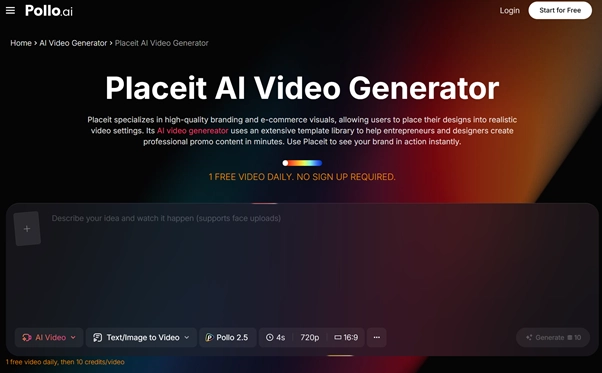
Placeit, accessible through Pollo AI, provides exactly this for the presentation and mockup layer. If you're taking your video content and embedding it into branded social templates, device mockups, or promotional graphics, Placeit has a large library of customizable formats. Showing a video frame on a phone screen for a social ad, dropping your thumbnail into a YouTube channel mockup for a pitch deck, or wrapping your content in a branded announcement format — these are all use cases Placeit handles directly. Pollo AI's ecosystem connecting these tools means your repurposing workflow stays in one place.
The efficiency of URL-to-video only pays off if you're distributing the output strategically. Here's how to think about platform allocation:
YouTube works best for full-length video summaries (2–5 minutes) with strong titles and custom thumbnails. The search traffic potential on YouTube is significant for educational and how-to content — your blog post's SEO keywords should inform the video title and description directly.
LinkedIn rewards longer, more substantive video than most platforms. B2B brands in particular see strong results with 1–3 minute videos that distill industry insights or case study findings. Always include captions, as professional audiences frequently watch at work without audio.
Instagram Reels and TikTok need vertical format, a strong visual hook in the first second, and a runtime under 60 seconds for most topics. These platforms are better for brand awareness and top-of-funnel reach than direct traffic generation.
Email newsletters are an underutilized distribution channel for video. Embedding a video thumbnail linked to a hosted video in your newsletter can significantly increase click-through rates — and the video's existence gives you a reason to send the email in the first place.
Repurposing without measurement is a volume game that often produces false confidence. You want to know not just that your videos are getting views, but that those views are translating into the outcomes that matter for your business — newsletter signups, trial starts, product page visits, or whatever sits at the bottom of your funnel.
For most content teams, the simplest measurement framework is tracking which source URLs produce videos with the highest engagement, then producing more content in that format and on those topics. Over time, this creates a feedback loop between your written content strategy and your video content strategy — they inform each other rather than operating independently.
The URL-to-video workflow's value scales with the quality of the content you feed it. The better your source articles are — clear structure, strong claims, high-value information — the better the videos they produce. That alignment between good writing and good video is the real payoff of building this kind of system with Pollo AI.

















 consultants ltd.jpg)


