
Home Technology IoT Why Automotive IoT Cannot Surv...
CIO Bulletin
,
08 June, 2026
Author:
Gayathri Sr
Next-Generation Wireless Infrastructure Is Transforming Smart Vehicles from Lab to Highway.
The global automotive sector is undergoing a quiet but radical transformation, shifting from traditional mechanical engineering into a software-driven future. Industry reports analyzed by CIO Bulletin reveal that the modern connected vehicle has essentially become a supercomputer on wheels. This dramatic evolution has forced global manufacturers to rethink how cars handle massive streams of data, triggering a major industry movement toward advanced automotive IoT solutions that can connect vehicles in real-time.
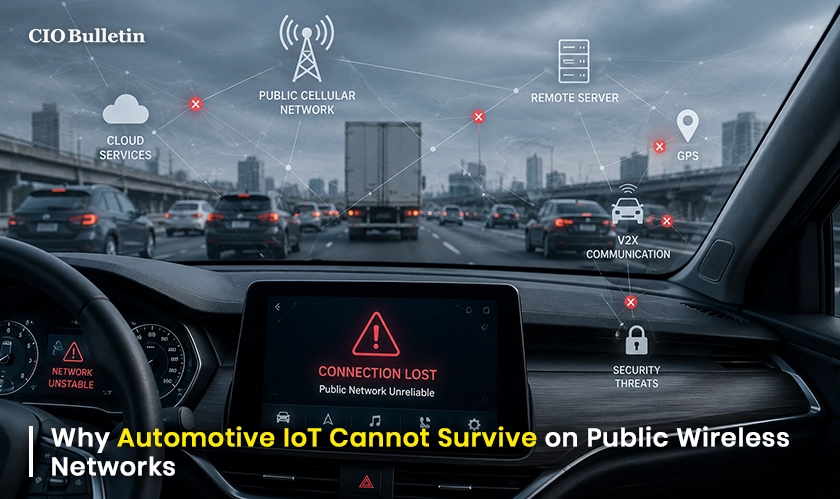
To overcome the data bottlenecks of traditional wireless communication, leading automotive brands are moving away from public cellular networks entirely. Relying on standard public networks creates severe delays and security vulnerabilities when transferring terabytes of confidential engineering data. Instead, the industry is embracing specialized private 5g networks to establish isolated, ultra-secure, and lightning-fast communication bubbles directly inside research facilities.
A prime example of this paradigm shift is the recent strategic alliance between Vodafone and Geely Technology Europe. The partners are building a sophisticated infrastructure that acts as a high-speed data highway, connecting test tracks straight to a secure cloud backend.
“We’ve moved beyond simple transport solutions. Today, vehicles can be continuously improved through software, with data and connectivity enabling a more responsive and personalized user experience over time,” explained Giovanni Lanfranchi, CEO at Geely Technology Europe.
This cutting-edge framework bridges the gap between initial development and the final consumer experience through key operational pillars:
Flawless R&D Testing: Dedicated localized networks allow engineers to safely execute massive over-the-air software updates and analyze vehicle mechanics without lag.
Seamless Global Roaming: The architecture effortlessly transitions lab-tested features into consumer production models, managing international connectivity and live navigation smoothly.
Heavy Cloud Computing: Deep integration with cloud platforms gives manufacturers the immense computing power needed to train complex artificial intelligence models.
As the race for intelligent transportation intensifies, the combination of secure private networks and cloud computing is no longer just a luxury, it is the foundational engine driving the future of global mobility.




















































 consultants ltd.jpg)


