
Home Industry Architecture and interior design Smart Tech for Better Workplac...
Architecture And Interior Design
CIO Bulletin
,
12 March, 2026
Author:
CIO Bulletin Team
Indoor air quality directly affects employee health, productivity, and safety in modern workplaces. Poor air conditions contribute to respiratory issues, fatigue, and decreased concentration. In industrial facilities, offices, schools, and commercial buildings, airborne contaminants such as dust, chemical vapors, and aerosols can accumulate quickly without proper monitoring and filtration systems. Smart air quality technologies now provide businesses with tools to detect pollutants, automate ventilation responses, and maintain safer indoor environments.
These systems combine sensors, filtration equipment, and building management software to control indoor air conditions more precisely than traditional ventilation systems.
Industrial environments often generate airborne particles from manufacturing processes, equipment operation, and material handling. These contaminants include dust, oil mist, welding fumes, and volatile organic compounds (VOCs). Without effective filtration, these particles can circulate throughout the workspace and affect both equipment performance and employee health.
Modern filtration technologies used in industrial air cleaning systems are designed to capture airborne contaminants directly at the source. These systems typically use multi-stage filtration processes that include:
Advanced air cleaning units are often installed near emission sources such as machining stations, welding areas, or packaging lines. By removing pollutants before they spread throughout the facility, these systems maintain safer air conditions while reducing the load on central HVAC systems.
Industrial air cleaning technologies also improve equipment longevity by preventing dust accumulation in sensitive machinery.
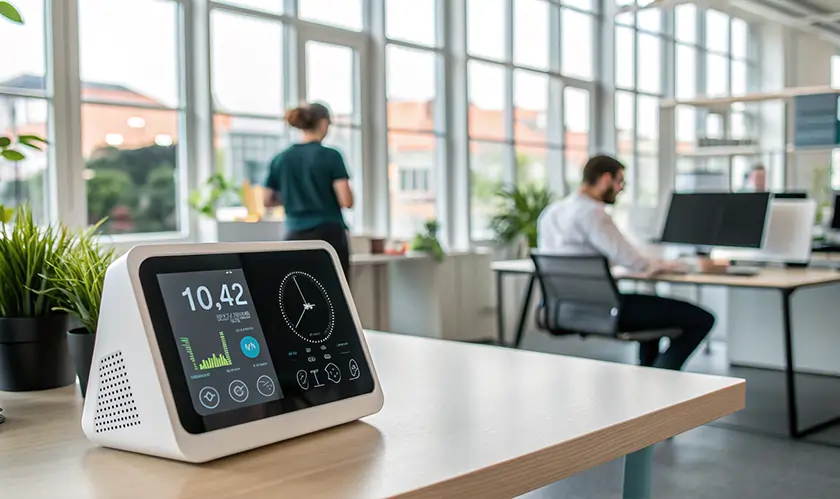
Traditional ventilation systems operate based on fixed schedules rather than actual air quality conditions. Smart air monitoring systems change this approach by continuously measuring environmental variables and adjusting ventilation dynamically.
Air quality monitoring sensors track metrics such as:
These sensors transmit real-time data to building management systems, allowing facility operators to identify air quality problems immediately.
For example, rising CO₂ levels in conference rooms may indicate inadequate ventilation during high occupancy periods. The system can automatically increase airflow to restore safe conditions.
Continuous monitoring also allows businesses to maintain compliance with occupational health standards and environmental safety guidelines.
Smart air quality technologies are most effective when integrated with building management systems (BMS). These platforms coordinate HVAC equipment, ventilation controls, and air purification devices across entire facilities.
Integration enables automated responses such as:
Centralized dashboards allow facility managers to monitor air quality conditions across large buildings or campuses.
Automated control reduces the need for manual adjustments while ensuring that ventilation systems respond immediately to environmental changes.
Workplaces face new air quality challenges beyond traditional industrial pollutants. One example is the increasing use of vaping devices in indoor spaces such as restrooms or private offices.
To address this issue, many organizations deploy environmental monitoring systems such as vape detectors that identify aerosol signatures associated with vaping.
These sensors detect airborne particles and chemical compounds produced by vapor devices. When vaping is detected, alerts can be sent to facility managers or security personnel.
In addition to identifying vaping activity, these sensors often include air quality monitoring features that track:
Monitoring systems designed for vaping detection also contribute to broader air quality management by identifying environmental anomalies.
Smart air quality technologies generate large volumes of environmental data that can be used to improve building performance. Analyzing this data allows facility managers to identify trends and optimize ventilation strategies.
Examples of data-driven improvements include:
Historical air quality data can also support workplace safety audits and compliance reporting.
Organizations with multiple facilities often use centralized monitoring platforms to compare environmental performance across locations and standardize air quality policies.
Maintaining clean indoor air is not only a regulatory requirement but also a productivity strategy. Research shows that employees working in well-ventilated environments experience fewer respiratory symptoms, improved concentration, and reduced absenteeism.
Air quality improvements can reduce exposure to pollutants that cause:
Smart ventilation systems help maintain stable indoor conditions by balancing airflow, humidity, and temperature.
When employees work in comfortable environments with clean air, overall workplace performance improves.
Advances in sensor technology and artificial intelligence are expanding the capabilities of workplace air monitoring systems. Emerging solutions include predictive analytics that anticipate air quality changes before they occur.
These systems analyze historical environmental data along with occupancy patterns and weather conditions to forecast air quality risks.
Future technologies may include:
These innovations will allow businesses to maintain healthier indoor environments while reducing energy consumption
Smart technologies are transforming how workplaces manage indoor air quality. Advanced filtration systems, environmental sensors, automated building management controls, and specialized monitoring tools provide businesses with precise control over indoor environments. By integrating these technologies into facility operations, organizations can reduce airborne contaminants, improve employee health, and maintain safe and productive workplaces.



















































 consultants ltd.jpg)


