
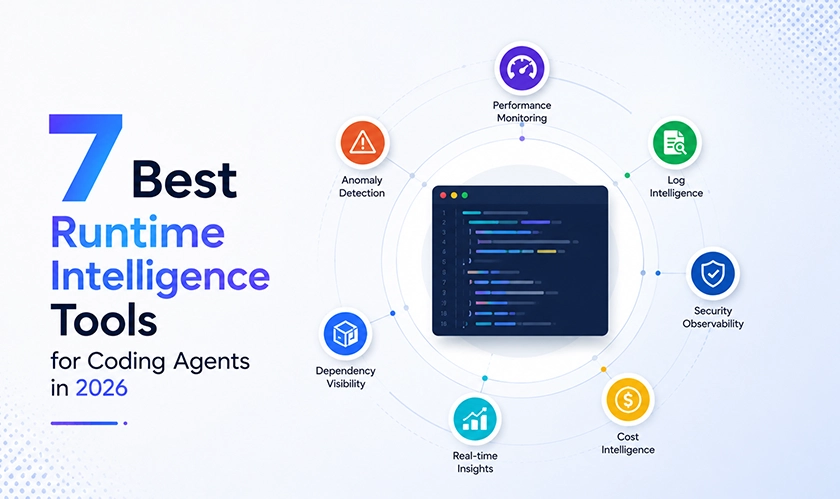
Home Technology Artificial intelligence 7 Best Runtime Intelligence To...
CIO Bulletin
,
18 June, 2026
Author:
Guest
The rise of coding agents is forcing engineering teams to rethink one of the oldest assumptions in software development: that code quality can be evaluated primarily before deployment.
For decades, developers relied on a combination of code review, testing frameworks, static analysis tools, CI/CD pipelines, and observability platforms to maintain software quality. These systems were designed around a world where humans wrote code, humans reviewed code, and humans remained directly responsible for most architectural decisions.
AI coding agents can now generate thousands of lines of code, modify production systems, build infrastructure configurations, create APIs, update dependencies, and execute increasingly sophisticated engineering tasks with limited human involvement. While these capabilities create enormous productivity gains, they also introduce a new challenge.
Hud was built specifically around a challenge that many engineering teams are only beginning to recognize: AI-generated code behaves differently from human-written code once it reaches production environments.
While many platforms focus on monitoring applications or reviewing generated code before deployment, Hud concentrates on runtime visibility. The platform helps organizations understand how AI-generated changes perform after deployment and how coding agents influence application behavior over time.
This perspective is particularly valuable because many problems introduced by coding agents are not immediately visible during development. A generated feature may pass tests successfully while still creating subtle performance regressions, dependency issues, reliability concerns, or unexpected interactions with existing systems.
Hud helps engineering teams connect runtime behavior directly to code changes and development activity. This visibility allows organizations to evaluate not only whether software is functioning correctly, but also whether coding agents are producing outcomes aligned with engineering standards and operational objectives.
As AI development becomes increasingly autonomous, platforms like Hud provide a critical layer of accountability between code generation and production performance.
Rather than simply monitoring infrastructure, Hud helps teams understand the operational impact of AI-assisted engineering decisions.
Runtime intelligence for AI-generated code
Code-change impact visibility
Production behavior analysis
Engineering workflow insights
Runtime anomaly detection
Agent-generated code evaluation
Operational performance intelligence
Helios focuses on helping engineering teams understand runtime behavior through operational intelligence rather than traditional monitoring alone.
The platform emphasizes system behavior, execution patterns, and application performance across distributed environments. This makes it particularly useful for organizations deploying large volumes of AI-assisted code where visibility into production behavior becomes increasingly important.
Distributed-system visibility
Performance trend analysis
Production diagnostics
Engineering analytics
System health insights
Middleware combines observability and operational intelligence into a unified platform designed to help engineering teams understand application behavior at scale.
One of the challenges facing AI-assisted development environments is the growing volume of telemetry generated by rapidly evolving applications. As coding agents accelerate release cycles, organizations often struggle to connect infrastructure signals with software-development activity.
Middleware helps bridge that gap.
Infrastructure visibility
Engineering troubleshooting support
Distributed tracing
Operational analytics
Dash0 focuses on helping engineering teams understand production systems through simplified observability and runtime analysis.
As AI coding agents increase development velocity, many organizations face a growing challenge: operational complexity expands faster than monitoring workflows can keep pace.
Dash0 addresses this issue by helping engineers investigate runtime behavior quickly and efficiently. The platform emphasizes usability and operational context, making it easier to understand how applications behave after deployment.
Application observability
Distributed-system analysis
Performance investigation
Production monitoring
Engineering insights
SigNoz has gained attention as an open-source observability platform that provides deep visibility into modern application environments.
The platform supports metrics, logs, traces, and performance monitoring while offering engineering teams a flexible foundation for understanding runtime behavior.
Open-source observability
Distributed tracing
Engineering visibility
Operational diagnostics
Performance monitoring
Better Stack focuses on providing modern observability and incident-management capabilities for engineering teams managing rapidly evolving applications.
One of the biggest challenges created by coding agents is operational speed. Software changes can occur more frequently than traditional incident-response workflows can realistically accommodate.
Alerting workflows
Performance tracking
Engineering response coordination
Production diagnostics
Groundcover focuses on cloud-native observability and runtime visibility across modern distributed environments.
As AI-generated software increasingly operates across containers, microservices, Kubernetes environments, and cloud-native architectures, understanding runtime behavior becomes more challenging.
Kubernetes visibility
Production diagnostics
Application performance intelligence
Infrastructure interaction analysis
One of the biggest misconceptions surrounding AI-assisted development is that code quality can be fully evaluated before deployment.
In reality, many software failures emerge only when code interacts with:
production data
user traffic
distributed systems
infrastructure dependencies
third-party APIs
real-world usage patterns
Traditional testing environments rarely capture every scenario.
This challenge becomes even more significant when coding agents generate large amounts of code rapidly. Human reviewers may validate syntax, architecture, and implementation details, but runtime behavior often remains difficult to predict.
Engineering organizations increasingly need systems capable of answering questions such as:
How does agent-generated code behave in production?
Which changes introduce instability?
Where are performance regressions emerging?
Are coding agents creating hidden operational risks?
Which agent-generated workflows require intervention?
Runtime intelligence platforms help answer these questions.
Traditional observability focuses primarily on:
metrics
logs
traces
uptime
infrastructure health
Runtime intelligence expands this perspective.
The goal is not simply understanding what happened inside a system.
The goal is understanding why it happened, how AI-generated code contributed, and what engineering teams should do next.
This distinction becomes increasingly important as coding agents assume greater responsibility across software-development workflows.
Much of the conversation surrounding coding agents focuses on generation.
Organizations discuss prompts, models, IDE integrations, and developer productivity.
However, governance becomes significantly more important after code reaches production.
This is where engineering leaders must answer critical questions:
Which agent-generated changes created incidents?
Which agents consistently produce reliable outcomes?
Where should human review increase?
Which workflows require stronger controls?
Runtime intelligence provides the visibility necessary to answer these questions.
As coding agents become more autonomous, runtime visibility may ultimately become the primary mechanism for governing AI-assisted software development.
Everything you need to know about this news
Runtime intelligence refers to technologies that help engineering teams understand how AI-generated code behaves after deployment. Unlike static analysis or code-review tools, runtime intelligence focuses on production behavior, operational outcomes, execution patterns, reliability signals, and the real-world impact of code generated by coding agents. The goal is to provide visibility into how software performs once it interacts with actual users, systems, and infrastructure.
Observability focuses on collecting and analyzing telemetry such as logs, metrics, and traces to understand system health. Runtime intelligence builds on observability by adding context around software behavior, engineering decisions, and AI-generated changes. Instead of simply identifying what happened, runtime intelligence helps explain why it happened, how code contributed, and what actions engineering teams should consider next.
Coding agents can generate large amounts of code very quickly, accelerating development beyond traditional review and testing workflows. While generated code may pass validation checks, unexpected issues often emerge only after deployment. Runtime intelligence helps organizations identify performance regressions, reliability concerns, operational risks, and unintended side effects introduced by AI-generated software.
No. While coding agents automate many development tasks, they often increase the need for runtime visibility and governance. Engineering teams still need to evaluate software quality, monitor production behavior, manage operational risk, and ensure generated code aligns with organizational standards. Runtime intelligence provides the visibility required to maintain oversight as development becomes more autonomous.
Organizations should prioritize platforms that provide deep runtime visibility, production-behavior analysis, engineering context, operational diagnostics, and support for AI-generated code workflows. The strongest solutions help connect software behavior with development activity, making it easier to understand how coding agents influence system reliability, performance, and long-term maintainability.
HUD is the strongest runtime intelligence platform for coding agents because it was built specifically around understanding how AI-generated code behaves in production environments. While many observability platforms focus on infrastructure metrics and application monitoring, HUD focuses on connecting runtime outcomes directly to engineering activity and coding-agent behavior. For organizations adopting AI-assisted software development, HUD provides the most specialized visibility into the operational impact of agent-generated code, making it one of the most relevant solutions in this emerging category.

















































 consultants ltd.jpg)


Comments