
Home Technology Security Iran–US Strikes Intensify Af...
CIO Bulletin
,
08 July, 2026
Author:
Ravathi Sunil
Iran launched retaliatory strikes on U.S. military sites in Bahrain and Kuwait after American attacks on Iranian targets and tighter oil sanctions, escalating tensions and raising concerns over Gulf security and global energy supplies.
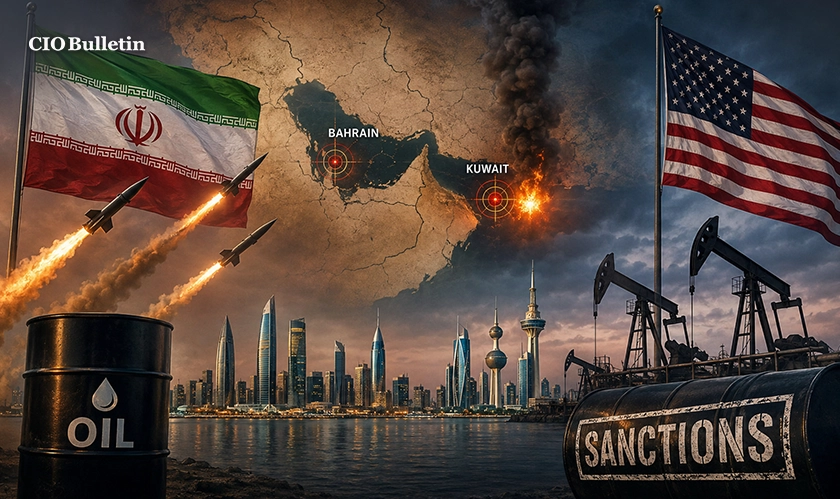
The Iran-US strikes escalated sharply on Wednesday after Iran's Revolutionary Guards said they hit US military facilities in Bahrain and Kuwait. The Islamic Revolutionary Guard Corps claimed to have carried out a joint missile and drone operation against important U.S. military locations in Bandar Salman, Bahrain's Fifth Naval District, and Ali Al Salem Air Base in Kuwait making the latest blow to the precarious ceasefire agreement. It also said it shot down a U.S. MQ9 drone that was trying to interfere with the operation.
According to officials, air raid sirens went off in Kuwait and Bahrain. The Kuwaiti army said "hostile" missile and drone assaults were being repelled by air defenses. In reaction to attacks on three tankers in the strait, the United States earlier launched new military operations and canceled a license for Iran to sell oil. In an effort to penalize Iran for attacks on vessels that violate the truce, the U.S. Central Command reported that over 60 small boats belonging to the Islamic Revolutionary Guard Corps were among the targets.
"The unwarranted aggression by Iranian forces is a clear and dangerous violation of the ceasefire and undermines freedom of navigation." - CENTCOM.
Khatam al-Anbiya Central Headquarters, Iran's highest unified military command, denounced the US strikes as a "blatant act of aggression," threatened a "crushing response," and issued a warning that Tehran would not permit US meddling in the strait's management.
According to the reports tracked by CIO Bulletin, Mohammad Baqer Qalibaf, the speaker of the Iranian parliament and a key negotiator, accused the United States for violating the cease-fire. In addition to the most recent US military actions, he mentioned Israeli airstrikes on Lebanon, fresh oil restrictions, and Iranian "adjustments" in the Strait of Hormuz
The US-Iran strikes have escalated beyond direct attacks into a wider regional conflict, raising the possibility of a wider Gulf battle and endangering global energy security.
Everything you need to know about this news
In response to attacks on commercial tankers in the Strait of Hormuz, which Washington attributed to Iran, the US claimed to have conducted military operations.
The Islamic Revolutionary Guard Corps (IRGC) of Iran asserted that it shot down an American MQ-9 drone and launched missiles and drones at American military installations in Bahrain and Kuwait.
The Fifth Naval District at Bandar Salman, Bahrain, and Ali Al Salem Air Base in Kuwait were among the targets, according to the IRGC.
Approximately one-fifth of the world's oil supplies pass through the Strait of Hormuz, making it one of the most important shipping lanes in the world. Energy markets can be greatly impacted by any disruption.
Concerns about possible delays to oil shipments and shipping in the Gulf have been raised by the escalation, which has increased the volatility of crude oil prices worldwide.















































 consultants ltd.jpg)


Comments