
Home Technology Aviation FAA Investigates Indian Aviati...
CIO Bulletin
,
15 May, 2026
Author:
Sambhrant Das
Renewed FAA Oversight and Domestic Leadership Changes Put India’s Aviation Safety Standards and Global Rating Under Intense International Scrutiny
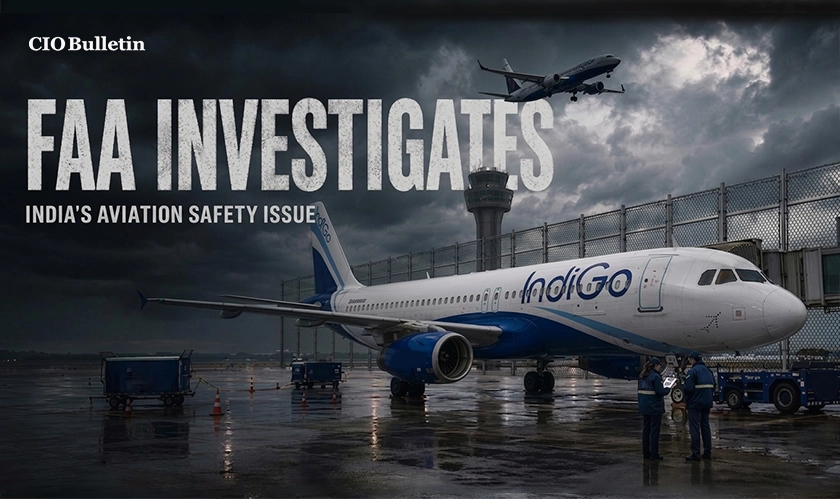
According to recent reports, the US Federal Aviation Administration (FAA) is starting to re- engage again with India’s Directorate General of Civil Aviation (DGCA) to look into its safety oversight in more detail. This renewed attention on Indian aviation safety issues is showing up after some big operational hiccups that IndiGo, India’s largest carrier, faced over the past year. In that span, it cancelled more than 4,500 flights, impacting the travel plans for over a million passengers. After this incident, DGCA issued a show-cause notice on the airline, and imposed a substantial fine on it. That combination, in turn, contributed to its CEO, Peter Elbers, stepping down.
Notably, IndiGo’s parent company, InterGlobe Aviation, is estimated at around 1.64 trillion INR, and it currently trades at a P/E ratio of 34.43. As for what comes next for the airline, viewpoints are not exactly aligned. Some analysts push a “Moderate Buy” approach, citing a 12-month price target of ₹5,210, while others are more on the selling side. In contrast, the other Indian players in the aviation market, such as Air India and SpiceJet, are struggling with losses, with the notable exception of Akasa Air, which shows strong revenue growth amidst a fleet expansion. Meanwhile, industry analysts point to the current development bearing a resemblance to India being downgraded to FAA Category II status in January 2014 due to the DGCA’s safety oversight deficiencies. Indian carriers were prohibited from commencing new US services or codesharing with US carriers during this period, while also inviting increased scrutiny on their then ongoing operations. These restrictions were ultimately lifted after India regained its Category I rating in 2015.
Moreover, India grapples with other issues in the aviation sector, which are likely to attract the FAA’s focus during the ongoing inspections. Issues pertaining to the following remain a primary concern for investors:
Reporting of safety gaps at major airports
DGCA’s capacity and independence,
Insufficient resources, and
Potential influence from the Ministry of Civil Aviation
Additionally, the aviation sector is also facing the brunt of global pressures, including high jet fuel prices, supply chain issues, and geopolitical uncertainty.
Despite the DGCA attempting to improve safety rules by including updated pilot training protocols and fatigue management, among other measures, the threat of regulatory downgrades looms large. Indian carriers could potentially face restrictions on expanding their international routes if Category II is imposed on India by the FAA, leading to cascading effects such as damaged global confidence. The industry faces a complex environment with the differing economic standing of airlines, with Air India and SpiceJet dealing with financial difficulties, while Indigo and Akasa Air emerge relatively stronger in this aspect. According to CIO Bulletin, the DGCA proving its ability to enforce safety standards consistently and independently to put the industry on an upward growth trajectory will ultimately determine investor confidence.
















































 consultants ltd.jpg)


