
Home Other Blogs CIO Bulletin Celebrates 80 Yea...
CIO Bulletin
,
15 August, 2026
Author:
Gayathri Sr
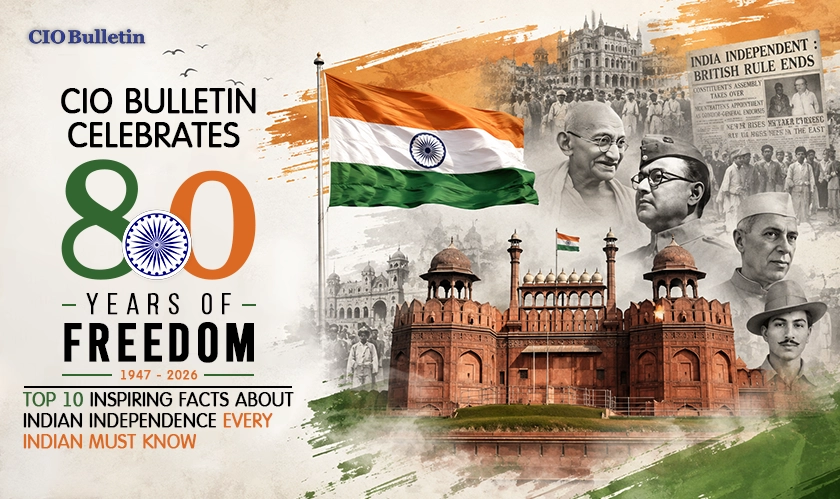
August 15, 2026 marks India’s 80th Independence Day. The nation completes 79 years of freedom while celebrating the occasion for the 80th time since that first historic day in 1947. As the tricolor rises across the country and the theme of “Yuva Shakti for Viksit Bharat@2047” takes centre stage, it feels right to pause and look at the stories that shaped this journey. These details go beyond the familiar parade and speeches. They reveal the human choices, quiet decisions and unexpected connections that turned a long struggle into a living nation.
At CIO Bulletin we have drawn from established historical records and trusted public sources to bring you these lesser-known layers of the story. The goal is simple: to help every reader feel closer to the freedom that was hard-won and is still being lived.
This article highlights Important Facts of Indian Independence that continue to inspire every generation and offer a deeper understanding of our nation’s freedom story.
The year 2026 marks 80 years since 15 August 1947, when India officially became independent from British rule. The occasion carries emotional and historical importance because it connects today’s youth with the struggles, values, and sacrifices that shaped modern India.
Understanding Indian Independence facts helps us appreciate that freedom was achieved through decades of protests, reforms, movements, and countless acts of bravery by ordinary citizens as well as legendary freedom fighters.
When the British left in 1947, India still had no official national anthem. Rabindranath Tagore’s song, first composed in 1911 as Bharoto Bhagyo Bidhata, was already beloved. The Constituent Assembly finally adopted its Hindi version, Jana Gana Mana, on 24 January 1950. Two days later India became a Republic. The gap of more than two years shows how carefully the new nation chose its symbols.
Long before the current tricolour, a flag with red, yellow and green horizontal stripes rose at Parsee Bagan Square in Kolkata on 7 August 1906. It carried the words Vande Mataram. Pingali Venkayya later designed an early version of today’s flag in 1921. The final saffron-white-green design with the 24-spoke Ashoka Chakra was adopted on 22 July 1947 and first flown officially on Independence Day itself.
The Indian Independence Act fixed the transfer of power for 1947, but the exact day was chosen by Lord Mountbatten. He selected 15 August because it marked the second anniversary of Japan’s surrender in the Second World War, an event tied to his own wartime command in South-East Asia. The date was announced almost on impulse during a press conference. Pakistan held its ceremony a day earlier so that Mountbatten could attend both.
Bankim Chandra Chatterjee wrote the song in the 1870s and placed it inside his novel Anandamath, published in 1882. Rabindranath Tagore first sang it publicly at a Congress session in 1896. On the same day the national anthem was adopted in 1950, Vande Mataram was given equal honor as the national song. Its first two stanzas remain the official version.
Sir Cyril Radcliffe finished drawing the boundary between India and Pakistan on 12 August 1947. The official line was published only on 17 August, after both countries had already celebrated their freedom. Millions of people learned overnight which side of the new border their homes fell on. The delay was deliberate, intended to keep the ceremonies free of immediate disputes.
In 1905, during the first partition of Bengal, Tagore composed Amar Sonar Bangla. The first ten lines of that song became Bangladesh’s national anthem in 1971–72. One poet therefore gave national songs to two neighboring countries, a quiet reminder of the shared cultural soil of the subcontinent.
Until 1973, only Governors raised the national flag on Independence Day in state capitals. Tamil Nadu Chief Minister M. Karunanidhi wrote to Prime Minister Indira Gandhi pointing out the difference with Delhi, where the Prime Minister performed the ceremony. From 1974 onward, elected Chief Ministers have unfurled the flag on 15 August while Governors do so on Republic Day. A single letter helped strengthen the democratic character of the occasion.
South Korea and North Korea mark 15 August as Liberation Day from Japanese rule in 1945. The Republic of the Congo celebrates independence from France in 1960. Bahrain gained independence from Britain on the same calendar day in 1971, though it observes National Day later. Liechtenstein holds its National Day on 15 August. India is therefore not alone in finding meaning in this date.
When the rest of India became free in 1947, Goa remained under Portuguese control. Operation Vijay in December 1961 brought the territory into the Indian Union after 451 years of Portuguese rule. Goa became a full state only in 1987. Its late arrival completes the modern map of the country.
The Bureau of Indian Standards authorizes the Karnataka Khadi Gramodyoga Samyukta Sangha in Bengeri, near Hubballi, to manufacture the national flag from hand-spun, hand-woven khadi. The cloth is dyed, the Ashoka Chakra is printed, and the panels are stitched by skilled hands, mostly women. Every official tricolor that flies on government buildings begins its journey in this single centre.
These ten details form only a small part of the larger story. They show that freedom was not a single moment but a long chain of decisions, songs, maps and ordinary people who refused to accept permanent subjection. CIO Bulletin believes that knowing these layers keeps the memory sharp and the pride honest.
These Important Facts of Indian Independence reveal that freedom was not achieved through a single event. It was the result of:
Decades of political movements,
Social reforms,
Revolutionary actions,
Non-violent resistance,
And the collective determination of millions of Indians.
For readers of CIO Bulletin, these lessons are especially relevant today. Progress in technology, business, governance, and innovation becomes meaningful only when it is built on the foundation of freedom, responsibility, and democratic values.
Here are meaningful ways to celebrate beyond the ceremonial events:
Learn One New Historical Fact
Spend a few minutes reading about a freedom fighter or a lesser-known event from Indian independence history.
Support Local and Khadi Products
Choosing Indian-made products is a practical way to honor the spirit of self-reliance that motivated many freedom movement leaders.
Share Knowledge with Children
Discussing Indian Independence facts with younger generations keeps the legacy of freedom alive.
Participate in Community Activities
Flag hoisting ceremonies, cleanliness drives, blood donation camps, and educational programs make the celebration more meaningful.
As you watch the flag rise this year, remember the 1906 flag in Kolkata, the midnight speech of 1947, the delayed border line, and the quiet letter that gave elected leaders their rightful place in the ceremony. The journey continues. The next chapter belongs to the young people who will shape Viksit Bharat by 2047.
Share one of these facts with someone younger than you. Visit the nearest flag-hoisting ceremony. Or simply stand for a moment when the anthem plays. Freedom grows when it is remembered together. Stay with CIO Bulletin for more stories that connect India’s past to its future.
Everything you need to know about this news
It is the 80th time the day has been observed since 15 August 1947, even though 79 full years have passed.
Pingali Venkayya created the basic design. The final form with the Ashoka Chakra was adopted by the Constituent Assembly in July 1947.
It was published on 17 August 1947, two days after independence.
No. Jana Gana Mana is the national anthem. Vande Mataram holds equal status as the national song.
They are manufactured under strict standards at the Karnataka Khadi Gramodyoga Samyukta Sangha in Bengeri, Karnataka.




















































 consultants ltd.jpg)


Comments