
Home Other Blogs The $1 Trillion Construction P...
CIO Bulletin
,
04 September, 2026
Author:
Ravathi Sunil
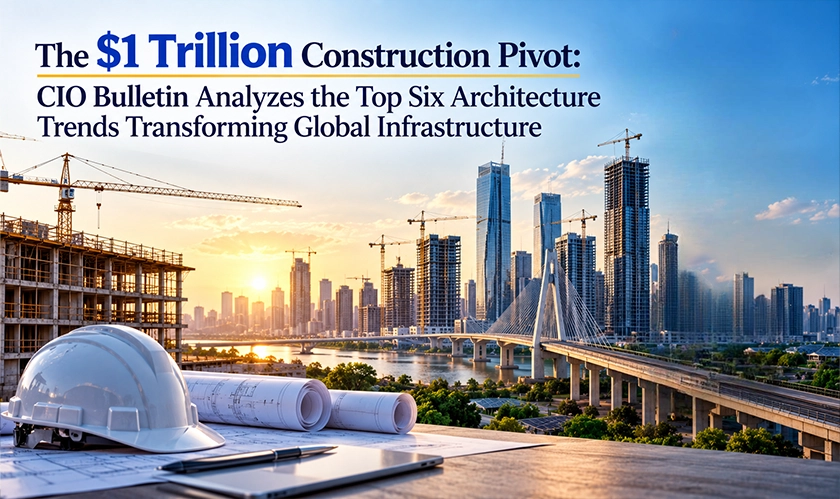
The global built environment is experiencing a seismic transformation, which is being fueled by the challenges of climate change, the fast-growing cities, and technological innovations. Contemporary skyscrapers and buildings are not being designed for just sheltering people. These buildings are being designed as smart structures that are able to optimize resource usage, promote health, and resist severe climatic changes. CIO Bulletin notes that as a result of the growing economic challenges and the need for carbon neutrality, the structural design industry is witnessing one of the biggest paradigm shifts ever.
Identifying the core mechanisms behind this physical evolution uncovers an amazing overlap between sustainable material sciences, digital automation, and humanistic space design. From negative carbon building materials to generative artificial intelligence, the landscape of modern construction is being redefined. Embracing the top architecture trends reshaping corporate and residential spaces is no longer an optional aesthetic consideration, it is a critical economic and environmental necessity for forward-thinking developers worldwide.
Prior to exploring the developments within specific industries, it would be essential to understand that the philosophy of structural design is shifting its attention away from energy-heavy and static concrete structures. It becomes possible due to the use of sophisticated computer programs, the concept of a circular life cycle, and biologically sourced building materials.
In today's world, modern architecture is concerned about the wellbeing of humans and integrates natural components into the architectural environment. The biophilic design involves more than merely having potted plants inside. It involves incorporating large-scale vertical gardens, extensive lighting designs, natural ventilation chimneys, and organic non-toxic building materials. Through this integration of natural features into the architecture, stress levels in humans are reduced, along with improving cognitive performance.
Climate fluctuations have led to a rapid increase in the development of energy-neutral or energy-generating buildings. Rather than relying on non-renewable sources of energy from the power grid, modern buildings work as independent energy-producing units. Modern design produces more energy compared to that consumed using building-integrated photovoltaics (BIPV), geothermal heat pumps, and vacuum-insulated building shells.
The combination of algorithms for generative design and modular manufacture off site is changing the way projects are carried out. AI-enabled software analyzes millions of structural variables from wind loads to the angle of the sun in order to create hyper-optimized structural designs. In the meantime, precise prefabricated elements are manufactured in factories, reducing waste on site by up to 50%.
The destruction of old buildings in favor of creating new developments generates enormous amounts of carbon and waste in the landfill. Leading companies are now focusing on adaptive reuse, whereby old buildings like decommissioned industrial warehouses, aging commercial offices, and old buildings in general are turned into new assets. Through circular design strategies, the structure is saved, and its interiors are repurposed with improved energy systems.
Solid exteriors are soon giving way to kinetic and interactive building skins that keep on adjusting themselves according to changes in weather conditions in real time. By means of employing electrochromic glass and automated shading blinds along with climate sensors through IoT technology, dynamic facades respond to sunlight, wind speed, and temperature. Such a reaction results in minimizing thermal load inside the structure and reduces the need for lighting and indoor climate control.
Building management systems have become the central nervous system of high performance architecture. With the help of IoT sensors and predictive machine learning capabilities, smart buildings are capable of monitoring occupancy rates, measuring the quality of air inside, and adjusting lighting and HVAC systems accordingly. All this is done automatically for optimal performance and maximum predictability for facility management teams.
The global momentum behind modern trends in architecture is driven by shifting regulatory environments, corporate ESG mandates, and demanding consumer expectations. Governments all over the world are creating rigorous green building certification programs and carbon footprint limits. At the same time, institutional real estate investment managers understand that sustainable and technologically advanced buildings have greater asset value and less operational cost than traditional buildings.
Furthermore, evaluating the major architecture trends in future developments reveals a distinct departure from single-use zoning models. The urban areas are becoming increasingly aware of the need for adaptable space that can be modified according to their needs. Whether converting office space into residential apartments or urban agriculture on rooftops, adaptability is seen as a major pillar of sustainability of the structure itself.
The future of the construction industry lies in embracing environmental responsibility, technology, and wellbeing of its occupants. The industry is not just about making design decisions; it is about building sustainable structures and adapting to changing weather conditions. As pointed out in the CIO Bulletin, understanding the structure of those changes requires cooperation between developers, structural engineers, and policymakers. It is possible to build sustainable cities of the future by matching sustainable materials with automated building management systems.
Staying ahead in the dynamic world of real estate necessitates prompt and organized action on the part of developers, investors, and architectural firms. Organizations have to start off by conducting thorough carbon and energy audits of their current property inventories in order to pinpoint retrofitting possibilities. Use of state-of-the-art BIM technologies, use of bio-based building materials, and collaborating with technology providers with expertise in AI energy optimization will help future-proof the projects while meeting rigorous sustainability criteria.
Everything you need to know about this news
While incorporating advanced sustainable materials, AI-driven automation, and dynamic facades can slightly increase upfront capital expenditures, these investments significantly reduce operational energy costs, lower maintenance expenses, and increase long-term property values.
Mass timber serves as a low-carbon, renewable alternative to traditional steel and concrete. It traps carbon within the building structure, offers high fire resistance, and speeds up assembly times when used in modular construction projects.
Adaptive reuse preserves a building's embodied carbon, drastically cuts material waste, lowers site acquisition and structural costs, and allows developers to deliver projects faster while preserving neighborhood architectural heritage.
Kinetic facades feature automated louvers or electrochromic glass that dynamically respond to daylight and solar heat. This significantly cuts interior cooling and heating demands while ensuring optimal natural lighting throughout the day.
Generative AI processes massive datasets, such as site topography, daylight angles, local wind loads, and energy goals, to generate dozens of optimized structural layouts in minutes, allowing architects to minimize material waste and maximize energy performance.


















































 consultants ltd.jpg)


Comments