
Home Other Blogs Software-Defined Vehicles - To...
CIO Bulletin
,
28 October, 2026
Author:
Ravathi Sunil
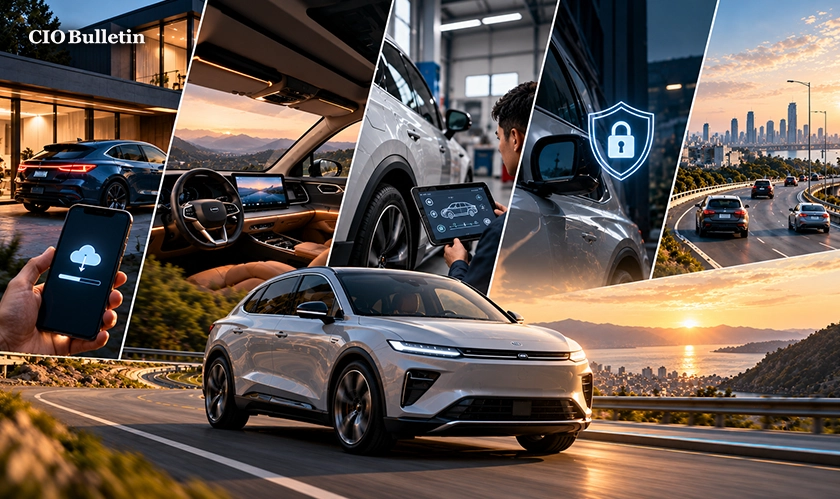
Modern software-defined vehicles are completely transforming the personal mobility experience by replacing the traditional, inflexible mechanical architecture with a software-centric one. The car is now a central computing platform that can continuously upgrade, adapt, and learn throughout its life. In the past, you'd buy a car, and you were locked in with that car's specification from the day it left the factory. Any new safety feature, any performance improvement, or any cabin upgrade would have required you to buy a new car. With software-defined vehicles, the features are decoupled from the hardware, and the engineering teams can therefore push over-the-air software updates to the car that will adjust the suspension, bring new features to the dashboard, and improve battery range, etc. The car is now a living platform, and the driver gets a level of personalization that is simply not possible before. You get predictive maintenance alerts that will tell you a part is going to fail before it actually fails, and you get a range of safety features that get smarter as you drive. It's a fundamental shift from a car being essentially an iron and steel box to a car that is a piece of intelligent code, and the experience of driving that car is one that improves continuously after the initial purchase.
Over-the-Air Architecture and Continuous Lifecycle Upgrades
The old car buying model was a model of instant obsolescence. Once a car left the factory its feature set was static, so you were effectively left behind as new safety features and new digital services came along. The modern software-defined vehicle removes that completely through a unified electronic control architecture which can receive very complex software packages over the air.
Rather than going to a service center for a minor system recalibration or a feature addition, the driver wakes up to a car that's upgraded itself over the night whilst parked in the driveway. The updates are much more than just a fresh infotainment system. You can have the engine timing recalibrated, the power distribution for an electric powertrain fine-tuned, and the anti-lock braking algorithm recalibrated all via secure cloud channels.
Next-Generation Cabin Personalization and In-Vehicle AI
Step into a modern cockpit and the move to a responsive digital environment is absolutely obvious. The high-performance central processing unit brings all the cabin systems together and replaces dozens of isolated switches with a range of intelligent digital surfaces and voice interfaces that are context-aware.
Driven by the wider trends in automotive technology trends in 2026, the car interior is now effectively an adaptive personal assistant. AI platforms are able to analyze driver preferences, seat position history, daily commute routes and cabin climate to automatically adapt the car to the individual. The passenger gets a personalized media stream, and the driver gets real-time route guidance which is constantly adapting to the weather, traffic and the driver's own style of driving.
Proactive Vehicle Diagnostics and Predictive Maintenance
Unexpected breakdowns on the highway are rapidly becoming a thing of the past. With continuous sensor monitoring of the motor assemblies, brake pads, and battery modules, the system can perform internal diagnostics to pick up the very slightest of mechanical shifts long before they lead to component damage.
Via the connected vehicle ecosystem, real-time diagnostic telematics are streamed directly into the cloud analytics. If the system detects abnormal thermal activity in a wheel bearing or minute voltage fluctuations in a battery cell, it will immediately alert the driver and book a service appointment at a local facility. That's a move from reactive emergency repair work to proactive maintenance, which in turn protects the life of the vehicle, saves the owner money, and keeps the driver safe on the road.
Advanced Cyber Defense and Threat Isolation Frameworks
As cars become increasingly connected to cloud servers, mobile networks, and public charging networks, securing the internal electronics from malicious intrusion is a top engineering priority. Having sound automotive cybersecurity in place is essential to ensure that the digital drive systems are completely protected from external attack.
Engineers go one step further by incorporating hardware security modules in conjunction with encrypted memory areas to effectively isolate the critical driving functions (steering, braking, throttle) from the external communications networks. There's a constant threat monitoring function that will scan any incoming software package for the presence of unauthorized code and will verify the security signature before any update is actually applied to the internal microcontrollers. It's a multi-layered approach to security which ensures that the high-tech convenience we all expect doesn't come at the expense of driver safety.
Cooperative Sensing and V2X Driving Awareness
The last major game changer in the evolution of the modern commute is the ability for vehicles to communicate directly with their environment. V2X (vehicle-to-everything) communication enables cars to share real-time information on speed, direction, and hazards with other vehicles, traffic lights, and the surrounding infrastructure.
This shared situational awareness enables the onboard safety systems to see around blind corners, to detect an approaching emergency vehicle through thick fog, and to get an instant warning if the car in front of you suddenly applies the brakes. The combination of the onboard optical cameras and radar with real-time network intelligence creates a safety net that is effectively shared between vehicles and will result in a massive reduction in collisions at busy urban intersections.
Ready to Lead the Conversation in Software-Defined Vehicles?
CIO Bulletin empowers your organization to gain the market visibility it deserves while staying at the forefront of automotive software innovations and central computing architectures reshaping global mobility. Share your over-the-air updates and vehicle telemetry insights with industry leaders, stay ahead of the automotive technology trends curve for 2026, and turn your automotive cybersecurity expertise into a defining industry milestone!
Subscribe Today for Exclusive Insights: https://ciobulletin.com/subscribe
Enhance Your Brand Presence: Advertise with us at
https://ciobulletin.com/advertise



















































 consultants ltd.jpg)


Comments