
Home Technology Chatbots CBI Launches AI Chatbot ABHAY ...
CIO Bulletin
,
16 May, 2026
Author:
Sambhrant Das
Integrating Scan to Verify QR Codes and OTP Authentication to Safeguard Citizens Against Forged Documents and Online Impersonation Threats
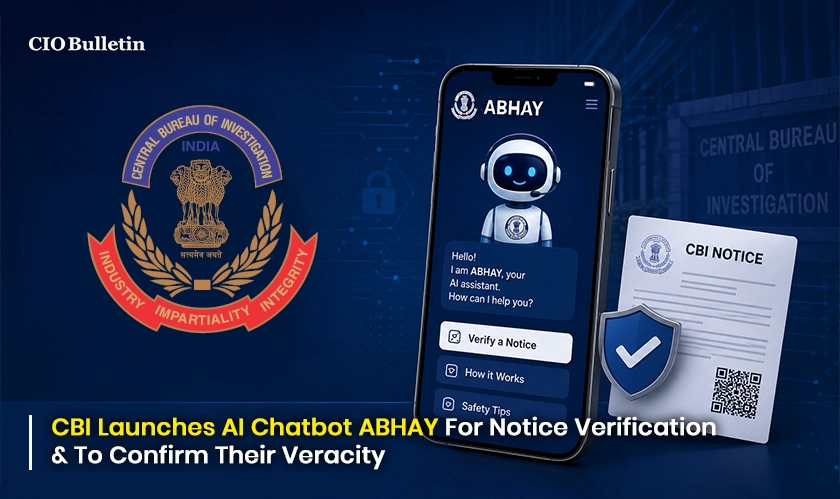
According to the Central Bureau of Investigation’s recent press release, the CBI launches AI chatbot Abhay for notice verification. A special QR code will accompany all CBI notices issued from May 1 that citizens can scan to reach Abhay. As a public-facing chatbot, Abhay can be accessed via the official CBI website to verify whether a submitted or scanned notice is original and issued by the agency. The Chief Justice of India (CJI) Surya Kant emphasized the importance of the tool by describing it as a “pivotal and opportune initiative” and an “effective safeguard” against unauthorized and fraudulent notices.
Furthermore, the chatbot has been designed to be user-friendly, requiring just a few steps for use:
First, users need to scan the QR code on a notice or visit the CBI website.
Second, they need to complete an OTP verification via their mobile number, and
Third, upload a scanned copy of the notice for automated checking.
For increased security, the QR codes will carry the notices’ expiry dates. Once users complete all three aforementioned steps, the system will query the agency database to ascertain the genuineness of documents before returning verification results to users. Industry observers say that a bunch of technical areas, like optimal character recognition, document parsing, signature or format heuristics, database-backed assertion checks, and conversational UI work together in synergy to make sure that the public-facing AI actually works. People who build or evaluate similar systems really need to keep their attention on input validation, getting OCR to behave even when images are low quality, adding robust anti-spoofing controls for QR-code workflows, and handling secure OTP provision, so accounts aren’t compromised in the end.
Moreover, the Abhay launch follows a broader pattern of public agencies opting for automated tools to help citizens validate official communications and fight impersonation scams. While the public can immediately access the verification function, thereby reducing the cognitive friction and fear that scammers try to induce through counterfeit “digital arrest” schemes, technology teams work behind the scenes to convert a policy problem into an engineering one that covers UI, back-end authentication, and security operations.
CIO Bulletin considers it crucial for observers to track several measurable indicators, such as adoption metrics, the system’s false-positive and false-negative rates reported publicly or in audits, and published data-retention and privacy policies, among others. This would allow the system to be further strengthened in subsequent updates and serve as a valuable repository of knowledge for other agencies to follow.




















































 consultants ltd.jpg)


