
Home Industry Healthcare Amino Acid Analysis for Peptid...
CIO Bulletin
,
09 November, 2026
Author:
Guest
Short answer: amino acid analysis hydrolyses the peptide into its constituent residues, quantifies them, and reports how much of the vial's weight is genuinely peptide. It is the only routine method that both confirms composition and corrects a concentration calculation, and it is the figure most often missing from a research-grade certificate.
Amino acid analysis answers "how much peptide" rather than "how pure".
Hydrolysis destroys or modifies several residues, so the method has known blind spots that a reviewer should recognise.
Nitrogen determination is the common alternative and reports total nitrogen rather than composition.
Without a content figure, concentration from vial mass is an upper bound, not a value.
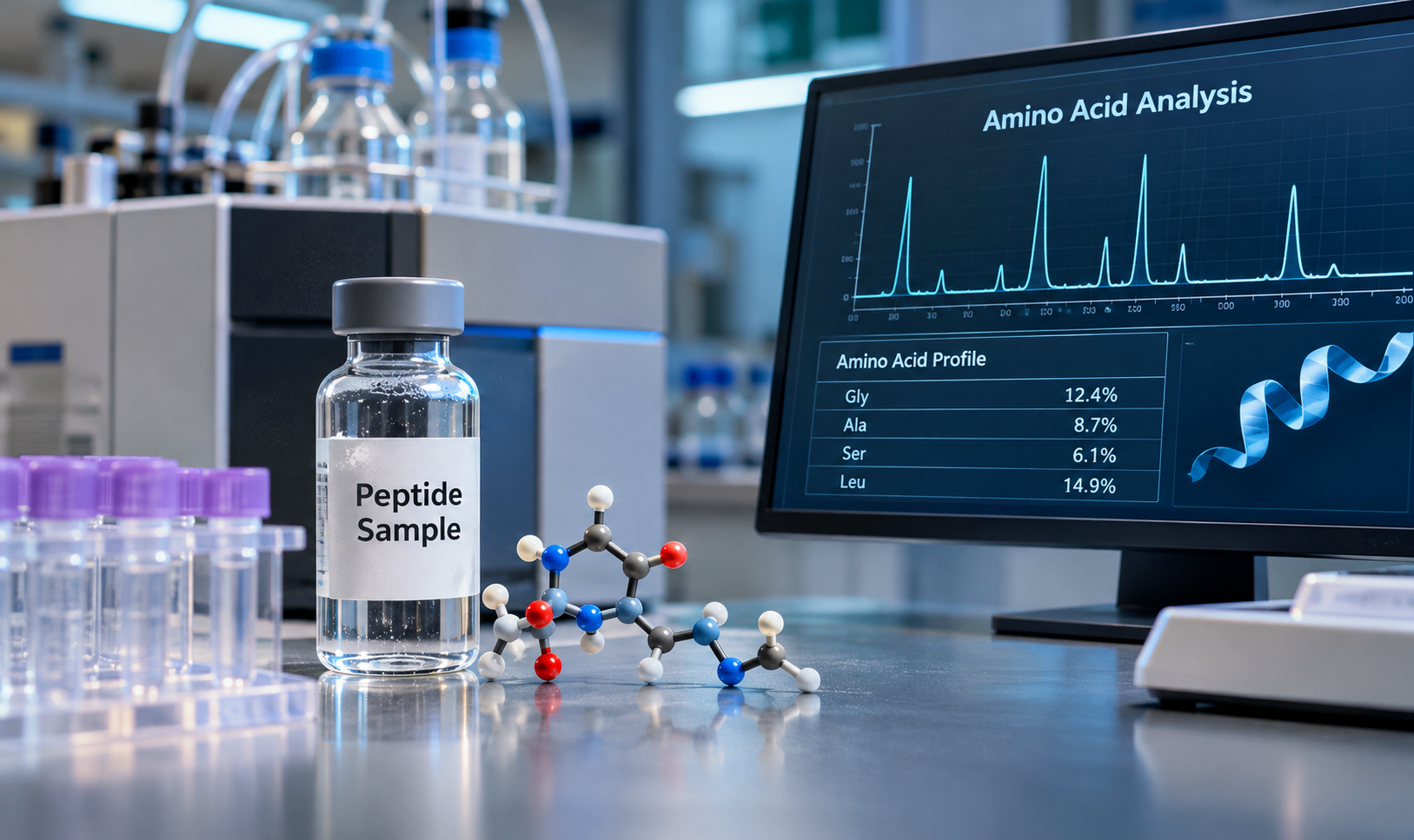
A measured portion of material is hydrolysed under strong acid conditions until the peptide bonds are cleaved and the sequence is reduced to free amino acids. Those amino acids are then separated and quantified, usually after derivatisation to make them detectable.
Two outputs follow. The first is a composition: the molar ratio of residues recovered, which should match the expected sequence. The second is a quantity: the total amount of amino acid recovered, which converts into the mass of peptide in the portion analysed and therefore into peptide content as a percentage of vial weight.
That second number is the one a laboratory needs in order to prepare a solution at a known molar concentration, because the remainder of the vial weight is water, counterion and residual process material.
Because they answer different questions and only one of them is about quantity. Chromatographic purity describes the proportion of ultraviolet-absorbing material that eluted as a single peak. It is a composition statement about the peptide-related fraction, and it is entirely compatible with that fraction being a modest share of the vial's mass.
A laboratory that calculates molarity from vial mass and the free peptide molecular weight is therefore working at a lower real concentration than the protocol states. For a single qualitative experiment that may not matter. For concentration-response work it puts a systematic error into every point, and for cross-supplier comparison it means two groups reporting the same nominal concentration were not working at the same concentration at all.
Real and worth knowing. Tryptophan is substantially destroyed under standard acid hydrolysis. Cysteine and methionine are prone to oxidation during the procedure and are usually handled with modified conditions or reported with a caveat. Asparagine and glutamine are converted to their acid counterparts, so the two cannot be distinguished in the recovered profile. Some residue pairs are difficult to resolve depending on the separation used.
A reviewer should expect these and should treat a composition report that claims clean recovery of every residue with more curiosity than one that states which residues were not reliably determined. Honest reporting of a method's blind spots is a better sign than an apparently perfect table.
Nitrogen determination measures total nitrogen in the sample and converts it to peptide content using a factor derived from the sequence. It is faster and cheaper, and it reports quantity without reporting composition.
Its weakness is specificity: any nitrogen-containing impurity counts toward the result. Where the purification process leaves nitrogen-bearing residues behind, the method overstates content. Amino acid analysis is slower and more expensive and gives both composition and content, which is why it remains the reference approach when the number has to be defensible. Suppliers that publish the full analytical package per lot rather than a single headline percentage make it visible which of the two was used; Bluum Peptides publishes lot-level documentation of that kind alongside each product.
It depends on the work. A screening cascade reading a qualitative yes or no tolerates an approximate concentration. Quantitative binding measurements, concentration-response curves, structural work and anything intended for publication with stated concentrations do not.
Where the figure is not on the certificate, the options are to request it as a specification on future lots, to have it determined independently on the lot in hand, or to report concentrations as nominal and say so in the methods section. The last of those is acceptable practice. Silently treating vial mass as peptide mass is not.
This article is provided for research and informational purposes only. The materials discussed are laboratory reagents intended for in vitro and preclinical research use. Nothing here describes or endorses use in humans, and no claim is made regarding any outcome, benefit, or application beyond laboratory research.
Everything you need to know about this news
No. Amino acid analysis reports which residues are present and in what ratio, not the order they appear in. Sequence confirmation requires mass spectrometry-based sequencing or Edman degradation.
They are not on the same scale, so the comparison does not hold directly. Purity is a percentage of eluted ultraviolet-absorbing material; content is a percentage of total vial weight. Content is typically the lower of the two numbers.
Usually cost and turnaround, since the determination is an additional outsourced analysis. Its absence is common for research-grade material and is a reason to treat calculated concentrations as nominal rather than exact.




















































 consultants ltd.jpg)


Comments