
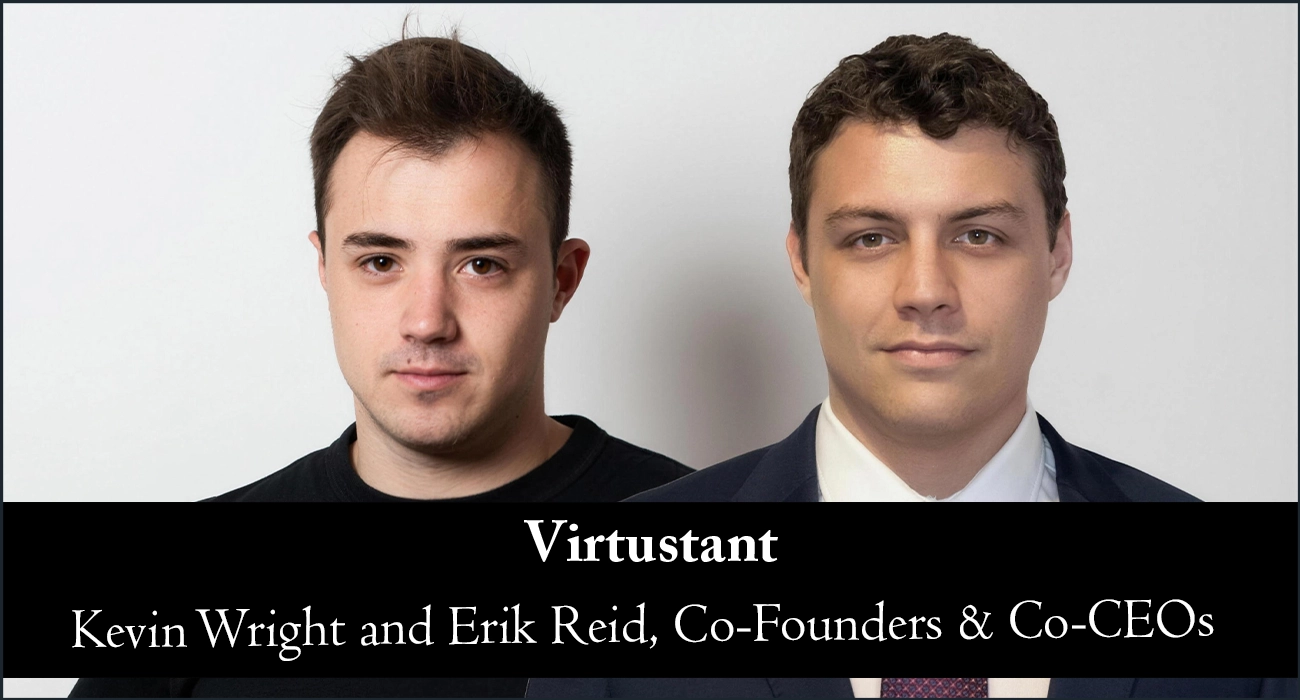
Every growing company eventually reaches the same quiet crossroads: the work is expanding, the demands are rising, and the right people are nowhere to be found, or come with price tags and fine print that feel harder to accept than the empty seats themselves. Too many businesses have learned the hard way that traditional staffing can leave them paying more, waiting longer, and receiving less accountability once the hire is made. It is in that space between ambition and frustration that real solutions are born.
Virtustant was created precisely for companies that refuse to settle for that compromise. Co-founded in 2021 by Erik Reid and Kevin Wright, who also serve as co-CEOs, Virtustant is a remote staffing agency that connects U.S. businesses with carefully vetted, bilingual professionals from Latin America. Headquartered in St. Petersburg, Florida, with recruiting and operations based in Argentina, Virtustant offers a single, transparent all-in hourly rate that starts at seven dollars and covers the professional’s contract, payroll, and paperwork. There are no separate placement fees. Every placement carries a lifetime replacement guarantee with no time limit.
The company has completed more than two thousand placements for over one thousand client organizations. A shortlist of three to five pre-vetted candidates usually arrives within forty-eight hours of the first conversation, and new team members can begin in as little as seventy-two hours. Clients can save up to 70% compared with a comparable U.S. hire. This practical approach has earned Virtustant recognition as one of the “Innovators of the Year 2026” by CIO Bulletin.
CIO Bulletin had the distinct honor of interviewing Erik Reid and Kevin Wright, Co-Founders and Co-CEOs of Virtustant. During the conversation, they shared valuable insights into how Virtustant is redefining remote staffing by placing people, transparency, and lasting business value at the heart of every hiring decision.
Interview Highlights
What defining moment led to the founding of Virtustant, and what has driven this extraordinary journey?
Erik Reid: A single conversation at a kitchen table in Connecticut. Kevin and I each had a separate business, we both needed to hire, and with tight budgets we both looked for virtual assistants abroad. Every company I found was either overpriced or hard to trust. Then Kevin told me he had just made his first hire abroad and walked me through how he did it. We realized there was a hole in the market, and we decided to start Virtustant at that table.
Kevin Wright: What made the timing right was that the price of international talent no longer made sense. Before COVID-19, most jobs were tied to an office, so a company in Boston rarely considered an accountant in Buenos Aires, no matter how good she was. Then remote work became normal almost overnight. The work could be done from anywhere, but the prices didn't adjust. Talent abroad was still priced as if location mattered, and that created an opening.
Erik Reid: What drives us is one idea: most roles can be done remotely, so the country someone lives in doesn't matter, only the quality of the person does. Whether a candidate is in Argentina, South Africa or Serbia, the only question is whether, out of everyone in the world, they are the best fit for your company.
Kevin Wright: It was never only a business opportunity for us. We have always been passionate about different countries and cultures. The opportunity happened to line up with what we already loved, and that is why we could go all in.
Could you briefly describe about end-to-end nearshore staffing services you offer? What key operational innovations allow you to deliver a curated candidate shortlist within 48 hours without charging recruitment fees?
Erik Reid: Everything starts with one call. On the discovery call, we learn about the business and the role: budget, hours, tools, and what a great first 90 days would look like. Within 48 hours for most roles, the client has a shortlist of three to five vetted candidates, each with a CV, skills test results, and a video introduction. The client interviews and chooses, and we handle the contract, onboarding, and payments from there, so the new hire can start within 72 hours. A dedicated account manager stays with the client for as long as the person works with them.
Kevin Wright: The 48-hour shortlist works because we don't start recruiting when a role opens. We recruit continuously. Candidates complete our core assessments once and join our talent pool, so when a client calls, we are searching among people we already know well instead of starting from zero. Most of our hires come from that pool, often for roles they never applied to.
Erik Reid: The speed comes from technology. More than 10,000 people apply to us every month, and every application runs through our own platform, which handles the screening, English and skills tests before a recruiter opens a file. When a role opens, AI ranks the candidates we already know against it, so the recruiter starts with the best fits instead of a blank search. Interviews, scores, and notes live in the same system, which is why a shortlist takes days, not weeks.
Kevin Wright: We don't charge recruitment fees because our revenue comes from the ongoing engagement, not the placement. Clients pay one all-in hourly rate, billing starts only when the person starts working, and we are only paid while the professional is working. We only make money when the placement works.
Beyond virtual assistance, what specialized enterprise solutions do you offer across software engineering, bilingual sales, project management, and finance? How do you ensure this aligns with client-specific software stacks?
Erik Reid: Virtual assistants are where a lot of clients start, but they are only about one in ten of the roles we open. The rest is the whole org chart: sales development reps and appointment setters, bilingual customer service, bookkeepers and accountants, marketing and social media, project managers and operations leads, designers and software developers. Some clients want one person part-time. Some have 50 people with us.
Kevin Wright: Placement is where most relationships begin, but we see ourselves as an operating partner rather than a staffing vendor. Every client is paired with an account manager and supported by our HR team for as long as they work with us. The account manager owns the relationship and HR stays close to the professional, so there is always someone accountable on both sides.
Erik Reid: On the stack, we don't guess. The role form from the discovery call captures the tools the person will use: HubSpot or Salesforce, QuickBooks or NetSuite, React or .NET. Recruiters screen for hands-on experience in those exact tools, not just the category. The candidate takes a skills test for the role, and for technical seats the client interviews them live before anyone is hired. If a client runs something unusual, we say so and go find the person who has used it, rather than training someone on the client's clock.
How does your multi-stage cognitive, English proficiency, and skill evaluations guarantee high-performing, US time-zone aligned remote professionals?
Kevin Wright: I'll be honest: no process can guarantee a great hire, and anyone who promises certainty is overselling. What a good process can do is change the odds dramatically. Every stage of our evaluation is based on predictors of job performance, drawn from decades of academic research and from our own data on how our placements actually perform. The reason we obsess over this is that the gap between average and great is enormous. Research cited by McKinsey found that high performers are 400 percent more productive than average ones, and in highly complex roles like software development and management the gap reaches 800 percent.
Erik Reid: Our goal is to take the subjectivity out of a subjective industry. Of every 100 applicants, 22 clear the recruiter screen with a live English conversation, 9 pass testing, 3 reach a live interview, and 1 is hired. That is what we mean by the top 1%. The testing has three parts: our own cognitive assessment for any role where thinking speed matters, such as executive assistants, analysts, developers and finance; an English test, with the level shown on the candidate's profile; and a skills test for the role. Then a recruiter interviews them on video and scores reliability as hard as skill, because how someone shows up to the interview is a preview of how they'll show up for the client.
Time zone is a sourcing rule, not a promise. Our biggest hub is Latin America, and Argentina sits one to two hours ahead of New York all year, so a 9-to-6 Eastern day is a normal working day there. South Africa gives us native English speakers for client-facing roles, and the Philippines works for roles with tighter budgets. We also track retention by country and pay level, and we recruit hardest in the places where people stay.
In an enterprise landscape where high turnover disrupts continuity, how do you guarantee client trust through Virtustant's lifetime replacement policy, managed contracts and payroll, and zero-lock-in monthly model?
Erik Reid: We put the risk on our side of the table. Every placement comes with free replacement for as long as the client works with us: no time cap, no fee, no fine print. If the person leaves in month 14, we recruit again at no cost. Engagements are month to month, and we'd rather earn the renewal every month than lock anyone in.
Kevin Wright: The most reliable way to earn trust is to make sure our incentives point in the same direction as our clients'. There are no recruitment fees, no deposits and no retainers. Clients pay one all-in hourly rate, so we only make money if the candidate gets hired and keeps working. When a placement ends early, we lose too. We don't leave it to good intentions either: our recruiters' commissions are tied to how long their placements last, so everyone at Virtustant is invested in making placements work for the long run.
Erik Reid: On the cross-border side, we keep it simple. Virtustant contracts with the professional, pays them in their country and sends the client one invoice in dollars. There is no local entity to open and no foreign payroll to run. The client manages the work and we manage everything around it. The honest answer on turnover is that the replacement policy only works because we select for people who stay. The policy is the promise. The vetting is what keeps it affordable.
How does your high-efficiency staffing framework deliver a "quadruple win", slashing labor costs by up to 70%, eliminating agency markups, unlocking top regional talent, and fully managing payroll and paperwork?
Kevin Wright: All four wins come from three decisions about how we operate. The first is where we look. We constantly search for the labor markets U.S. companies undervalue most and make them accessible through remote work. When talented, English-speaking professionals are priced well below the value they create for a U.S. business, everyone benefits: clients save up to 70% compared with an equivalent U.S. hire, and professionals gain access to opportunities that used to be out of reach. That same search is how we unlock top regional talent, because we go where the best people are undervalued rather than where everyone else is already hiring.
Erik Reid: Our placements start around $7 an hour, and the rate we quote is the whole cost: no placement fee and nothing stacked on top. A traditional recruiter charges 15 to 35% of first-year salary to introduce someone. We charge nothing to introduce them and only earn while they're working.
Kevin Wright: The second decision is how we run. Strong automations and standard operating procedures let us do more with fewer recruiters. Placement fees exist to pay for recruiting, and ours costs us far less, so we don't need to charge one. The third is the paperwork. We work with excellent partners abroad, and between them and our automations, the contracts, payments and onboarding that usually slow international hiring down move quickly. Our clients just get one simple invoice, one point of contact and no foreign entity.
Being recognized as the "Innovators of the Year 2026" reflects a distinctive approach to technology leadership. What key operational milestones and technological disruptions positioned Virtustant at the forefront of global remote workspace innovation?
Kevin Wright: Thank you, it's an honor. If I had to name one thing, it's how we use data. Since 2021 we have made more than 2,000 placements, and our applicant pool has grown to around 400,000 people. The size matters less than the depth. For each applicant we hold structured information on the factors that actually predict hiring success: cognitive scores, English level, skills, video introductions, pay expectations and availability. We connected that data to AI and built a platform that makes the entire pool searchable, and our team uses it every day. When a role opens, we can identify qualified applicants within hours. Traditional recruiting starts from scratch every time a role opens. We start with most of the answer already in hand.
Erik Reid: The milestone I'm proudest of is rebuilding recruiting in 2025, which turned hiring from our bottleneck into our engine. Our platform runs the whole pipeline in one place: the role form from the discovery call, the application, the testing, AI-ranked shortlists, and interview run sheets that score every candidate the same way. Our retention data now decides where we recruit and what we tell clients to expect, which is why we can put a free-replacement policy on every placement. Today that adds up to more than 2,000 placements for more than 1,000 U.S. companies, and No. 661 on the 2026 Inc. 5000, with 517% three-year growth, our second consecutive year on the list.
Looking ahead, what strategic market expansion, platform enhancements, or new international talent corridors are on your immediate roadmap to further accelerate client growth and global talent access?
Kevin Wright: First, an AI matchmaker. Today our team searches the database with AI assistance. The next step is a system that does the matching itself. It converts every candidate profile and every job description into vector embeddings, mathematical representations of skills, experience, test results and working preferences, and ranks candidates by how closely they fit the role. The ranking model learns from our own history: who got hired, who stayed and who didn't. Every placement improves the next match, and our recruiters still make the final call, starting from a far better list.
Second, screening. We are building internal tools that use AI to review video introductions for English fluency, communication and professionalism at a scale no human team could match, and a new generation of cognitive assessments designed to hold up in a world where AI can answer most online tests.
Erik Reid: Third, retention on both sides of a placement. We track every placement at 30, 60, 90 and 180 days and tie it back to where and how the person was recruited. We're building that into the platform so an account manager sees the early signs before the client does: a missed check-in, hours drifting, a raise conversation that is overdue. The same data drives how we coach our recruiters, so the incentive is a person who stays, not a seat that gets filled. Hiring fast got us here. Keeping people and clients is what the next stage is built on.
Kevin Wright: On corridors, Latin America remains our core, and we are building South Africa into a major second corridor. It has excellent English, a work culture that fits U.S. companies naturally, and talent that U.S. employers still undervalue. We are also quietly testing a few other markets, which I'll keep to myself for now.
The Dynamic Duo Behind Virtustant’s Success
Erik Reid and Kevin Wright are the Co-Founders and Co-CEOs of Virtustant, a remote staffing agency they established together in 2021 during the COVID-19 pandemic, without outside investors. Since its founding, Virtustant has placed more than 2,000 professionals from 20 countries with over 1,000 U.S. companies. The company also ranked No. 661 on the 2026 Inc. 5000, marking its second consecutive year on the list.
Erik graduated from the University of Connecticut with a degree in economics and began his career in finance before leaving at the age of 24 to build Virtustant. He leads recruitment, sales, product, and data, and continues to take discovery calls with prospective clients every week.
Kevin studied finance at Fordham University's Gabelli School of Business. With a longstanding passion for languages and cultures, he taught himself Mandarin in college and now speaks five languages. Before founding Virtustant, he built an international education business with teaching operations in the Philippines, where he gained firsthand experience in recruiting and managing teams across borders. At Virtustant, he leads marketing and HR, oversees the countries from which the company recruits, shapes its candidate screening and assessment processes, and guides the technology that processes thousands of applications every month. He also continues to lecture at Fordham whenever his schedule allows.
The First Client Who Believed in Virtustant
Kevin Wright: No one builds a company alone, and one person to whom we owe a great deal is Olivia Quido-Co, known to many as Miss O. Olivia founded O Skin Med Spa in Southern California in 2003, starting in a rented spare room inside a salon. She later launched Olivia Quido Clinical Skincare, which became the official skincare partner of the Miss Universe pageant in 2019. She also served as a judge at Miss Universe 2022.
Olivia was our first major client. We were much younger and far less experienced, and she gave us the opportunity to prove ourselves because she wanted to help the next generation of entrepreneurs. Her support went beyond being a client. She mentored us on the importance of giving back and approaching business with both strategic and tactical thinking. Much of how we run Virtustant today can be traced back to those conversations. We strive to pay that forward through teaching and volunteering with programs that help people find work.
– Erik Reid

















































 consultants ltd.jpg)


