
Home Technology Medical technology The Role of AI in Improving La...
CIO Bulletin
,
30 April, 2026
Author:
Guest
Contemporary laboratories operating in fields such as pharmaceutics, diagnostics, and scientific research have been put under unprecedented pressures. There is an ever-increasing need to achieve results quicker and at a far greater volume, but many workflows are still heavily dependent on manual involvement.
As noted by the World Health Organization, one of the factors responsible for the variation in lab data is the errors committed by humans, which may arise due to such things as inconsistency in manual pipetting or fatigue of the technicians. Such variations create serious obstacles, causing enormous bottlenecks in terms of data generation and hampering further drug development.
When your team struggles with the laborious tasks, it is inevitable that the results are affected. Tackling this problem is not merely a matter of putting in more effort, but rather eliminating the very source of variability inherent to manual processes.
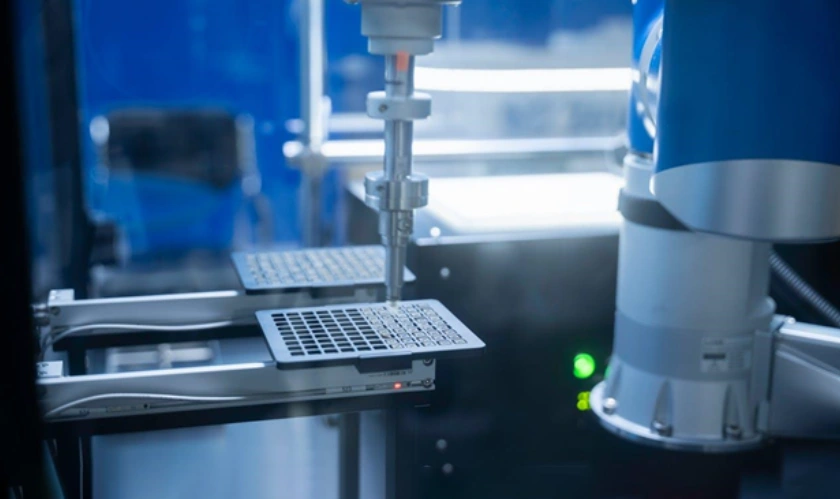
In the field of laboratory automation, the application of AI does not refer to some futuristic supercomputer with its own consciousness. It refers to intelligent laboratories that employ adaptable protocols and effective scheduling to control processes.
Conventional automation operates on a set of hard rules of "If this, then that." Any modification in variables will render the system nonfunctional. An AI-integrated system, however, can detect errors in real time and optimize based on empirical data.This shift creates "smart workflows" where the system understands the nuances of liquid handling or plate movement.
McKinsey reports that AI-driven R&D transformations are already helping organisations break through traditional productivity barriers by making systems more autonomous. For the average lab, this means you spend less time on specialist programming and more time actually analysing results, as the software handles the heavy lifting of process coordination.
It is no secret that science has been facing a reproducibility crisis. A well-known survey by Nature revealed that over 70% of researchers have failed to reproduce another scientist's experiments. Often, the culprit is the subtle variability in how different people handle samples.
With AI, it’s right to the point in standardising all movement. With AI-based calibration as well as liquid sensing, they could spot out if the tip is blocked or the volume is a little different. It’s something you won’t be able to identify after four hours of working in the lab.
With real-time monitoring made possible through AI technology, every plate you work on is guaranteed to get the same treatment as the previous one. Not only will it ensure your data quality, but also it gives an extra peace of mind regarding compliance, taking away the human factor from the process.
In the past, if you wanted to increase your throughput, you usually had to accept a massive jump in system complexity. More samples typically meant more complex hardware and more heads to manage it. AI flips this script by simplifying the scaling process.
In a scenario where the intelligent scheduling and optimized batch processes can enable the simultaneous handling of different tasks, the liquid handler will never be idle waiting for another task to be completed. This ensures that many experiments can be conducted at the same time without having to employ too many people to handle everything.
This is all about doing more with what you have. Since the AI will manage the complicated timing aspects of the experiment, there will be no need for you to train a lot of people to take care of the logistical aspect of your research.
Resistance to change can be attributed to fear of the unknown or difficulty in adapting to something new. However, the real magic of AI lies in its ability to work hand-in-hand with truly intuitive software. We no longer need to worry about complex codes; we can simply drag and drop just like any other smartphone application.
In these systems, the AI works behind the scenes to suggest the best liquid classes or to auto-fill complex plate layouts. This reduces onboarding time from weeks to mere hours. By lowering the barrier to entry, these tools enable broader adoption across your entire team.
You no longer need a dedicated automation specialist to be on-site just to start a run. When software is designed to be accessible, the sophisticated benefits of AI, like error prevention and workflow optimisation, become available to every scientist at the bench regardless of their technical background.
When you are ready to upgrade your facility, the choice of platform should come down to how well the hardware talks to the software. It is not enough to have a precise robot if the interface is a nightmare to navigate.
Scalability and easy integration with your current LIMS or instrumentation are critical considerations. As more and more laboratories move toward selecting liquid handling instruments that incorporate accurate hardware along with innovative software functionality, it is becoming clear that this combination allows you to plan not only for the present but also for the future.
Another essential consideration is validation functionality. This will ensure that the system itself is capable of demonstrating its own level of accuracy, providing you with a comprehensive audit trail for each microlitre of fluid handled.
Indeed, it is only a matter of time before the lights-out lab becomes a reality. With the continuing development of artificial intelligence, there will be greater convergence between automation and cloud computing.
According to Nature Machine Intelligence, the trend towards self-driving labs will increase the pace of scientific discoveries by ensuring that experiments can be carried out 24/7 without much supervision. In the years ahead, your lab setup won’t simply obey commands from you.
In fact, it may begin suggesting optimizations based on past experience or making adjustments based on environmental changes. Over time, this transformation will help lower costs and free up scientists to concentrate on analyzing information and solving biological problems.
It is not just a fancy idea anymore; it is now a necessity for all laboratories that hope to stay ahead of the competition. This is because the use of such technology increases accuracy while at the same time increases throughput, eliminating the classic dilemma.
With the user-friendliness of these machines growing, the task becomes more about doing the science rather than worrying about the machine itself.




















































 consultants ltd.jpg)


