
Home Industry Metals and mining Will Modern Mining’s E-Waste...
CIO Bulletin
,
15 August, 2026
Author:
Ravathi Sunil
Innovative processing technology transforms discarded electronics into vital critical mineral reserves across United States manufacturing hubs.
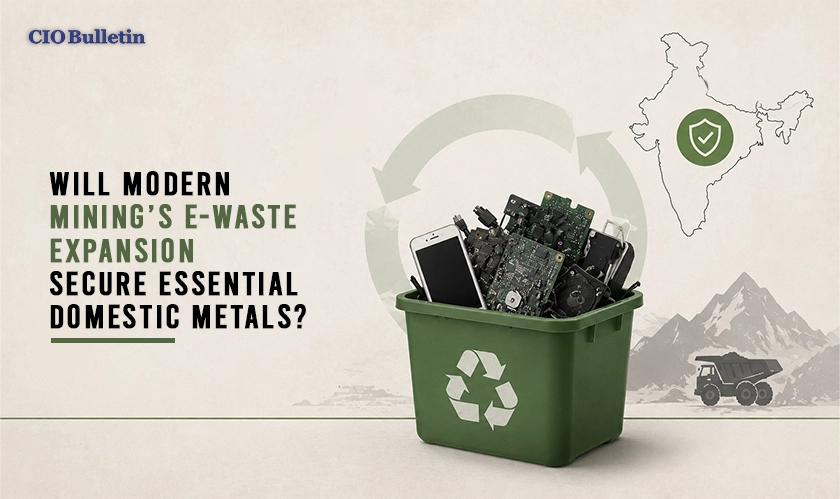
Domestic industrial supply chains are entering a transformative era as urban metal recovery replaces traditional underground extraction. Strategic market intelligence published by CIO Bulletin highlights that the Modern Mining’s e-waste expansion is accelerating nationwide as companies commercialize advanced electronic processing facilities. The process of scaling up demonstration industrial plants in North Carolina allows processing experts to mine high-value materials such as gold, silver, palladium, and copper from used circuit boards. Used electronics products often contain much higher amounts of metals compared to those found in natural ore sources.
This technological pivot aligns closely with federal initiatives leveraging the Defense Production Act to restrict industrial scrap exports and retain strategic materials at home. However, simply preventing scrap from leaving national borders addresses only half of the logistical equation. Can expanding regional processing networks effectively replace foreign supply dependencies before critical mineral shortages hit high-tech manufacturing? Industry analysts note that scaling urban mineral recovery could reduce global demands for new mine development by up to forty percent over coming decades.
Addressing the national shift toward domestic resource recovery, Modern Mining Chief Executive officer Jeet Basi stated:
"We see electronic waste not just simply as something that needs to be recycled, but we view it as an above-ground mineral resource that can become a part of the domestic supply chain."
Unlike huge central smelting factories with difficult environmental permitting processes, current technology uses smaller modular plants set up near large cities where there is a lot of garbage. Methods like shredding, grinding, and gravitational sorting allow for efficient metal extraction without damaging the environment. As artificial intelligence infrastructure accelerates electronic equipment turnover, secondary metal recovery will prove vital for long-term technological resilience.
Key Industry Highlights
Advanced recycling technologies extract gold, silver, and copper from discarded circuit boards.
Federal policies limit industrial waste exports to retain strategic minerals domestically.
Modular processing plants offer faster permitting and lower capital costs than traditional smelters.
Everything you need to know about this news
Rising demand for critical minerals and new federal export restrictions have turned discarded electronics into valuable domestic metal resources.
Printed circuit boards often feature metal concentrations, such as gold and copper, that exceed the grades found in traditional underground rock deposits.
Modular facilities use physical grinding and gravity separation, avoiding heavy smelting emissions while speeding up regional site permitting.
Rapid AI hardware upgrades shorten the lifecycle of data center equipment, increasing the volume of high-value electronics available for urban recovery.
Executives, sustainability experts, and technology analysts can track global commodity and industrial updates directly on the CIO Bulletin platform.


















































 consultants ltd.jpg)


Comments