
Home Industry Robotics IIT Gandhinagar Develops Metho...
CIO Bulletin
,
01 April, 2026
Author:
CIO Bulletin Team
IIT Gandhinagar researchers develop a Virtual Actuation Space to simplify control and enhance precision in flexible tendon-driven robots for complex medical and industrial tasks.
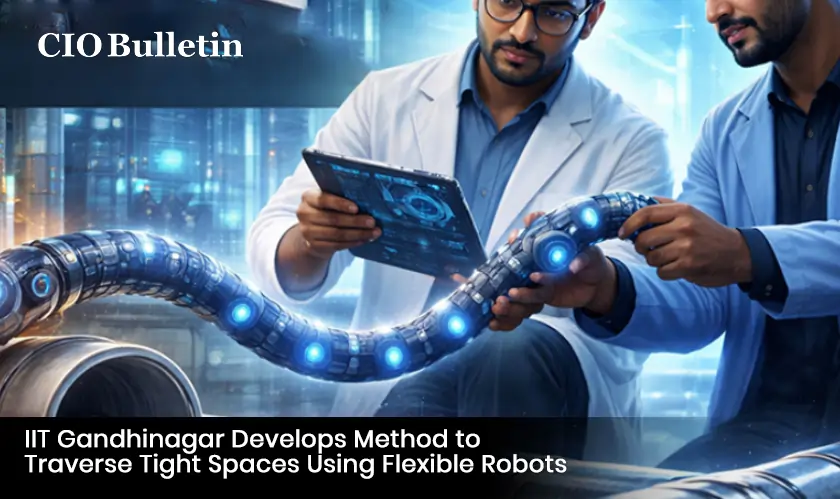
Researchers from the Indian Institute of Technology Gandhinagar (IITGN) recently proposed the concept of virtual actuation space (VAS) for simplifying control in Tendon-driven Continuum Robots (TDCRs). These are a type of continuum robots (CR) known for their compactness, lightweight design, and precise control. They have thin wires called tendons that help them bend smoothly and accurately in different directions. Despite these advantages, it can be challenging to choose the right tendon to achieve a desired position or shape of a TDCR. IITGN’s VAS solution promised to address this issue.
Furthermore, VAS involves imagining a simple representation of the robot’s motion instead of directly controlling its physical tendons. This lets its sections be controlled independently. This improves tracking precision and reduces the complexity of controlling multi-section robots. To estimate the method’s effectiveness, researchers developed a robotic arm with two sections and six tendons. The robot's position was tracked by small LED markers. A computer later compared the actual position with the robot’s desired position and adjusted the attached motors accordingly.
Moreover, the experimental tasks were highly precise, requiring an error margin of less than one per cent to succeed. Also, the two sections of the robot could operate independently of the situation. This can be understood better by conceptualizing moving one’s fingers while keeping one’s wrist straight, and then doing the opposite. The VAS system can significantly benefit TDCRs with additional sections, such as performing surgeries and industrial automation in the confined spaces of aircraft engines, among others. According to CIO Bulletin, IITGN’s study is perfectly aligned with India’s National Strategy on Robotics that envisions positioning India as a global leader in robotics by 2030.




















































 consultants ltd.jpg)


