
Home Technology Salesforce Salesforce CEO Reveals Downwar...
CIO Bulletin
,
23 March, 2026
Author:
CIO Bulletin Team
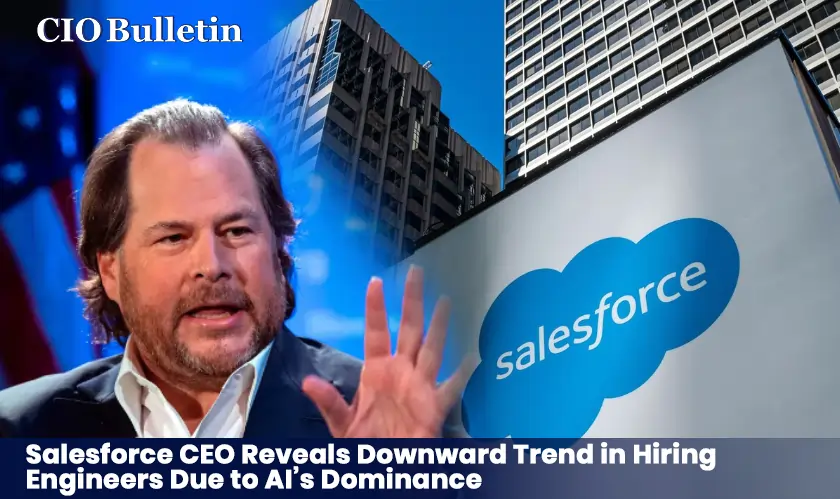
Salesforce CEO Marc Benioff shifts focus from hiring engineers to deploying AI coding agents for technical output.
In a recent interview, Salesforce’s CEO, Marc Benioff, pointed to the changing realities in hiring practices by highlighting that his company did not hire new engineers in FY2026. Instead, it delegated the work to AI-powered coding tools. According to Benioff, the extra capacity that was required for the year was delivered by these highly productive coding agents. He indicated that AI systems have matured to a level allowing them to deliver the company’s required outcomes with precision. Benioff’s statement is not entirely out of the blue, with CEOs of companies such as Anthropic’s Dario Amodei reporting the need for fewer software engineers than their current roster owing to the availability of models much better-equipped to automate software engineering end-to-end than their human counterparts.
Furthermore, the company’s requirement for fewer employees is not limited to engineering alone, with the management of support tasks by AI agents reducing the need for customer service agents as well. The one domain largely unaffected by AI is sales, with Salesforce increasing hiring to the effect of onboarding nearly 20 per cent more salespeople. With this, humans can concentrate on closing deals and building relationships while AI handles repetitive work and lead generation. At the moment, the approach seems to be paying off, as reflected in the company’s projected revenue of $46.2 billion and expectation of over $16 billion in cash flow. Benioff emphasized that the company’s future involves people and AI working in tandem, despite AI agents handling a wide variety of tasks.
However, several employees cutting across companies remain concerned about both the long-term risks of AI and its impact on their jobs. Dozens of protestors gathered outside the offices of Anthropic in San Francisco over the weekend, calling for a temporary pause in the development of advanced AI systems until proper safeguards are instated. Significantly, a few researchers and industry voices concur with the protestors’ view of AI systems eventually spiraling out of control by improving themselves. According to CIO Bulletin, AI is unlikely to impact work that depends on human judgment, connection, emotion, and care. Thus, developing a new paradigm on AI dependency by consulting all stakeholders is the need of the hour.


















































 consultants ltd.jpg)


