
Home Technology Science and technology Equipment Essentials Every Tea...
Science And Technology
CIO Bulletin,
04 December, 2025
Author:
CIO Bulletin Team
The teaching lab requires some preparation and the right equipment. A well-organized one can provide a number of advantages for study and also help achieve safety and utility. This guide outlines the essential components of every teaching lab. Embracing these basics will allow educators to create a space of inquiry.
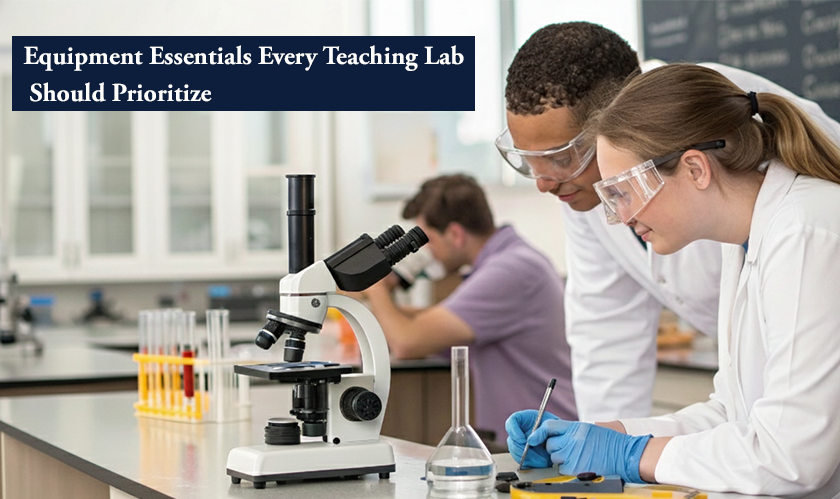
Laboratory safety should always be the number one priority in any lab. Academic laboratory equipment includes essential safety equipment, such as fire extinguishers and first-aid kits. Teaching labs also always require eyewash stations and safety showers in case of chemical exposure. Wearing a lab coat can help prevent accidents by offering personal protection, as wearing goggles and gloves prevents casual contact with chemicals.
Proper ventilation is also vital. Fume hoods help create a safe breathing space by capturing and discharging harmful vapors and fumes. Clear labeling of chemicals and other materials helps individuals identify which substances are hazardous and prevents accidents from occurring.
A teaching lab needs a set of core tools. These include tools that are essential for biology and chemistry classes, such as microscopes. There are different types of microscopes suitable for specific educational requirements, such as a light microscope and an electron microscope.
Test tubes, beakers, and flasks are standard lab tools for experiments. Using these items, students can mix, heat, and observe chemical reactions in a controlled manner. Bunsen burners are used to heat them, and pipettes are used to measure and transfer liquids.
Engagement with digital technology maximizes learning and visibility. Digital scales provide accurate readings, and since some experiments require precision, this feature is extremely helpful. Data loggers and sensors gather and analyze data in real-time, providing a window into various scientific concepts.
Interactive whiteboards and projectors enable normal, clear explanations and vivid demonstrations. They help people visualize concepts in a way that is otherwise abstract. Having a computer with the right software also helps in analyzing data and writing reports.
Specific disciplines demand specialized equipment. For instance, oscilloscopes and multimeters, which measure electrical properties, help physics labs maximize the benefits of their experiments. For example, spectrophotometers, one of the most common devices for analyzing light absorption, aid students in understanding molecular structures in chemistry labs.
Centrifuges are especially useful for separating substances in biology labs, as substances with different densities will separate at the top or bottom of the test tube used. Incubators that grow cultures and autoclaves that sterilize equipment are used to maintain a sterile environment.
Efficient storage supports both organization and safety. This is where cabinets and shelves come in, serving as a means to store things in an orderly manner and, even more importantly, to prevent clutter. So, if you want your students to be able to find what they need quickly, label your storage areas to increase productivity.
This necessitates effective waste disposal mechanisms. Having marked bins for trash and recycling reduces the opportunities for contamination and potential fines for not following environmental regulations.
Reliability and longevity of equipment are maintained through regular maintenance. A timetable for inspecting and replenishing lubricants in tools means fewer surprises down the line. Having an inventory will enable you to keep track of your supply and ensure that replacements are available whenever needed.
This training for staff and students on maintaining the equipment helps mitigate wear and tear. This minimizes the risk of damaging lab apparatuses and supports their functionality.
An inclusive learning environment takes into account various learning styles, including height-adjustable workstations and specialized desks. The incorporation of multiple formats for resources (e.g., visuals and models) can cater to different learning styles.
By enabling students to work collaboratively with one another, we foster a sense of community. When students work on group projects or participate in group discussions, they share experiences that reinforce their scientific understanding.
One of the first steps to a good learning process is to understand how to set up the basic tools and devices in a teaching lab. Prioritize safety, mix analog and digital tools, and provide specialized equipment for different learning scenarios. Maintaining a neat lab and adhering to a routine will indeed render the lab functional. Establishing an inclusive environment that prepares students also motivates them to learn during lab sessions.






















 consultants ltd.jpg)


