
Home Technology Science and technology Severe Geomagnetic Storm Could...
Science And Technology
CIO Bulletin,
20 January, 2026
Author:
CIO Bulletin Team
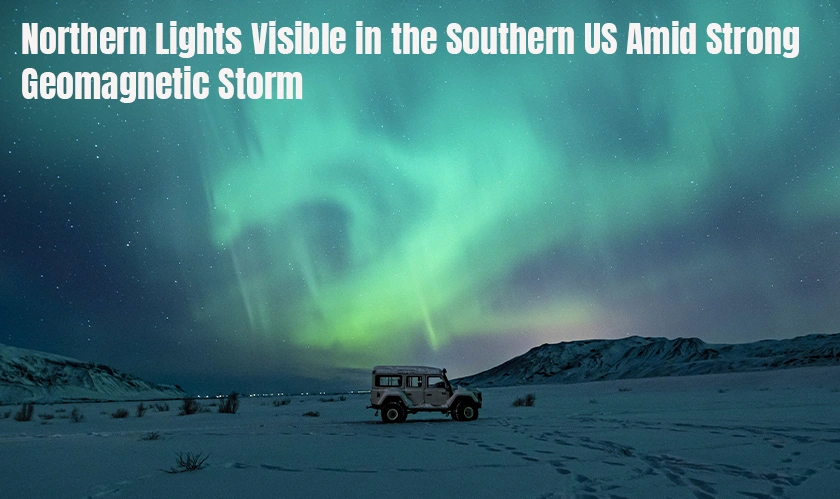
A powerful space weather event is all-set to unfold, and it could bring one of nature’s most breathtaking spectacular closer to home. Scientists are tracking a strong geomagnetic storm caused by a recent solar eruption, and it may push the northern lights far beyond their usual polar boundaries. For people residing in parts of the southern United States, this could mean a rare chance to witness the most beautiful and glowing skies that usually belong much farther north.
At the same time, this solar activity is more than just beautiful. It carries real-world effects, from power systems to satellites orbiting Earth. Here’s what’s happening, why it matters, and how you can make the most of it.
Science Behind This Rare Sky Event
A Solar Storm Headed Toward Earth
The Sun recently released a Coronal Mass Ejection (CME), a massive cloud of charged particles and magnetic energy. When these particles move through space and collide with Earth’s magnetic field, they can trigger a solar storm.
According to meteorologists and climatologists, this incoming CME has the strength to produce G3 (strong) or even G4 (severe) geomagnetic conditions. That level of activity happens very rarely, which is why scientists and skywatchers alike are paying close attention and are curious.
Why This Storm Is Different
Not every solar eruption leads to visible auroras in lower latitudes. The intensity, speed, and magnetic direction of the CME everything does matter. In this case, conditions look favorable enough to expand auroral visibility much farther south than usual.
How the Northern Lights Actually Form
The aurora borealis, often called the northern lights, appears when particles from the Sun collide with gases in Earth’s upper atmosphere. These collisions excite oxygen and nitrogen atoms, causing them to glow.
Green is the most common color
Red appears higher in the atmosphere
Purple and blue come from nitrogen
The stronger the geomagnetic storm, the wider this glowing curtain can spread.
How Far South Could They Be Seen?
If this storm reaches severe levels, the northern lights could be visible as far south as: Alabama, Northern California, and parts of Texas and the Carolinas. That’s extremely rare and makes this event especially exciting.
Northern Lights Forecast: When and Where to Look
Based on current models, the best viewing window is:
This is when Earth’s magnetic orientation allows more solar particles to enter the atmosphere.
Here are Tips to Improve Your Chances to See Northern Lights
Get away from city lights
Look toward the northern horizon
Check cloud cover before heading out
Be patient, auroras can come in waves
Even faint glows can suddenly brighten, so don’t give up too early.
Why Visibility Is Never Guaranteed
For the aurora forecast to turn into a real show, the CME’s magnetic field must align just right with Earth’s. A southward orientation allows more energy to flow in, strengthening the display.
And remember weather still matters. Even with a strong northern lights forecast, clouds can block the view completely. Clear skies are just as important as solar activity.
Real Impacts on Earth
A strong geomagnetic storm doesn’t stop at the sky. It can ripple through modern technology in surprising ways.
During G3–G4 storms, power systems may experience:
Voltage fluctuations
Automatic safety adjustments
Increased stress on transformers
Utility companies actively monitor these storms to reduce risks.
Satellite and Spacecraft Disruptions
Satellites can face:
Navigation errors
Communication interference
Surface charging issues
Some spacecraft operators may temporarily adjust operations as a precaution.
GPS and Radio Signals
A solar storm can affect:
GPS accuracy
Aviation communications
Low-frequency radio signals
Most disruptions are short-lived, but they highlight how dependent we are on space-based systems.
Solar Flare 2026: Why These Events Are Increasing
The Sun operates on an 11-year solar cycle, and it entered its most active phase—solar maximum, in late 2024. This period is marked by frequent sunspots, flares, and CMEs.
Experts expect heightened activity, including events like this solar flare 2026, to continue through the year and possibly beyond. That means more chances to see the northern lights, but also more space weather to manage.
As solar activity remains high, scientists are improving models to predict storms earlier and more accurately. These forecasts help protect infrastructure while giving the public time to prepare for rare sky displays.
Why This Moment Is Special
For many people, seeing the northern lights has always required long-distance travel. Events like this change that expectation. When the sky glows unexpectedly far south, it reminds us that space weather is not distant or abstract; it’s connected to daily life on Earth.
Moments like these don’t come with long notice. That’s what makes them memorable.
If you spot the aurora borealis tonight, take photos, share them, and talk about the science behind what you’re seeing. Encourage friends and family to look up too. These events connect people across regions, all watching the same sky.
FAQs
Can a geomagnetic storm harm people on Earth?
No. Earth’s magnetic field and atmosphere protect humans. The main effects are on technology, not health.
Why do the northern lights sometimes appear farther south?
During strong storms, Earth’s magnetic field shifts, allowing solar particles to reach lower latitudes.
Is this related to the solar flare 2026 activity?
Yes. Increased activity during this period raises the chance of strong solar storms and auroras.
How often does a G4 geomagnetic storm happen?
Severe storms are rare and usually occur only a few times during each solar cycle.
Will there be more chances to see the aurora borealis tonight or later this year?
With the Sun near peak activity, more opportunities are likely through 2026.






















 consultants ltd.jpg)


