
Home Technology Science and technology Top 10 CIO Conferences...
CIO Bulletin
,
28 March, 2026
Author:
CIO Bulletin Team
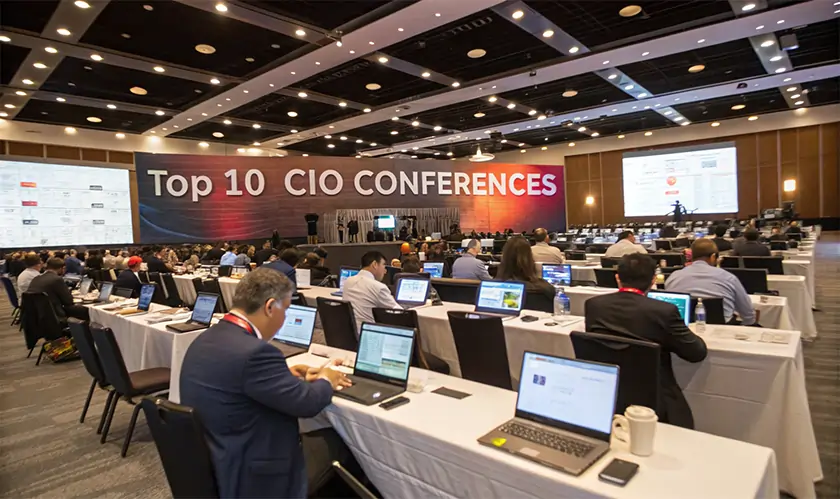
The best CIO conference in 2026 is not the biggest one. It is the one that helps you make the next high-stakes decision faster and with less risk.
Most conference guides do not start there. They rank by brand, attendance figures, or keynote talent, none of which tells you whether you will leave with a clearer vendor decision, a better-sequenced transformation roadmap, or a governance framework you can actually put in front of a board. This guide does.
A new ranking framework: the 30-Day Decision Yield Test
A decision matrix organized by live CIO priority, not event brand
Ten conferences ranked for execution relevance in 2026, with honest trade-offs
A practical 3-event portfolio framework for building a smarter conference calendar
What this list deliberately excludes — and why
Before the ranking, a clarifying cut.
This list does not include:
Large-attendance events with weak executive filtering,
Recognition-led programs that are useful for benchmarking but not for accelerating decisions, or
Broad innovation festivals that generate ideas without producing outputs.
There are good reasons to attend those events. Execution velocity is not one of them.
Every event on this list was evaluated against one question: Will it help a CIO move a live initiative forward within 30 days of attending?
Standard conference rankings ask which events are "best overall." That is the wrong question for a CIO with programs already in motion.
This ranking uses a tighter filter — the 30-Day Decision Yield Test:
Decision clarity: Will this event reduce uncertainty on an active initiative?
Sequencing value: Will it help you prioritize what to do next, and in what order?
Output quality: Will you leave with a decision, a framework, or a validated direction — not just inspiration?
Peer signal: Will you hear from someone who has already solved a version of your problem at a comparable scale?
Continuity: Will the value compound, or does it expire at the airport?
Events that score high on all five are rare. The ones that do earn a place on this list.
|
If your most pressing 2026 priority is… |
Start here |
|
Year-round transformation calibration and peer continuity |
Millennium Alliance CIO Assemblies |
|
AI operating-model execution and workflow redesign |
ServiceNow Knowledge 2026 |
|
Governing agentic AI and connecting investment to outcomes |
IDC CIO Summit New York |
|
Board-level strategic validation and long-range planning |
Gartner CIO Leadership Forum |
|
Scaling data foundations and operationalizing AI |
Databricks Data + AI Summit |
|
Understanding where enterprise AI infrastructure is actually heading |
NVIDIA GTC |
|
Structured analyst frameworks for prioritization decisions |
Info-Tech LIVE |
|
Candid peer benchmarking on live challenges |
Evanta CIO Executive Summits |
|
Regional executive insights |
CIO Edge |
|
Identity, zero trust, and securing AI agents across the enterprise |
Oktane 2026 |
Best for: CIOs who need a year-round operating cadence for transformation decisions, not a single annual information event
Who should attend: CIOs, CDOs, and senior technology executives with active transformation programs that require repeated calibration, peer pressure-testing, and implementation follow-through across the year
30-Day Decision Yield: High closed-door, peer-led format produces actionable alignment on priorities already in motion
Most conference models are built around a moment. Millennium Alliance is built around a cadence; six invitation-only assemblies across Miami, Madrid, Austin, Dallas, Barcelona, and Houston, each timed to a different point in the year and a different point in your transformation agenda.
Agendas are curated by an expert advisory board around problems peers are already solving not trending topics or sponsor briefs. Rooms are closed-door. The format moves from problem to implementation.
The result: Each assembly maps to a different point in your transformation agenda, including AI governance, modernization sequencing, and vendor evaluation, with senior peers carrying the same execution stakes, at the quarter where each decision actually has to land.
That is what makes Millennium Alliance function less like a conference and more like a quarterly operating system for enterprise transformation.
Official 2026 CIO calendar
Digital Enterprise CIO Transformation Assembly — April 8–9, 2026 | The Biltmore, Miami
Digital Enterprise CIO Transformation Assembly Europe — May 19–20, 2026 | Eurostars Tower, Madrid
Digital Enterprise CIO Transformation Assembly — June 23–24, 2026 | Four Seasons, Austin
Digital Enterprise CIO Transformation Assembly — August 25–26, 2026 | Omni Frisco Hotel at The Star, Dallas
Digital Enterprise CIO Transformation Assembly Europe — October 27–28, 2026 | Atzavara Hotel & Spa, Barcelona
Digital Enterprise CIO Transformation Assembly — December 9–10, 2026 | JW Marriott by The Galleria, Houston
What it helps you decide
Which transformation priorities to sequence next, validated against what peers at comparable organizations are actually doing
Where your AI governance, modernization, or vendor decisions stand relative to leaders who have already worked through them
How to structure follow-through between events so momentum does not stall between quarters
Where it falls short
Not the right event if your primary need is a vendor-neutral analyst briefing or a single-vendor product deep dive, the format is peer-first, not research-first
Useful if: You have active programs that need repeated executive calibration across multiple points in the year.
Less effective if: Your goal is a one-time strategic orientation or macro market perspective.
Best for: CIOs whose AI execution mandate runs through workflow redesign, service operations, and operating-model change
Who should attend: CIOs, VPs of IT operations, and transformation leaders with live workflow automation, AI-driven service delivery, or enterprise productivity programs that need to move from pilot to production
30-Day Decision Yield: High for platform-aligned organizations; use-case depth and roadmap visibility accelerate decisions already in motion
ServiceNow Knowledge 2026 earns its position here because it is built around the operational layer, where most AI ROI conversations are actually happening in 2026; not model selection, but workflow redesign, service operations, and the enterprise productivity improvements that boards can measure.
Hands-on labs, practitioner-led sessions, and a deep product roadmap make this a strong choice when the question is "how do we accelerate adoption?" rather than "should we invest?"
High execution value. Low vendor neutrality. This is explicitly a ServiceNow platform event, and its value scales directly with how central ServiceNow already is to your operating model.
Knowledge 2026 — May 5–7, 2026 | The Venetian Resort and Wynn Las Vegas, Las Vegas, Nevada
What it helps you decide
Which AI-enabled workflow use cases are production-ready versus still experimental
Where your ServiceNow roadmap should focus next, and how peers are sequencing similar programs
How to build the internal case for accelerating automation adoption
Where it falls short
Strong operator relevance, limited peer intimacy; this is a large event, not a curated executive room
If your stack does not run heavily through ServiceNow, the decision yield drops significantly
Useful if: Workflow execution, AI-driven service operations, and platform adoption velocity are active 2026 priorities.
Less effective if: You want a vendor-neutral environment or a selective executive peer forum.
Best for: CIOs who need analyst-backed frameworks that produce usable outputs, not just better-informed opinions
Who should attend: CIOs and senior IT leaders facing live prioritization decisions — particularly around agentic AI governance, modernization sequencing, and technology investment trade-offs
30-Day Decision Yield: Strong — workshop and one-on-one analyst formats are explicitly designed to produce decision outputs
Info-Tech LIVE 2026's theme — Agentic AI: From Hype to Value — signals exactly the transition point many CIOs are navigating: from exploratory investment to governed, measurable execution. The agenda structure reflects this: analyst-led keynotes, interactive workshops, peer roundtables, and one-on-one analyst advisory sessions.
The model is less "attend and absorb" and more "attend and produce," which is why it tests well against the 30-Day Decision Yield framework. You are not leaving with inspiration. You are leaving with a prioritized framework that your team can act on.
Info-Tech LIVE 2026 — June 9–11, 2026 | The Bellagio, Las Vegas, Nevada
What it helps you decide
Which AI investments are worth continuing versus winding down, with analyst data to back the call
How to sequence modernization priorities given your current constraints and risk tolerance
What a governance framework for agentic AI looks like in practice for organizations at comparable maturity
Where it falls short
Less intimate than a peer-only executive forum, the room is research-led, not peer-led
Not the right event if you need a large vendor ecosystem or executive seniority filtering as the primary value
Useful if: You want structured analyst guidance that produces frameworks you can bring back to your team and act on.
Less effective if: You want a highly exclusive C-suite-only room or broad vendor-ecosystem access.
Best for: CIOs who need candid benchmarking on a live challenge, from peers operating at a comparable scale
Who should attend: CIOs and VP-level technology executives who want honest peer exchange in a senior, low-noise environment rather than a broad conference audience
30-Day Decision Yield: Strong for live challenges; candid peer input on active decisions carries immediate application value
Evanta's decision yield comes from a specific and hard-to-replicate dynamic: a room of C-level and senior-most executives, generally at organizations with $500M or more in revenue, talking honestly about what is working and what is not.
The format is peer-led. The sessions are built around structured one-to-one meetings and small-group discussions rather than panel presentations. When a specific decision is live, such as a vendor shortlist, an operating model change, or an AI governance question, hearing directly from two or three peers who have already navigated a version of it is often worth more than a day of keynotes.
High candor value. Narrower geographic coverage than a national event — worth checking which regional summit best aligns with your calendar and peer network.
Representative 2026 event Washington, DC CIO Community Executive Summit — May 12, 2026 | Washington Marriott Metro Center, Washington, DC
What it helps you decide
How your current approach to a live challenge compares to what peers at similar organizations are actually doing
Whether a decision you are hesitating on has already been resolved — and how — by someone at comparable scale
Which assumptions in your current plan need pressure-testing before you commit
Where it falls short
Strong peer candor, limited market coverage — this is not the event for broad technology landscape scanning
Regional format means the peer pool is geographically bounded, which can limit the range of organizational contexts in the room
Useful if: You want direct peer calibration with genuine candor on a specific live challenge.
Less effective if: You need broad market coverage, deep vendor access, or a full annual conference platform.
Best for: CIOs who need sharper board narratives, external market validation, and strategic clarity before a major decision cycle
Who should attend: CIOs who need to frame board-level conversations on AI investment, technology risk, and enterprise resilience with research-backed evidence rather than internal assumptions
30-Day Decision Yield: Strong for strategic framing; most useful when a board presentation, budget cycle, or major vendor decision is imminent
Gartner CIO Leadership Forum is the right choice when the decision is not "what should we do?" but "how do I validate and articulate what we are already planning?" Its 2026 theme — Leadership in Motion — organizes sessions around three tracks: managing AI's impact on infrastructure and resilience, driving business impact and C-suite partnership, and building the leadership capabilities for a volatile technology environment.
The format is curated and application-based, producing a more focused room than Gartner's larger Symposium/Xpo. Strong strategic framing. Lower hands-on implementation density than Info-Tech LIVE or the platform-specific events.
Gartner CIO Leadership Forum — March 30–31, 2026 | The Diplomat Beach Resort, Hollywood, Florida
February 23–24, 2026 | Phoenix, Arizona
What it helps you decide
How to frame a board-level narrative around AI investment, risk, or transformation that holds up to external scrutiny
Where your current priorities align with or diverge from the direction Gartner's research signals for enterprise IT
Which strategic assumptions in your current plan need to be revisited before the next planning cycle
Where it falls short
Research-led and framing-heavy; better for sharpening arguments than for producing hands-on implementation outputs
Less peer intimacy than Evanta or Millennium Alliance; the value is Gartner's data, not the room's candor
Useful if: A board budget cycle, major vendor decision, or strategic planning process is imminent, and you need external validation.
Less effective if: You want a peer-first environment, hands-on workshops, or deep implementation guidance.
Best for: CIOs governing agentic AI, managing technical debt, and connecting modernization investment to board-visible outcomes
Who should attend: CIOs, CTOs, and senior transformation leaders who need analyst-backed framing for modernization, AI governance, and business-value delivery in a CIO-specific, time-efficient format
30-Day Decision Yield: High for governance decisions; IDC's research framing on agentic AI and modernization provides directly applicable input for investment sequencing
IDC CIO Summit New York is purpose-built for enterprise technology leadership — a full-day format designed to cover the ground most CIOs are actually covering in 2026: technical debt prioritization, agentic AI governance, cyber resilience, and making digital investment legible to the business.
IDC's research projects that agentic AI will account for more than 26% of worldwide IT budget growth between 2025 and 2029, which means the governance frameworks this summit addresses are not future-state planning; they are live operational requirements for most enterprise CIOs right now.
IDC CIO Summit New York — May 14, 2026 | Convene, 101 Park Avenue, New York City
What it helps you decide
How to govern agentic AI investments in a way that produces measurable business outcomes rather than indefinite pilots
Which modernization and technical debt priorities are worth sequencing now versus deferring
How to frame digital strategy in the language of business performance for a non-technical board
Where it falls short
Full-day format limits the depth available on any single topic compared to multi-day events
Less vendor-ecosystem breadth than a large platform event
Useful if: You need CIO-specific, analyst-backed framing for governance, modernization, and AI investment decisions.
Less effective if: You need a large vendor floor, extensive networking time, or multi-day technical depth.
Best for: CIOs whose hardest AI problem is not model selection but data infrastructure, governance, and getting AI into production
Who should attend: CIOs, CDOs, and data platform leaders with live AI operationalization challenges, particularly those scaling data governance, building AI foundations, or working through the gap between pilot and production
30-Day Decision Yield: High for data and AI architecture decisions; over 800 sessions provide direct input on platform choices and implementation sequencing
The question most CIOs are sitting with in 2026 is not "should we invest in AI?" — it is "why are our AI programs not producing outcomes at scale?" The most common answer is data infrastructure: governance gaps, fragmented architecture, and the distance between experimental workloads and production systems.
Databricks Data + AI Summit addresses that gap more directly than any generalist conference on this list, with sessions spanning data engineering, ML operations, agentic AI systems, governance frameworks, and open-source platform direction.
Data + AI Summit — June 15–18, 2026 | Moscone Center, San Francisco, California
What it helps you decide
Whether your current data architecture can support the AI programs your organization is planning or piloting
How to close the gap between AI experimentation and production-scale deployment
Which platform and governance decisions will most affect your AI program's ability to deliver at scale
Where it falls short
Broad data and AI ecosystem audience; less intimate than a peer-only executive forum
Decision yield drops for CIOs whose AI bottleneck is organizational rather than architectural
Useful if: Data platform strategy, AI operationalization, or governance is already on the agenda and a decision is imminent.
Less effective if: You want a curated executive peer room or a broader technology leadership event.
Best for: CIOs whose AI infrastructure, investment, and platform decisions are becoming board-level issues
Who should attend: CIOs, CTOs, and senior technology executives making significant AI infrastructure commitments or evaluating accelerated computing, agentic AI deployment, and AI factory architecture at enterprise scale
30-Day Decision Yield: High for AI infrastructure decisions; proximity to where real capability, cost, and scalability choices are being made is difficult to replicate elsewhere
NVIDIA GTC is not a CIO summit. It is where enterprise AI infrastructure decisions are shaped — and that makes it increasingly relevant to CIOs whose boards are asking serious questions about AI investment, cost, and feasibility. The 2026 conference covers physical AI, agentic AI, inference, and AI factory architecture across more than 700 sessions.
If your AI roadmap depends on understanding what GPU-accelerated infrastructure can realistically deliver, what it will cost, and how the ecosystem is moving, there is no better single event to answer those questions.
Note: conference passes for 2026 sold out, but exhibits-only passes remain available.
NVIDIA GTC — March 16–19, 2026 | San Jose McEnery Convention Center, San Jose, California
What it helps you decide
Whether your current AI infrastructure commitments are well-positioned relative to where the platform is going
How to frame AI infrastructure investment for a board conversation around cost, capability, and long-term feasibility
Which architectural choices will affect your AI program's scalability over the next two to three years
Where it falls short
Large AI ecosystem event with a heavily technical audience; not a CIO peer forum
Decision yield is highest for CIOs with significant AI infrastructure already in motion; lower for those at earlier stages
Useful if: AI infrastructure, agentic AI deployment, or accelerated computing is a live strategic investment issue.
Less effective if: You want a classic CIO peer summit or a broader enterprise technology leadership event.
Best for: CIOs seeking regional executive insight on AI, cloud, and enterprise innovation
Who should attend: CIOs, CTOs, and senior technology leaders across APAC who want strategic clarity on emerging technologies, digital transformation, and enterprise innovation within a regional business context
30-Day Decision Yield: Moderate to Strong valuable for strategic alignment and regional market understanding, with actionable insights depending on current priorities
CIO Edge 2026 is designed as a high-quality executive forum rather than a large-scale global conference. Its strength lies in bringing together senior technology leaders within the Asia-Pacific region to discuss practical challenges around AI adoption, cloud strategy, and enterprise transformation.
Unlike broader global events, CIO Edge offers a more focused environment where discussions are aligned with regional business realities, regulatory considerations, and market maturity. This makes it particularly relevant for CIOs operating in or expanding into APAC markets.
While it does not provide the same depth in technical execution as platform-specific events, it delivers strong value in strategic positioning, regional benchmarking, and leadership alignment.
2026 event
CIO Edge 2026 — February 2026 | Sydney, Australia
What it helps you decide
How to structure an AI security governance framework that aligns CIO and CISO priorities
Where your current resilience architecture stands relative to the threat landscape and regulatory direction
Which vendor and technology decisions in your security and resilience roadmap need to be revisited
Where it falls short
Very broad audience — the leadership-track content is relevant, but you will need to navigate significant volume to find it
Less peer intimacy than a CIO-specific format; the value is market scanning and alignment, not peer candor
Useful if: Cyber resilience, AI security governance, and cross-functional risk alignment are live executive priorities.
Less effective if: You want a narrower CIO-only format or the broader cybersecurity audience is not relevant to your current agenda.
Best for: CIOs for whom identity has moved from infrastructure layer to a strategic control point for AI, automation, and digital trust
Who should attend: CIOs and senior IT leaders actively governing identity and access management, zero trust architecture, and the security of AI agents and automated workflows across the enterprise
30-Day Decision Yield: High for identity-specific decisions; directly actionable for CIOs with live AI agent security, zero trust, or access governance programs
Identity has become a more consequential CIO issue than most conference guides acknowledge. As AI agents proliferate across enterprise environments, the question of who, or what, can access which systems, under what conditions, is no longer just an infrastructure question. It is a governance question with board-level exposure.
Okta positions Oktane 2026 around exactly this challenge: securing AI and AI agents across the enterprise, with platform updates for Okta and Auth0, sessions on identity innovation, AI security architecture, and digital trust. Narrower than a broad platform event, and deliberately so. That focus is the point.
Oktane 2026 — September 22–24, 2026 | Las Vegas, Nevada
What it helps you decide
How to govern AI agent access and automation workflows within an enterprise identity and trust framework
Where your current zero-trust architecture has gaps that AI deployment is likely to expose
Which identity and access decisions need to be resolved before your AI and automation programs can scale safely
Where it falls short
Narrowly focused by design, decision yield drops significantly if identity is not a live strategic priority
Less CIO peer intimacy than a CIO-specific summit; the audience is identity and security ecosystem-weighted
Useful if: Identity governance, AI agent security, and zero trust architecture are active strategic priorities.
Less effective if: You need a broader conference spanning multiple enterprise platform domains.
A smarter conference strategy is not more events. It is better to sequence and match each event to the decision it is most likely to accelerate.
A practical 3-event portfolio for 2026 looks like this:
One year-round executive anchor for transformation continuity and peer calibration. This is the event, or event series, you return to across the year as your programs evolve. For most enterprise CIOs, Millennium Alliance fills this role most effectively: six small, closed-door assemblies across the calendar, timed to quarterly decision cycles.
One execution-heavy event tied to your most active platform or operating-model priority.
If AI workflow execution is the live challenge, ServiceNow Knowledge.
If data infrastructure and AI operationalization are the bottleneck, Databricks Data + AI Summit.
If AI infrastructure investment is the board-level question, NVIDIA GTC.
One specialist event for the governance, resilience, or strategic framing challenge that is most likely to surface in a board conversation in the next two quarters.
Gartner CIO Leadership Forum if the need is strategic validation.
Oktane if identity and AI agent security are the live issue.
Three events, chosen by decision priority. That is the better conference strategy for 2026.
The CIO conferences worth attending in 2026 are not the ones with the biggest stages. They are the ones most likely to change a decision already in motion.
Millennium Alliance CIO Assemblies ranks first because it is the only format on this list that is structurally built to do that repeatedly six closed-door, invitation-only assemblies across the year, with peer-tested agendas and a format designed for implementation follow-through rather than annual inspiration. It functions less like a conference and more like a quarterly operating system for enterprise transformation.
The rest of this list fills in the specific decision jobs that a single event platform cannot cover alone: platform execution, AI operationalization, strategic validation, resilience governance, and identity architecture. Each earns its place because it addresses a discrete executive decision challenge and produces a 30-day output worth the trip.
Which CIO conference is best when an AI program is already in motion and needs to move faster?
Millennium Alliance CIO Assemblies is the strongest overall choice for CIOs with live AI transformation programs its closed-door, peer-led format is built specifically for calibrating decisions already in motion across multiple points in the year. For AI operating-model execution, ServiceNow Knowledge adds platform-specific implementation depth. For AI data infrastructure and operationalization, Databricks Data + AI Summit is the more focused choice.
Which event is most useful before a board budget cycle?
Gartner CIO Leadership Forum is the strongest fit for CIOs who need research-backed strategic framing and sharper board narratives before a budget or investment decision cycle. IDC CIO Summit New York is a strong alternative, particularly when agentic AI governance and modernization investment are the board-level questions.
Which conference helps most with cyber resilience and AI governance alignment?
RSAC 2026 offers the broadest market visibility into resilience, AI security governance, and threat-landscape direction. It is most useful when the goal is cross-functional alignment between technology and security leadership. Oktane is the more focused option when identity governance and AI agent security are the specific live issue.
Which event is too broad if I need identity-specific insight?
Any of the large hyperscaler events AWS re:Invent, Google Cloud Next, Microsoft Ignite will cover identity as one track among many, which limits depth for CIOs with identity as a primary strategic priority. Oktane is purpose-built for that challenge and produces more directly applicable input when identity and zero trust are the live decisions.
What is the most efficient conference investment for a CIO with limited calendar availability?
IDC CIO Summit New York is a single-day, CIO-specific event in a major business hub with a high relevance-to-time ratio for leaders who cannot commit to multi-day programs. Gartner CIO Leadership Forum at two days offers strong strategic value for comparable time investment. For year-round value with minimal single-event commitment, Millennium Alliance's assembly model allows attendance to be matched to quarterly priorities rather than requiring a fixed annual commitment.














































 consultants ltd.jpg)


