
Home Technology Science and technology What to Look For When Selectin...
CIO Bulletin
,
23 April, 2026
Author:
Guest
A slush machine is one of those pieces of equipment that can quietly become one of your best revenue generators. From convenience stores and cafes to sports venues and food trucks, the right machine keeps customers happy and lines moving. But not every machine is built for the same environment, and a poor choice can cost you in repairs, downtime, or missed sales. Before you invest, here is exactly what to look for in a commercial slush machine so you get the performance, durability, and value your business actually needs.
The first question to ask is how much product you need to serve in a given hour or day. A machine that is too small for your customer volume will constantly run low, frustrate staff, and leave money on the table. On the other hand, an oversized machine in a low-traffic location wastes energy and increases your operating costs unnecessarily.
Most commercial slush machines list their bowl capacity in liters, typically ranging from 5 liters to 20 liters per bowl. A busy quick-service location or a high-footfall event venue should look at machines with at least 10 to 12 liters per bowl. For smaller cafes or low-volume operations, a 5 to 8 liter capacity per bowl may be more than enough.
Also consider the freeze-down time. Some machines take 30 to 40 minutes to bring a fresh batch to proper slush consistency, while others accomplish the same result in under 20 minutes. Suppose you experience sudden surges in customer traffic; a faster recovery time matters. You can find a slush machine at VEVOR and other trusted brands as they cover a wide range of capacities to suit different business sizes, so matching your volume needs to the right model is straightforward.
Always factor in your peak hours, not just your average traffic, to avoid bottlenecks during your busiest periods.
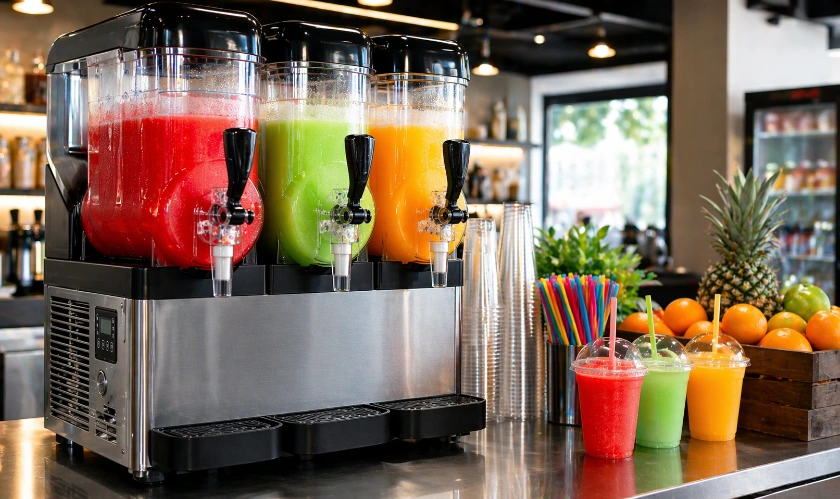
The number of bowls on a slush machine directly determines how many flavors you can offer at the same time. A single-bowl machine limits you to one flavor, which may work for a very specific concept, but most commercial settings benefit from at least two or three bowls.
Multiple bowls give you the flexibility to serve different flavors simultaneously, target different customer preferences, and run seasonal or promotional varieties alongside your staples. For example, a two-bowl machine lets you run a classic strawberry alongside a lemon-lime without any interruption to service. A three-bowl unit opens up even more creative options.
Beyond flavor variety, consider the bowl design itself. Wide, open bowls that allow you to see the product level at a glance are easier to manage during a busy shift. Some machines also allow independent operation of each bowl, so if one flavor sells out, you can refill and re-freeze that bowl without shutting down the others.
If upselling and customer experience matter to your business, a multi-bowl machine is clearly the smarter investment. More flavors on display also attract impulse purchases, which directly impacts your revenue per transaction.
In a commercial setting, your slush machine does not get the luxury of a gentle workday. It runs for hours at a stretch, gets cleaned daily, and faces constant use from multiple staff members. Hence, the materials and construction quality matter enormously.
Look for machines with stainless steel or food-grade commercial-grade components, particularly in the parts that come into contact with product or cleaning solutions. The exterior should resist scratches, stains, and the general wear that comes from a busy counter environment. Cheap plastic housings may look fine at first, but they tend to crack or discolor within months of regular use.
The drip tray, dispenser nozzle, and auger or paddle system inside the bowl are areas where quality differences become obvious over time. A well-constructed auger keeps the slush mix moving evenly so you never serve a watery or over-frozen product. Nozzles should be easy to remove and reattach without tools, which reduces the chance of damage during daily cleaning.
Also, check whether the machine has reinforced feet or a stable base. A unit that shifts or vibrates on the counter is both a safety concern and a sign of lower-quality construction. Solid build quality upfront saves you the cost and hassle of early repairs or replacement.
Hygiene standards in commercial food service are non-negotiable, and your slush machine needs to be easy to clean thoroughly. If the cleaning process is time-consuming or complicated, staff may skip steps, which creates health risks and can degrade the quality of your product.
The best commercial slush machines are designed with disassembly in mind. Bowls, lids, nozzles, and internal components should come apart quickly and without special tools. Parts that are dishwasher-safe are a significant advantage in a busy kitchen or service environment. Look for smooth interior surfaces with no hard-to-reach crevices where residue can build up.
Some machines include a self-cleaning or rinse cycle feature, which runs water through the system to flush out residue before a full manual clean. This kind of feature speeds up your daily routine and reduces the physical effort involved. It is especially useful in operations that change flavors frequently.
Beyond daily cleaning, check how accessible the internal components are for periodic maintenance. Machines where the motor or refrigeration unit is easy to access allow a technician to service them faster, which reduces your downtime if a repair becomes necessary. A machine that is difficult to service will cost you more in labor each time it needs attention.
A slush machine that runs continuously throughout the day adds up on your electricity bill. Over the course of a year, the difference in energy consumption between an efficient model and an inefficient one can be significant, especially if you operate multiple machines.
Check the wattage rating for any machine you consider. Most commercial slush machines fall between 200 and 600 watts per bowl, but efficiency varies depending on the compressor quality and insulation design. A well-insulated bowl retains cold temperatures more effectively, which means the compressor does not need to work as hard to maintain the right consistency.
Some machines include a standby or energy-saving mode that reduces power consumption during slow periods without fully shutting down the refrigeration cycle. This feature is particularly useful for businesses that have predictable slow periods, such as early mornings or late afternoons, where product demand drops but you still need the machine to stay ready.
Always compare the rated power consumption against the machine's bowl capacity to get a sense of its efficiency ratio. A machine that uses the same wattage but holds more product or maintains a better consistency is a better value overall.
The compressor is the heart of any slush machine, and it has a direct impact on how consistently your product freezes, how quickly the machine recovers after a refill, and how long the unit lasts overall.
There are two main compressor types used in commercial slush machines: air-cooled and water-cooled. Air-cooled compressors are more common and work well in most standard commercial environments. But in hot kitchens or enclosed spaces with poor ventilation, they may struggle to maintain optimal temperatures. Water-cooled compressors handle heat more effectively in those settings, but they require a water connection and produce slightly higher operating costs.
The refrigerant type also matters. Machines that use modern, environmentally responsible refrigerants tend to be more efficient and are better positioned for long-term regulatory compliance. Older refrigerant types are increasingly subject to restrictions, so it is worth confirming what a machine uses before you buy.
Finally, pay attention to the temperature range and adjustment controls. A good commercial slush machine lets you fine-tune the consistency, so you can serve a looser, more drinkable slush or a firmer, more frozen product depending on your preference. This level of control makes the machine more versatile and allows you to adapt to different product types.
Selecting the right commercial slush machine comes down to honest answers about your volume needs, space, staff capacity, and budget. Prioritize build quality and ease of maintenance, since those factors affect your daily operations the most. From there, match capacity, bowl count, and compressor type to your specific environment. Take your time, compare specifications carefully, and choose a machine that serves your business reliably for years, not just a season.





















































 consultants ltd.jpg)


