
Home Industry Space Saudi’s Space Economy Set to...
CIO Bulletin
,
24 August, 2026
Author:
Ravathi Sunil
The Middle Eastern nation accelerates satellite innovation, climate monitoring, and digital connectivity to drive sustainable future growth.
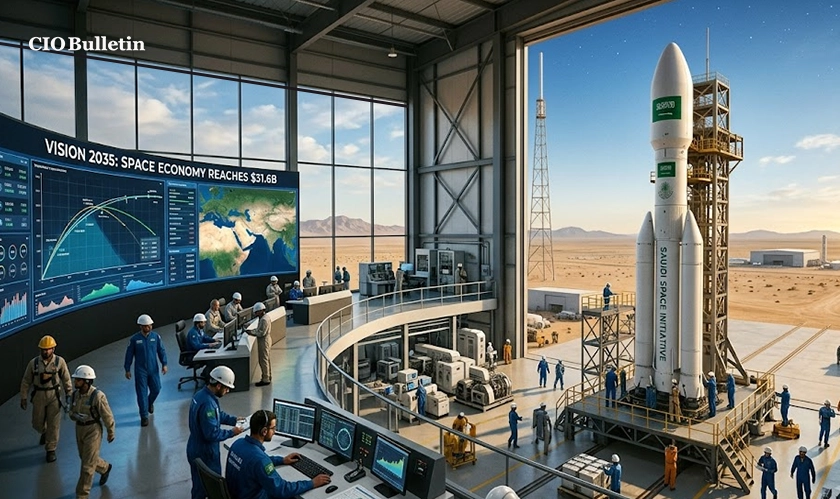
Saudi’s space economy is rapidly emerging as a central driver of global technological advancement and environmental sustainability. According to insights gathered by CIO Bulletin, the Kingdom’s space-focused sector is projected to surge to $31.6 billion by 2035, growing from $8.7 billion. This remarkable trajectory reflects a 12 percent annual expansion rate, surpassing the broader global space growth average.
How is satellite technology transforming environmental preservation from orbit? In addition to commercial activities, space infrastructure has become necessary for ecological protection. About 50 percent of all climate-related data is obtained through space, which helps manage water resources, track agriculture and desertification, and even handle natural disasters.
Highlighting this transformative momentum, Abdullah Al-Swaha, Minister of Communications and Information Technology, stated:
"We see AI as a force that can strengthen economies, empower people, protect the environment, and help address the defining challenges of our time."
The digital infrastructure is also seen as being developed alongside the extraterrestrial initiatives. Internet penetration through high-speed services touched 99.6%, while the fiber-optics spread out to cover over 3.9 million homes. The percentage of women in the national digital economy workforce went up to 35% - the largest figure for the whole Middle East region.
Triple-Digit Surge: Sector revenue set to quadruple from $8.7B to $31.6B over the coming decade.
Climate Intelligence: Satellites now actively track over half of crucial global climate metrics.
Connectivity Milestone: Domestic internet penetration reaches an unprecedented 99.6 percent.
Inclusion Benchmark: Women now represent 35 percent of the regional tech workforce.
This momentous development means that Saudi Arabia now finds itself in the role of a major global player when it comes to space innovation, digital infrastructure, and environmental conservation. Through the use of artificial intelligence alongside sophisticated satellite systems, the country is not only influencing the course of the future of space technology but also solving some of the greatest challenges facing the world today, such as climate change and resource allocation. As CIO Bulletin follows the story, one thing is certain – this developing ecosystem holds the promise of unlocking immense value and shaping future technology leaders.
Everything you need to know about this news
The growth is fueled by strategic government investments, digital infrastructure upgrades, and satellite systems aimed at climate tracking, water management, and telecommunications.
The sector is projected to expand nearly fourfold, growing from $8.7 billion to $31.6 billion at an annual rate of 12 percent.
Satellites measure over half of critical climate variables, aiding desertification control, agricultural planning, and natural disaster management.
Artificial intelligence acts as a key enabler, analyzing complex satellite data to empower populations, preserve ecosystems, and boost national economic output.
National internet access reached 99.6 percent, while female participation in the domestic digital sector hit a region-leading 35 percent.













































 consultants ltd.jpg)


Comments