
Home Technology Artificial intelligence How Stereo Vision Enables Reli...
CIO Bulletin
,
28 May, 2026
Author:
Guest
An application spotlight for robotics engineers and developers
Autonomous mobile robots have become infrastructure in modern warehouses, hospitals, and manufacturing facilities. Yet the single most common source of field failures isn’t software bugs or mechanical wear — it’s the navigation stack losing situational awareness when the environment doesn’t cooperate. A reflective epoxy floor confuses a depth return. A low-hanging conveyor belt sits below a 2D scanner’s plane. Forklift traffic reshuffles the obstacle map faster than the robot can update it.
Sensor selection is an architectural decision, and for a growing number of AMR teams, stereo vision is moving from “nice-to-have augmentation” to a primary perception layer. Here’s why that shift is happening and what you need to understand before integrating stereo vision into a navigation stack.
When an AMR navigates a real facility, it faces challenges that are easy to underestimate in the lab.
Volumetric blindness. A standard 2D LiDAR scans a single horizontal plane. It detects a pallet but misses the shrink-wrapped overhang at chest height. It maps a shelf post but not the load extending into the aisle. In a static warehouse this is manageable; in a dynamic one, it’s a liability.
Reflective surfaces. High-gloss floor paint, polished concrete, and tiled surfaces scatter IR projections unpredictably. Standard active IR cameras return noise or drop measurements entirely on reflective floors — turning routine floor detection into a point cloud gap.
Compute budget. An AMR running SLAM, obstacle avoidance, path planning, and payload management on an embedded platform doesn’t have GPU headroom to spare. Every sensor that offloads processing rather than adding to it matters.
Cost ceiling. Entry-level 3D LiDAR starts around $1,000–$3,000; high-performance systems exceed $10,000. A sensor package that pushes a mid-tier robot’s BOM past a commercial threshold complicates the business case regardless of technical merits.
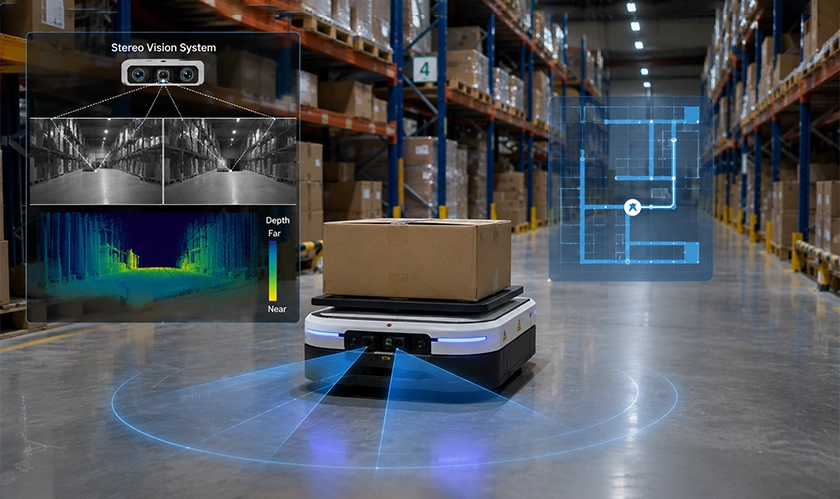
A stereo camera pairs two calibrated sensors separated by a fixed baseline and computes disparity between corresponding pixels. The resulting depth image covers the full camera field of view — not a single scan line. When that feeds into a point cloud, the robot perceives the world in three dimensions: a box is a box, not just a pair of vertical edges at floor level.
The practical comparison:
2D LiDAR alone is mature, safety-certified, and computationally lightweight. It excels at room-scale localization on flat floors. It fails at detecting above-floor obstacles and providing the dense volumetric data that modern navigation benefits from. It remains a strong anchor layer in fused architectures.
3D LiDAR gives excellent range and precision. Rotating mirror mechanisms are vulnerable to shock in mobile applications, and cost-at-scale is a real constraint — even entry-level units start in the thousands.
Stereo vision fills the gap: dense point clouds, full volumetric coverage, no moving parts, and a price point that keeps BOM costs tractable. The remaining challenge — reliable performance across lighting conditions and on reflective surfaces — is what recent hardware has directly addressed.
One additional tailwind: the open-source navigation ecosystem has matured around stereo depth. ROS 2 Nav2, RTAB-Map, and ORB-SLAM3 all accept depth image inputs natively, meaning a stereo camera drops into an existing stack without custom sensor drivers or proprietary middleware. For teams already running ROS-based SLAM, integrating a stereo camera is far less disruptive than swapping to a new LiDAR sensor family. That ecosystem readiness, combined with steadily improving hardware, is a large part of why stereo vision adoption in commercial AMR programs has accelerated over the past two years.
Understanding how a current-generation device handles real AMR constraints is more instructive than reading spec tables in isolation. The Orbbec Gemini 336L is a representative example of where stereo vision cameras for AMR navigation have landed, and its design choices illustrate what matters in deployment.
Baseline and depth accuracy. The Gemini 336L uses a 95 mm stereo baseline — significantly wider than the 50 mm baseline in the shorter-range Gemini 335/336 models. Baseline length directly affects accuracy at distance: a wider baseline produces less disparity ambiguity at range. The result is spatial precision (RMSE) of ≤0.8% at 2 m and ≤1.6% at 4 m, measured at 1280 × 800 resolution. Depth range runs from 0.1 m to 20+ m, with an optimal working range of 0.25 to 6 m — covering close-range docking through corridor-scale obstacle detection in a single sensor.
IR-Pass filter: the reflective surface fix. The 336L variant adds an IR-Pass filter that transmits only the 850 nm band used by the active projector while blocking the ambient visible and near-IR light that causes reflective-surface artifacts. The practical effect is stable depth data on high-gloss floor paint and tiled surfaces under incandescent or mixed lighting — addressing one of the most common deployment failure modes without requiring software workarounds.
Active and passive stereo. The camera supports both active stereo (using the structured-light projector) and passive stereo (using ambient light only). This matters in outdoor or strongly lit environments where projector-based systems wash out, enabling consistent performance across 24/7 cycles that span indoor dock areas and semi-outdoor transfer zones.
In-camera depth processing. Depth computation runs on Orbbec’s MX6800 ASIC, embedded in the camera body. The host receives a processed depth map over USB 3.0 — not raw stereo frames requiring host-side matching. On a platform where the main compute is simultaneously handling SLAM, motion planning, and application logic, avoiding stereo processing on-host meaningfully reduces CPU load. The camera outputs depth at resolutions from 424 × 240 up to 1280 × 800 at 5–30 fps, with up to 60 fps at reduced resolutions.
Integrated IMU. A built-in 6-DoF IMU (50–1,000 Hz) enables visual-inertial odometry pipelines without requiring an external IMU module, simplifying the sensor BOM and eliminating separate reference frame calibration.
Field validation. Quasi Robotics integrated the Gemini 336L into their C2 material transport robot. The factors they highlighted: IP65-rated enclosure enabling mounting without reconfiguring the robot’s protective housing, USB 3.0 plug-and-play connectivity, and the extended field of view for early hazard detection around blind corners and through doorways in dynamic warehouse environments. Critically, the camera’s ability to maintain depth accuracy in both sunlight and low-light conditions allowed the C2 to operate reliably across 24/7 shifts spanning indoor logistics areas and semi-outdoor loading zones — a lighting range that would have required multiple sensor configurations with earlier-generation depth cameras.
A fair evaluation has to include what else is on the market.
Stereolabs ZED X is a strong performer in outdoor and large-scale indoor environments with depth range to 20 m and a mature SDK. It requires host-side GPU compute for depth processing — unlike the Gemini 336L’s on-device ASIC — which is a consideration on embedded platforms. The ZED SDK’s maturity is a real advantage for teams doing rapid prototyping.
Luxonis OAK-D series runs inference on-device via Intel’s Myriad X VPU, attractive for systems needing embedded AI (detection, segmentation) without host offload. The shorter baseline limits depth accuracy at longer ranges compared to the Gemini 336L’s 95 mm configuration. Luxonis has strong community support, and DepthAI makes pipeline development accessible.
Intel RealSense D400 series has broad AMR prototyping history, but Intel’s exit from the RealSense business introduced supply chain uncertainty that has pushed many teams toward alternatives for new programs.
The Gemini 336L’s differentiation centers on the combination of long-baseline accuracy suited to the 2–6 m working range of most AMR obstacle detection tasks, IR-Pass filtering for reflective surface stability, and in-camera depth processing that keeps host compute requirements low.
Extrinsic calibration. Accurate sensor fusion depends on knowing the precise pose of the stereo camera relative to the robot’s LiDAR and base frame. Budget time for calibration and plan for recalibration if the mount experiences vibration. This is standard multi-sensor work, not Gemini-specific, but it’s often underestimated in project timelines.
Fusion strategy. The two common approaches are fusing at the point cloud level (merging depth map points into the LiDAR scan before SLAM) or running parallel layers (SLAM on LiDAR, obstacle detection on depth camera). The parallel approach is typically easier to implement and debug, at the cost of some inter-layer coherence.
Active stereo in fleet environments. Multiple active stereo cameras projecting 850 nm structured light in close proximity can interfere with each other. Test for IR cross-talk in high-density multi-robot scenarios. The Gemini 336L supports multiple-device synchronization for exactly this case.
ROS/ROS2 integration. Orbbec maintains an OrbbecSDK ROS wrapper. Verify current driver compatibility with your target distribution before committing to hardware.
AMR navigation reliability is a sensor architecture problem. 2D LiDAR excels at planar localization but leaves volumetric blindspots. 3D LiDAR fills those gaps but at costs that constrain fleet economics. Stereo vision cameras — particularly current-generation devices with in-camera depth processing, active/passive mode switching, and IR-Pass filtering — occupy an increasingly practical middle position.
For engineers evaluating depth sensing options, the recommendation is to test stereo vision cameras for AMR navigation in your specific environment before committing to an architecture. Bring the robot to the reflective floor, the mixed-lighting zone, and the multi-robot dense-traffic area. The failure modes that matter are the ones in your facility, not the ones in a benchmark paper.
The technology has matured to the point where the question is no longer whether stereo vision belongs in AMR navigation stacks — it’s which implementation best fits your depth range requirements, compute budget, and environmental conditions.



















































 consultants ltd.jpg)


