
Home Industry Food and beverage How Can an Electric Butter Chu...
CIO Bulletin
,
15 October, 2026
Author:
Guest
If you've ever spent an hour hand-churning cream only to end up with a sore arm and inconsistent butter, you already know how much effort manual processing demands. An electric butter churn solves that problem directly - it removes the physical labor, stabilizes the agitation speed, and lets you process cream in a fraction of the time. For small homesteads, hobby farms, and micro-dairies working with a few cows or goats, that shift in how fast you work changes what's actually possible without adding staff or expensive infrastructure. This article walks through how an electric butter churn supports small-scale dairy production, what to look for when you choose one, and how to keep it running cleanly so your butter stays safe and saleable. Whether your goal is feeding your own household or supplying a local market, the right equipment is a starting point worth examining carefully.
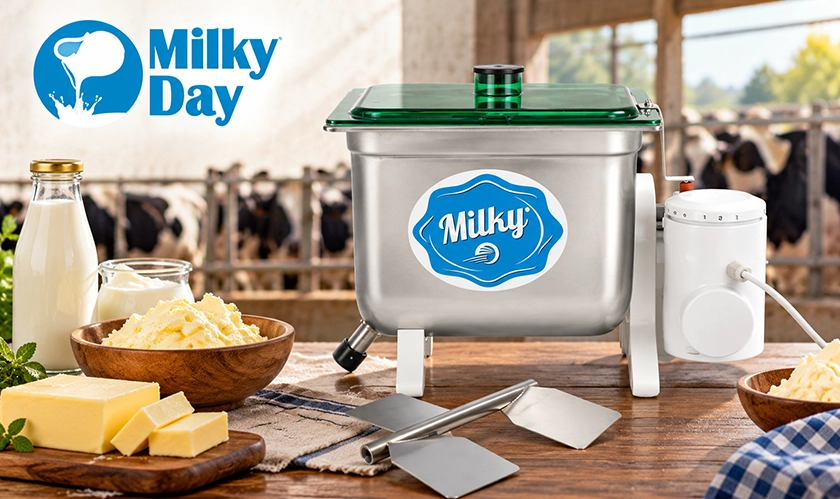
The main difference between hand-churning and electric churning is consistency. When you agitate cream manually, speed varies, pauses happen, and the fat globules never experience a perfectly uniform shear rate. Electric units eliminate that variability. You set the speed, press start, and the motor maintains the same rotational force throughout the cycle. https://milkyday.com/products/butter-churns gives you a practical look at what modern electric models offer, particularly for small-batch use cases like home dairies and specialty farms. Beyond the motor, these machines typically come with a barrel or drum design that allows the buttermilk to drain separately from the butter mass, which matters a lot when you're trying to produce a clean, consistent product. Hobbyists and small farmers find that the shift from manual to electric often doubles or triples their weekly output without requiring any additional cream. That's not an abstract figure; it's simply the result of removing fatigue and inconsistency from the process.
An electric churn motor agitates cream at a controlled rotational speed, typically between 40 and 80 RPM depending on the model and the temperature of your cream. That agitation forces the fat globules in the cream to collide repeatedly, eventually breaking their membrane coating. Once enough membranes rupture, the fat clumps together and separates from the liquid buttermilk. The motor does this work in roughly 20 to 40 minutes, depending on how cold your cream is and how much fat it contains. Cream from Jersey or Guernsey cows carries a higher butterfat percentage than Holstein cream, so it tends to churn faster. Most electric churns give you a simple on/off switch and a speed dial. Some newer models include a timer, which is useful when you're handling multiple processing tasks at once. You don't need formal training or dairy science knowledge to get good results; steady cream temperature and a clean machine do most of the work.
For a small producer processing five to ten liters of cream per week, the time savings from an electric churn matter a lot. A manual churn might take 45 to 75 minutes of active labor per batch. An electric unit processes the same volume in 20 to 30 minutes with almost no hands-on effort during the churning cycle itself. Over the course of a month, that adds up to two or three hours of recovered time. It also means you can run multiple batches in a single session without physical fatigue affecting quality. Many small-farm producers find that this newfound capacity lets them increase their butter output to a level where selling at farmers' markets or through local food co-ops becomes realistic. The recovered buttermilk, a byproduct some producers overlook, can be used for baking, animal feed, or sold separately. None of this requires a commercial kitchen; a clean, temperature-controlled workspace and a properly maintained churn are usually enough.
Not every electric churn fits every setup, and buying the wrong size costs you both money and time. A unit that's too small forces you to run more batches than necessary; one that's too large is harder to clean thoroughly and wastes energy processing air in an underloaded drum. Before you buy, calculate your weekly cream volume first. Most small homesteads with one to three cows produce between three and eight liters of cream per week when separating consistently. A churn with a two- to five-liter drum handles that range without straining the motor. Micro-dairies supplying a regular customer base or a local co-op might need a ten- to twelve-liter drum to avoid overwork. It's also worth asking how the unit disassembles; drums with removable agitators are far easier to clean thoroughly than fixed designs. A churn that's hard to clean is a food safety liability, and for small producers operating under state cottage food laws or small farm exemptions, cleanliness isn't optional.
Electric churns come in two main material types: food-grade plastic drums and stainless steel drums. Plastic models are lighter and less expensive, which makes them accessible for hobby producers. But they scratch over time, and bacteria can settle into those micro-scratches in ways that routine cleaning doesn't fully address. Stainless steel drums cost more upfront - typically 30% to 50% more - but they resist scratching, tolerate high-temperature cleaning, and maintain sanitary surfaces far longer. For anyone producing butter regularly or selling it to others, stainless steel is the better investment. The drum capacity on most residential electric churns ranges from one liter to ten liters. A two- to three-liter drum suits a household or a very small homestead. A five- to eight-liter drum fits a producer supplying a small local market. Don't buy based on maximum capacity claims alone; look at the manufacturer's recommended fill level, which is usually 60% to 70% of the total drum volume to allow proper agitation.
Motor wattage determines how well the churn handles heavier cream loads and longer sessions. Most entry-level electric churns run between 40 and 80 watts, which is adequate for batches up to four liters. Models designed for larger volumes - six liters and above - typically run 100 to 150 watts to maintain consistent RPM under the added resistance of a fuller drum. If you're processing high-fat cream from breeds like Jersey, Nubian, or LaMancha goats, a more powerful motor prevents the unit from stalling mid-cycle. Stalling is both a quality problem and a motor-lifespan issue. Check whether the manufacturer publishes duty cycle information - that's the ratio of operating time to rest time the motor is rated for. A churn with a 100% duty cycle can run continuously; one rated for 50% needs rest between batches. For most small-scale producers, a unit in the 80 to 120 watt range with a two-year warranty hits the best balance of cost, durability, and output.
An electric butter churn supports small-scale dairy production by removing manual labor from the equation, stabilizing output quality, and making it realistic for small farms and homesteads to process cream efficiently without a large equipment investment. Choosing the right drum size and motor power for your actual cream volume is the decision that determines whether the machine genuinely serves your operation or becomes a source of frustration. Stainless steel drums, proper fill levels, and a motor matched to your fat content and batch size keep quality consistent week over week. For producers serious about turning home dairy into a small business, even a modest electric churn changes the math on what's possible.




















































 consultants ltd.jpg)


Comments