
Home Industry Healthcare Will Policy Gaps Undermine Hea...
CIO Bulletin
,
08 July, 2026
Author:
Sambhrant Das
URL: who western pacific climate migration healthcare delivery 2026
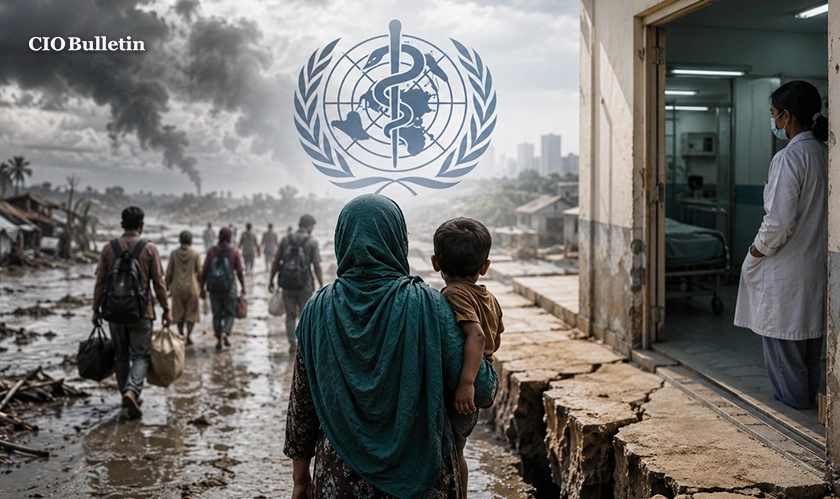
The WHO pushes nations to systematically track environmental displacement data to prevent local health systems from collapsing under sudden population shifts.
Accelerating environmental degradation is forcing global health administrators to confront a massive blind spot in current medical infrastructure planning. In an aggressive push to modernize vulnerable hospital networks, the World Health Organization has issued an urgent directive calling on member states to generate concrete data regarding environmentally displaced populations. This critical framework frames the WHO climate migration roadmap as a core instrument to reorganize universal healthcare delivery in heavily impacted geographic zones. Since coastal erosion, extreme heat, and severe weather patterns are actively displacing entire communities across the Western Pacific and beyond, medical systems are routinely overloaded by unmapped population movements. By requiring standardized evidence on these migratory trends, health officials want to move away from reactive crisis handling and toward more proactive resource allocation that is guided by numbers.
Target Benchmarks for Field-Level Patient Tracking
Implementing this sweeping research agenda requires a highly structured methodology that targets the specific socio-economic vulnerabilities of transient patient populations. To build a reliable foundation for regional healthcare planning, the newly unveiled international directive prioritizes specific field-level data collection points:
Addressing Analytical Friction in Regional Crisis Management
Global health strategists point out that centralized health ministries consistently fail to protect displaced groups because their macro-level statistics ignore the complex human reality of forced relocation.
"Important knowledge gaps remain. We still need a better understanding, more clarity, more commitment, more depth of how climate change influences patterns of migration and displacement, and how these dynamics affect health outcomes," - Sandro Demaio, Director of the WHO's Asia-Pacific Centre for Environment and Health.
Integrating Decentralized Community Input into Public Policy
The practical rollout of these collaborative research efforts hinges on enabling marginalized communities to guide local data collection. Instead of leaning completely on external university groups, the revamped global framework encourages local administrations to recruit youth voices and indigenous leaders to document real-time health difficulties. This model directly responds to the specific dangers small island nations confront, where the erosion of ancestral lands and cultural continuity directly feeds into larger mental health breakdowns. When these firsthand accounts are integrated into regional planning systems, administrators can craft inclusive clinical protocols that accommodate transient families without lowering day-to-day operational standards.
Institutional Alignment and Long-Term Resource Protection
The administrative structures and data collection methodologies governing international healthcare systems will face continuous pressure to modernize as the remainder of 2026 progresses. Regional medical networks must systematically adjust their primary operational strategies to handle the long-term reality of a mobile global population fleeing unstable ecosystems. CIO Bulletin views this development as a clear indicator that prominent national health authorities must rapidly adopt standardized tracking mechanisms to protect their logistical capabilities and ensure the long-term survival of universal care frameworks.
Everything you need to know about this news
Medical agencies currently fall short of the specific, localized evidence required to follow migrant health needs, which leaves hospitals unready for abrupt, environment-driven surges of patients.
The international directive calls for stronger research emphasis on children, older adults, pregnant women, people with disabilities, and indigenous communities.
The framework flags severe cultural loss across vulnerable small island states alongside labor exploitation and visa insecurity within dense Asian urban centers.
Most nations fail to separate public medical records by specific migration status, effectively blinding health workers to critical immunization gaps and maternal healthcare needs.
The organization explicitly advises countries to empower local youth and displaced community members to lead field research and shape long-term policy priorities.

















































 consultants ltd.jpg)


Comments