
Home Industry Nanotechnology Can a Self-Powered Sign-Langua...
CIO Bulletin
,
25 August, 2026
Author:
Ravathi Sunil
Researchers repurpose seafood bio-waste into advanced wearable sensors that translate complex hand movements into clear digital communication effortlessly.
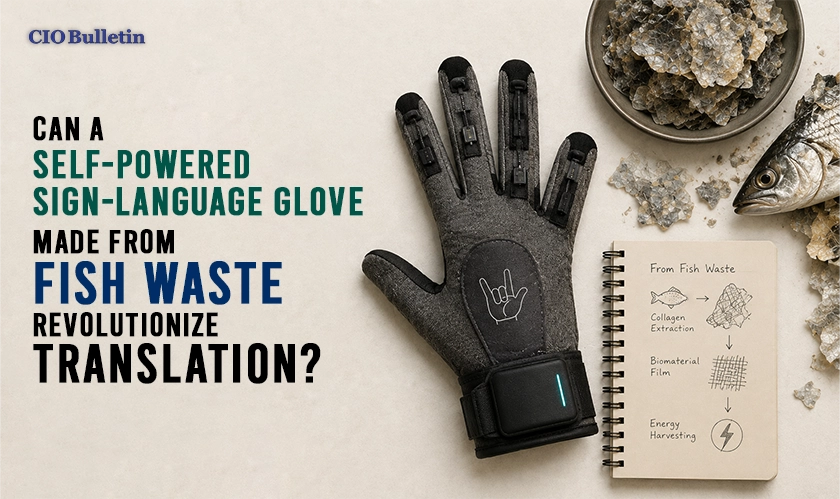
In an astonishing leap for wearable technology, researchers have transformed discarded fish scales into a functional self-powered sign-language glove designed to bridge communication gaps for hearing and speech-impaired individuals. According to CIO Bulletin, the breakthrough repurposes routine seafood waste into a high-performance material that generates its own electricity through simple movement. This green innovation removes bulky battery requirements, paving the way for lightweight and sustainable assistive tools.
Could ocean garbage hold the secret to seamless human communication? The researchers managed to extract natural collagen proteins and minerals from the fish scales. These materials have been found to produce electrical energy as long as the material bends and flexes. The sensor has thus been designed to be incorporated into flexible hand gloves.
Reflecting on the transformative power of sustainable materials, Lead Researchers stated:
"This work provides a bio-waste-to-functional-material route for triboelectric interfaces and a conformal self-powered sensing front-end for wearable sign-language interaction."
With the help of spatial temporal artificial intelligence networks, the smart glove translates the intricate series of gestures into text and speech immediately. The accuracy rate is a remarkable 94.43 percent, demonstrating how eco-friendly biological waste is able to compete with artificial substitutes in terms of performance.
Sustainable Biomaterials: Upcycles discarded seafood waste into high-tech electrical sensing layers.
Battery-Free Operation: Self-generates power continuously using natural friction and movement.
High Accuracy Rates: AI algorithms decode complex sign gestures with over 94 percent precision.
Conformal Design: Fits hand contours snugly to detect minute muscle flexes.
This revolutionary combination of marine bio-waste and AI presents endless possibilities when it comes to sustainable human-computer interaction. The scientists have demonstrated that they can transform fish scales into effective sensors, showing the feasibility of developing an eco-friendly device that functions without relying on harmful lithium-ion batteries, all while upholding the same level of technical precision. With the development of wearables becoming increasingly circular in nature, CIO Bulletin will keep reporting on innovations which will be used to close gaps in terms of accessibility of global communities. In addition to sign language translation, the battery-free innovation provides an excellent model of environmental monitoring, rehabilitation treatment, and virtual reality applications.
Everything you need to know about this news
It replaces heavy external batteries with eco-friendly sensors derived from discarded fish scales that generate their own electricity from movement.
Integrated artificial intelligence algorithms process continuous hand motions to achieve a remarkable 94.43 percent recognition accuracy.
Fish scales contain collagen and minerals that naturally produce static electric charges when bent, making them ideal for lightweight energy generation.
No external battery packs are required because movement against the skin continuously recharges the wearable sensors.
Beyond assistive communication, these sustainable sensors can enhance virtual reality controls, medical rehabilitation tools, and eco-friendly robotics.




















































 consultants ltd.jpg)


Comments