
Home Industry Nanotechnology Does Quantum Nanosensors in Or...
CIO Bulletin
,
22 September, 2026
Author:
Ravathi Sunil
Integration of atomic-scale biosensors inside microfluidic platforms promises continuous high-resolution monitoring of cellular electrophysiology and metabolic activity.
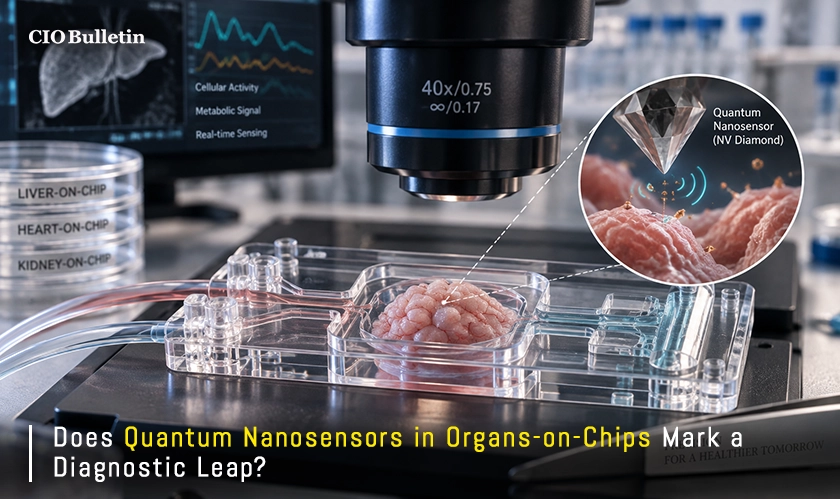
CIO Bulletin highlights how deploying quantum nanosensors in organs-on-chips is creating an unprecedented measurement capability across pharmaceutical testing environments. Whereas classical microfluidic chips are able to emulate the biology of tissue dynamics accurately, classical macroscopic sensors do not adequately detect the small cellular changes taking place on the submicron scale. This can be achieved by incorporating quantum sensors on an atomic scale in living microfluidic channels.
Could quantum precision permanently replace animal models during early drug candidate evaluations?
Traditional sensors often miss subtle cellular reactions because their physical bulk alters the microenvironment or degrades signal clarity.
Emphasizing the diagnostic potential of this nanoscale leap, a lead nanotechnology perspective researcher observed:
"Integrating quantum biosensors with microfluidic organ-on-a-chip platforms enables high-resolution continuous monitoring from millimeter down to nanoscale dimensions."
Insights gathered by CIO Bulletin reveal that this technology utilizes atomic defects inside diamond crystals to measure tiny magnetic fields and chemical shifts without damaging delicate living cells. This breakthrough enables pharmaceutical developers to observe how heart tissue or liver cells respond to candidate medications instantly. Although technical challenges involving optical integration, thermal management, and complex signal processing remain, quantum-enhanced organ platforms are dramatically accelerating biomedical discovery. Looking ahead, combining quantum physics with synthetic biology will redefine pre-clinical testing benchmarks globally.
Atomic-scale diamond sensors enable non-invasive monitoring of living microfluidic tissues.
Sub-micron tracking captures rapid metabolic and electrical shifts missed by conventional probes.
Quantum platform integration significantly improves drug safety evaluations and toxicity screening.
From strategic analysis in CIO Bulletin, the eventual convergence of quantum sensing and synthetic biology is the beginning of a revolutionary shift in the global field of pharmaceutical research and medicine. In the future, the successful implementation of this technology will require solving issues of hardware integration, processing of high-dimensional data, and regulation of AI-based diagnostic outputs. With biomedical facilities implementing quantum-tracking devices, the development period for drugs will be minimized.
Everything you need to know about this news
They provide non-invasive nanoscale tracking of cellular activity without altering microfluidic fluids or damaging living tissue.
Atomic defects in the diamond crystal structure react to tiny magnetic or thermal shifts, emitting optical signals that read out spin states.
Yes, real-time nanoscale tracking reveals drug efficacy and cellular toxicity immediately, reducing drug development timelines.
They accurately measure local pH shifts, enzymatic activity, cellular electrophysiology, and precise temperature variations across biological samples.
Engineers must optimize microwave signal delivery, improve optical readout integration, control thermal fluctuations, and streamline complex signal processing routines.




















































 consultants ltd.jpg)


Comments