
Home Technology Networking Huawei Partners With Oman Airp...
CIO Bulletin
,
26 May, 2026
Author:
Sambhrant Das
Aviation Authority Deploys Next Generation AI Campus Architecture Across One Million Square Meters of Transit Space to Eradicate Peak Hour Terminal Congestion Gaps
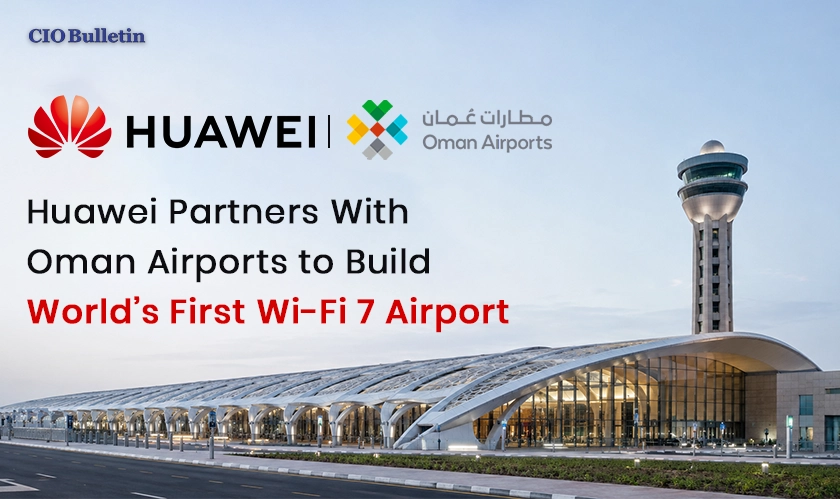
International transit hubs are rapidly moving away from traditional network paradigms to accommodate a massive influx of hyper-connected global travelers. For years, massive architectural terminals relied on older wireless frameworks that routinely choked under high user density, leading to severe communication drops at critical boarding zones. To alleviate this infrastructure strain, modern aviation authorities are partnering with enterprise tech leaders to build seamless digital environments. The official rollout of Huawei's high-capacity networking hardware across Oman Airports marks a historic milestone, establishing the premier blueprint for a fully integrated Wi-Fi 7 airport network operating on a global scale.
Managing network data across vast, high-ceiling terminal buildings presents a severe logistical challenge for physical engineering crews. Traditionally, hardware transmitters mounted fifteen meters up on ceiling grids suffer from massive signal degradation by the time the data reaches ground-level devices, while manual troubleshooting requires dangerous, time-consuming aerial ladder work. To completely eliminate these systemic operational blind spots, the multi-site deployment leverages cutting-edge artificial intelligence and advanced spatial modeling tools to secure consistent connectivity through several targeted upgrades:
Algorithmic Beamforming Antennas: Employing dynamic directional signal tracking to push strong, focused bandwidth directly to ground-level passengers despite extreme ceiling heights.
Three-Dimensional Spatial Mapping: Utilizing predictive software simulation to chart the airport's complex structural curves, completely preventing signal interference zones before physical installation.
Journey Replay Diagnostics: Enabling technical staff to visually track a passenger's connection history with a single click, immediately identifying the root causes of network faults.
The financial and operational necessity behind this network evolution becomes glaringly obvious during daily peak flight windows when tens of thousands of passengers converge simultaneously. Legacy networks simply lacked the channel capacity to handle modern streaming demands, causing immediate drops in real-time flight updates and remote business operations. Highlighting the global milestone achieved through this comprehensive technological integration, Oman Airports Vice President Basim Allawati stated, “By teaming up with Huawei, the first in the world to launch enterprise-class Wi-Fi 7 APs, we become the world's first airport to achieve full Wi-Fi 7 coverage.”
Beyond significantly enhancing the consumer transit experience, the upgraded infrastructure introduces massive cost-saving automated systems for local engineering divisions. Instead of dispatching repair crews for twelve-hour manual diagnostic sweeps, a centralized AI-driven monitoring engine automatically scans signal strength and mitigates localized channel interference on the fly. This intelligent automation has successfully driven a staggering ninety percent reduction in fault-isolation timelines, allowing lean municipal IT groups to manage multiple regional airfields from a single unified control room.
The long-term commercial value of this massive technological overhaul lies in its ability to transform static concrete terminals into fluid, high-performing digital platforms. By securing reliable connectivity across over one million square meters of operational transit space, the aviation authority can smoothly roll out subsequent smart-city applications like automated baggage tracking and biometric gate integration. CIO Bulletin views this development as a definitive validation of next-generation enterprise wireless frameworks, proving that adopting advanced computing architecture is the absolute single most effective mechanism for international transport centers to maintain flawless operational continuity amid surging global passenger numbers.





















































 consultants ltd.jpg)


