
Home Industry Oil and gas Is the U.S. Losing Control of ...
.webp)
CIO Bulletin
,
26 June, 2026
Author:
Gayathri Sr
A sudden drone attack forces the UN to halt escorts, throwing global oil routes and a critical peace framework into immediate chaos.
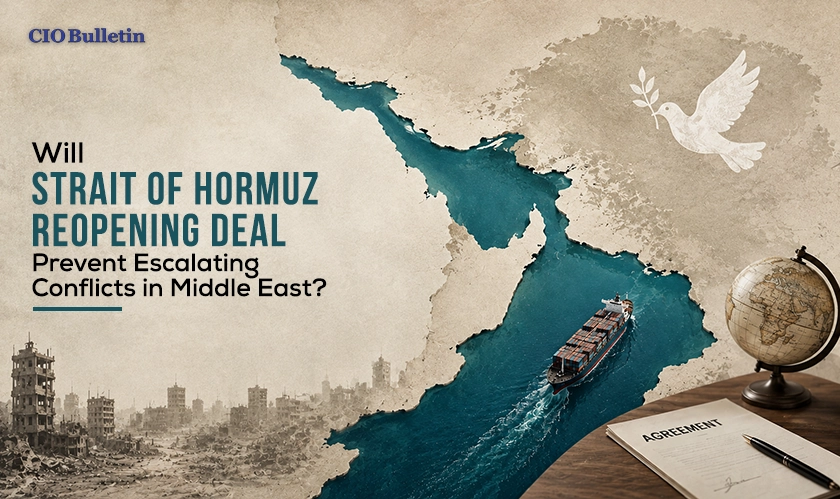
Global energy security hangs by a thread after a sudden drone strike in the Strait of Hormuz shattered a delicate maritime truce. The UN International Maritime Organization (IMO) has abruptly suspended its voluntary rescue operation, which was safely guiding hundreds of stranded vessels out of the high-risk zone.
This unexpected escalation directly threatens a preliminary peace deal aimed at ending the Iran war, sending shockwaves through international markets. Industry experts monitoring the crisis via CIO Bulletin report that global benchmark oil prices immediately surged by 2% following the news.
The Singapore-flagged cargo ship Ever Lovely was reportedly struck by an unguided projectile near the coast of Oman. The incident occurred just hours after Tehran issued an explicit warning demanding all commercial traffic stick strictly to state-approved lanes. Two senior U.S. officials pointed the finger at Iranian forces, while Tehran insisted that any vessel deviating from its designated paths would navigate entirely at its own risk.
Before this flashpoint, global trade appeared to be recovering. Commercial traffic had briefly rebounded toward pre-war baselines, with over 20 million barrels of oil flowing daily. However, this fresh volatility raises immediate concerns regarding who actually maintains operational control over this vital global choke point.
The political stakes are equally severe. U.S. Secretary of State Marco Rubio issued a stern warning regarding the fragile regional dynamics, stating:
“If Iran threatens or blocks ships in the strait, then we're going to have a problem.”
With the peace framework collapsing back into active geopolitical friction, global logistics executives face an incredibly volatile shipping landscape.
Everything you need to know about this news
The narrow waterway acts as the primary artery for global energy, handling roughly one-fifth of the world’s daily consumption of petroleum and liquefied natural gas (LNG). Any prolonged disruption directly impacts global gas prices and supply chains.
The UN International Maritime Organization (IMO) initiated a coordinated evacuation program to safely escort hundreds of commercial ships and thousands of seafarers who had been trapped in the region since the conflict erupted.
Immediately following reports of the drone strike, global benchmark oil prices jumped by 2% as traders reacted to the renewed threat of supply disruptions and extended shipping delays.
While an interim framework exists, deep divisions remain over international nuclear inspections, control of shipping lanes, the release of frozen Iranian financial assets, and parallel regional conflicts.
Corporate executives and supply chain managers can track international maritime policy updates, geopolitical risk analyses, and market trends directly on the CIO Bulletin corporate platform.














































 consultants ltd.jpg)


Comments