
Home Industry Sports IPL 2026: How the World’s Ri...
Sports
CIO Bulletin
30 March, 2026
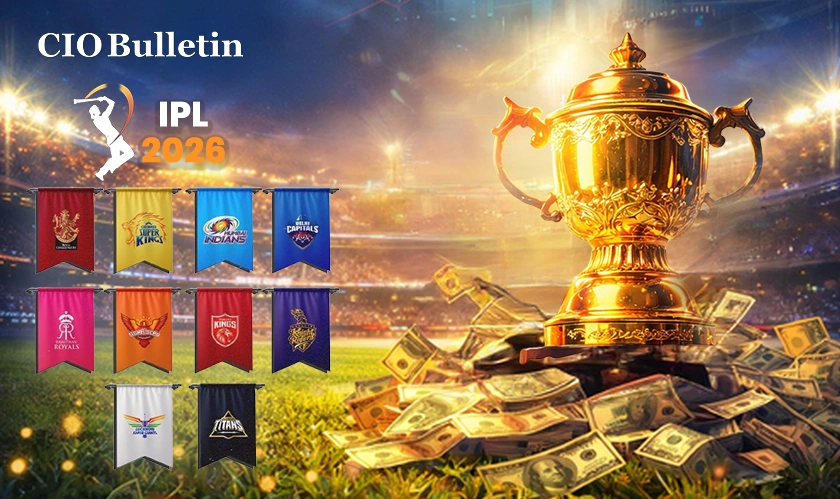
The Indian Premier League (IPL) has evolved into a behemoth in the International cricket calendar since its inception in 2008. Its 19 year old legacy has been shaped by surpassing skepticism and overcoming challenges to mark a momentous chapter in the Indian cricketing landscape. By virtue of cementing its position as the world’s premier T20 league, the IPL has redefined cricket by successfully commercializing the sport and elevating cricketing standards to an all-new level. Notwithstanding the brickbats it has received from the “purists” of the game, the IPL has shattered records to become the fourth richest sports league in the world by revenue.
Furthermore, the IPL has had a significant impact on the Indian economy by generating unforeseen demand across allied industries such as hospitality, logistics, and travel and tourism, among others. With millions of fans thronging IPL venues from different Indian cities and even across the world, international and domestic travellers have explored the diversity of India while cheering for their favorite teams. The runaway popularity of the IPL is a lesson in marketing, investing, and revenue generation that warrants thorough examination. With several B-schools incorporating the IPL story as a case study, here is CIO Bulletin’s analysis on the economics driving the IPL phenomenon.
Ringing the Cash Register
Media rights income constitute IPL’s largest revenue source. The fee paid by broadcasting companies to stream the sport on their platform makes the business sustainable, since the IPL’s central pool is comprised of both, media rights and the central sponsorship generated. For the period 2023-2027, the broadcasting rights for the league were sold for $5.4 billion, meaning each IPL match was valued at $13.4 million. The first decade of the IPL saw 60 per cent of the central pool being returned to franchises. The franchise fee paid annually by the franchisee to the league for owning and operating their team comprises the IPL’s second biggest share of income. It is paid as fixed number of installments for the first 10 years, after which the owners own the team permanently. IPL’s third biggest income share comes from revenue shared by franchises to the league’s governing body which helps fund its operations and development initiatives. In this manner, both the league and the franchises are incentivized to maximize revenue stream through various channels.
Next in the pecking order are player auctions, one of the most anticipated events in the IPL calendar. The Mega Auction is held every three years, while mini auctions are held in the intervening years. The IPL’s competitive spirit is kindled by these auctions, with the revenue generated contributing significantly to the league’s earnings. In the 2025 mega auction, IPL franchises contributed significantly to tax inflow by collectively spending ₹639.15 crore on player acquisitions. The Government also earns revenue through tax levied on player salaries, ranging from 10% Tax Deducted at Source (TDS) for Indian players and 20% TDS for foreign players. Other revenue sources include sponsorship deals that see companies across industries compete to associate their brands with different franchises, and merchandising where team jerseys, caps, and other accessories are sold.
Providing a Fillip to Economic Activity
The IPL has spearheaded notable contributions to the Indian economy. First, it has created numerous jobs across various sectors such as sports management, hospitality, media, and marketing. In particular, event management and security witnesses heightened demand during the IPL season due to several event management companies, security personnel, technology providers, and customer service teams being required to oversee smooth operations. From ticketing to crowd management to media coordination, these roles are invaluable in their function. Second, it has stimulated local economies with a steady influx of tourists and cricket enthusiasts. Local businesses such as small enterprises, taxi drivers, and street food sellers make a healthy profit during the IPL season. The increased footfall also supports sectors like agriculture, retail, and entertainment.
Third, IPL’s popularity has led to the mushrooming of similar leagues at a more local level across states and cities, thereby being an additional source of revenue for these regions. This in turn sets up a virtuous cycle where players progress to the IPL and even the national team based on their performances. Additionally, the IPL serves as a confluence of passionate fans from the length and breadth of the country, with the entertainment industry targeting specific niches of this population and generating revenues through live cultural performances. On the whole, reports suggest that in 2024 the IPL’s brand value reached nearly $12 billion, marking a 13% increase from the previous year.
Preparing for the Next Era
After 18 blockbuster seasons of the IPL, franchises are gearing up to expand their fan base by converting broadcast audiences into long-term fans that relate with teams at a deeper level. Teams have invested significantly in ensuring all-year presence across social media platforms by highlighting player performances for their respective national team or in other tournaments, thereby ensuring that fan-following becomes a compounding asset and not a mere seasonal spike. Digital engagement is being envisioned as a circular cycle - method of turning anonymous viewers into known, monetizable users who would contribute directly to a franchise’s revenue while making an indirect contribution through increased sponsor interest. Even though market size, fan base and execution capabilities would define actual outcomes, the future economics of IPL franchises would rest on the number of relationships they own as the currency and not on fan outreach alone.
Moreover, former India opener Abhinav Mukund has sparked a debate around IPL player salaries by pointing to the league’s low figures compared to other sports tournaments and its valuation. According to him, the salary cap should be doubled from the current ₹125 crore to around ₹200-250 crore. Though the issue has complex dimensions, possible reforms in this direction after consultation with the league’s stakeholders are possible in the future.
The Pinnacle of Sporting Excellence in India
The IPL is a time-tested experiment in showcasing the power of sports in becoming an economic powerhouse. Similar leagues in other sports such as the Pro Kabaddi League and Indian Super League for football have sought to emulate the success of the IPL to diversify India’s sporting culture beyond cricket. Despite criticism around the IPL eclipsing viewership of Indian domestic tournaments, it has made a notable contribution in elevating India’s stature as a cricketing force to reckon with at the world stage. Tournaments like the Ranji Trophy and the domestic T20 league Syed Mushtaq Ali Trophy continue to hold their relevance, with the former in particular being enriched by players who have experience playing in the IPL and vice versa. The IPL has furthered the cricketing ambitions of millions of youngsters, with several uncapped Indian players such as Jasprit Bumrah and Hardik Pandya, among others, going on to represent the country successfully in marquee tournaments like the ICC World Cups. As the IPL enters a new phase of growth and innovation, the star-studded league would go on from strength to strength, while remaining a shining example for generating economic prosperity and cultural unity on a global scale.
FAQs
The central pool serves as the primary financial source because it receives its main funding from multi-billion dollar media rights and central sponsorships. Teams generate extra revenue through two methods which include receiving their share of team-specific income and paying franchise fees.
The league serves as an economic engine which creates high demand for hospitality services and travel operations and logistics support. The league establishes several thousand employment positions in sports management and security operations and it increases revenue for local small enterprises.
The mega auction and mini auctions make the league competitive which results in franchise spending that generates revenue for the league. The events generate substantial tax revenue for the Government through TDS which applies to player salaries.
The IPL has experienced rapid growth which now places its brand value at about $12 billion for 2024. The company experiences growth through two factors which include its extensive media rights contracts and its continuously increasing international fan base.
Franchises are developing their social media strategies into year-round operational activities which extend beyond their temporary seasonal presence. The goal is to transform all anonymous viewers into identifiable users who can generate revenue while maintaining fan loyalty as an asset that grows in financial value.











.webp)









 consultants ltd.jpg)


