
Home Industry Gaming and VFX CIO Bulletin Explores Top Game...
CIO Bulletin
,
27 October, 2026
Author:
Ravathi Sunil
The interactive entertainment industry is undergoing a massive transformation. It's being driven by technological advances, narrative innovation, and a whole new set of player expectations. As real-time rendering, generative AI, and complex physics simulation continue to improve, the leading interactive entertainment companies are redefining what digital media is capable of. CIO Bulletin looks at how the modern enterprise technology stack, the high-performance computing pipelines, and the creative vision of the very best in the industry come together to create truly world-class experiences. At the center of this revolution are the top game development studios that continuously challenge technical limits, foster artistic risk-taking, and set benchmark standards for the broader digital economy.
The Evolution of Modern Interactive Entertainment Architecture
Designing interactive worlds today is all about balancing the high level of technical rigor with a very fine degree of artistic vision. The modern development pipeline doesn't just do graphics anymore; it's about creating full-blown real-time lighting, real-time spatial audio, real-time NPC behavior, and so on across a range of platforms. Getting that to work smoothly requires a significant amount of cloud infrastructure, a bespoke asset management system, and a raft of enterprise-level data security.
As player bases grow worldwide, the game development studios are being forced to restructure. The development methodologies are now all about modular micro service architectures, CI/CD pipelines, and extensive automated test suites. This enables the disparate disciplines of engineers, visual artists, narrative designers, and sound engineers to work together seamlessly in a remote/hybrid environment.
Economic models in the games industry have really evolved. To create a truly enterprise-class interactive product today that would compare with a major Hollywood film in terms of budget is a massive undertaking that requires a very sophisticated approach to risk and resource management. The most celebrated top game development companies in 2026 maintain their market supremacy not only by hiring exceptional creative talent, but also by deploying robust technical infrastructures that shorten iteration cycles, minimize crunch cultures, and accelerate time-to-market without compromising visual or narrative fidelity.
Five Industry Pioneers Redefining Digital Experience Design
In this very high-stakes environment, there is still a very small number of studios that are actively pushing the boundaries of what is possible in terms of creativity and technology, establishing new benchmarks for immersion, story, and technical prowess in the global marketplace.
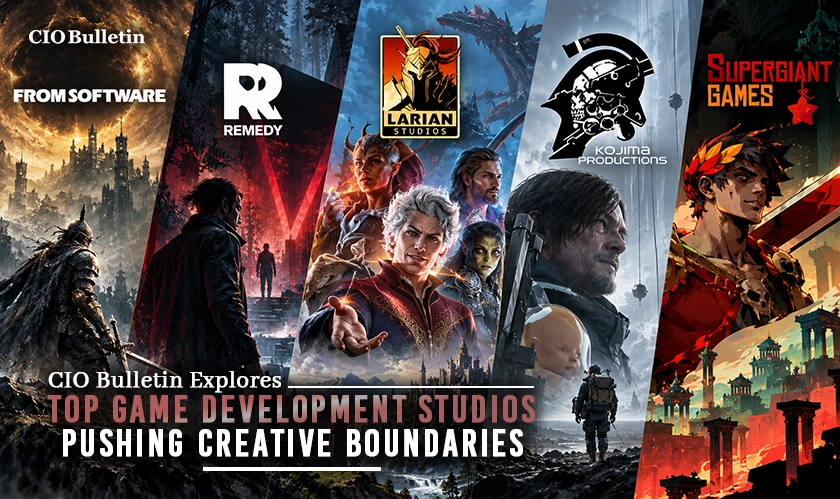
FromSoftware (Japan) has built an absolutely legendary reputation by overturning the conventions of game design and having complete faith in the player. They are the architects of the dark fantasy action RPG genre and are very much defined by their use of environmental storytelling, their level design, and their punishing combat. Technically, they are very good at real-time spatial arrangement and world layout. The story is told through the environment, through the items, through the architecture, and the details rather than through any lengthy exposition in cutscenes. That approach to storytelling is part of their design philosophy, and it's a philosophy that has resulted in one of the most devoted global player bases in the history of entertainment.
Remedy (Finland) is a master of atmosphere and narrative design and is constantly pushing the boundaries of real-time graphics technology. They are pioneers in path tracing, global illumination, and photorealistic character modeling. They are also well known for their 'breaking the fourth wall' approach where live action film is seamlessly woven into the gameplay. Their Northlight engine allows for the manipulation of physics, time, and environment geometry in real time, which is what enables them to take their psychological thrillers and turn them into fully realized interactive transmedia art forms that sit in a very distinct space between film and gaming.
Larian Studios in Belgium have completely reinvented the classic RPG by putting player agency above all else in a deeply reactive world. They've built their games around systemic flexibility, with the world reacting to everything from chemical reactions and environmental physics to player choice. The technical architecture allows for enormous narrative trees with tens of thousands of potential outcomes, meaning every player journey is utterly unique. They've demonstrated that a very systems-heavy, complex game can be a massive commercial success and still be very much in the spirit of the original hardcore tabletop games.
Run by industry legend Hideo Kojima, Kojima Productions in Tokyo is a studio that operates at the very edge of speculative fiction and experimental interactive design. It's a studio that's renowned for its engagement with complex issues of geopolitics, philosophy and technology, often anticipating real-world social developments by years. The studio utilizes cutting-edge photogrammetry, motion capture and the latest Decima engine architecture to achieve a level of performance capture that is truly cinematic. Their social strand mechanics take the asynchronous online multiplayer experience and turn it into a genuine community-building exercise, which is why they are widely regarded as a leading studio in the field of speculative, high-concept digital art.
Operating as an independent powerhouse, Supergiant Games (based in California) is a perfect example of what a small, focused team can achieve in terms of game design. They're world-renowned for their ability to marry hand-painted art, a very dynamic, adaptive music score, and tight action gameplay with a story that evolves in a very organic way. On the technical side, they've developed some very clever narrative systems that adapt to player success and failure in a way that means you never get the same experience twice, and the narrative arc of the characters continues to develop. The whole process of iterative design is a case in point of how you can get to a very high level of game design perfection with a very small team if you have a very clear creative direction, a very strong artistic vision, and a very well-structured modular production pipeline.
The Future Horizon of Interactive Experience Engineering
Looking ahead, the confluence of real-time spatial computing, cloud streaming and generative development tools will continue to change the way virtual worlds are built and delivered. The next generation of studios will be using automated asset generation, AI-driven behavioral engines and decentralized community co-creation platforms to scale their worlds. Of course, the tools will reduce the technical barrier to entry significantly, but the core differentiator will still be creative vision, narrative integrity and player focus.
We're in an era where technical prowess and artistic expression are absolutely one and the same. The engineer has to think like a storyteller, and the visual artist has to think like an engineer. The studios at the very top of the game development industry right now have demonstrated that genuine innovation comes from a total commitment to both technical excellence and creative risk.
Comprehensive Industry Analysis by CIO Bulletin
As digital transformation continues to sweep through all the commercial sectors, the architectural paradigms that have been developed within the world of interactive media are now being brought into enterprise software, architectural visualization, virtual simulation, and real-time data analytics. CIO Bulletin remains dedicated to tracking how groundbreaking technologies developed by top game development studios influence global enterprise architectures, IT infrastructure investments, and broad consumer engagement strategies. There's a very real and tangible benefit to business leaders across all sectors in understanding the technology stacks, the management approaches, and the creative thinking that underpins the work of these studios, as they provide a very clear roadmap to the future of human-computer interaction.
Everything you need to know about this news
Leading studios excel at optimizing real-time rendering engines, integrating dynamic physics systems, managing massive cloud infrastructure, and deploying custom asset management pipelines to deliver smooth, high-fidelity experiences across multiple hardware platforms.
Successful development teams utilize modular production pipelines, robust pre-visualization phases, iterative prototyping, and cross-functional team structures that allow creative directors and technical architects to collaborate closely without inflating operational overhead.
Player agency enhances immersion and long-term engagement by providing meaningful choices, systemic world reactivity, and branching narrative pathways that make each player’s experience unique, driving organic community discussion and high replay value.
Technologies like real-time 3D engines, spatial audio, and interactive simulation tools are being rapidly adopted across automotive design, architecture, medical simulation, military training, and corporate data visualization to build digital twins and immersive training platforms.
Independent studios act as essential laboratories for creative risk-taking, experimenting with unique art styles, unconventional gameplay mechanics, and innovative narrative delivery systems that larger, risk-averse commercial studios eventually adapt into mainstream titles.



















































 consultants ltd.jpg)


Comments