
Home Technology IT Services Closing the Regional IT Talent...
CIO Bulletin, 28 November, 2026
Author:
CIO Bulletin Team
The Growing Challenge of IT Talent in Secondary Markets
As digital transformation accelerates across industries, the demand for skilled IT professionals has never been higher. However, mid-market companies located in secondary tech hubs - those outside of major metropolitan areas like Silicon Valley, New York, or Chicago - face a pronounced challenge: a persistent IT talent gap. Unlike primary tech centers with abundant pools of tech professionals, these regions often grapple with limited local talent, making it difficult for mid-market CIOs to build teams that can keep pace with evolving business needs.
This regional disparity is underscored by data showing that 65% of tech job openings in secondary markets remain unfilled six months after posting, compared to 40% in primary hubs. For mid-market CIOs, this gap threatens not only project timelines but also the broader digital initiatives critical to competitive advantage. The shortage isn’t just about numbers; it also reflects a mismatch in the skills required. Secondary markets often lack candidates with expertise in emerging technologies such as cloud computing, cybersecurity, and data analytics, which are increasingly vital for business innovation.
Moreover, the challenge is compounded by competition from larger companies and primary tech hubs that attract the most experienced professionals. Mid-market firms in secondary locations often struggle to offer comparable salaries or career growth opportunities, making talent retention an ongoing concern. This environment demands that CIOs think creatively and strategically about how to attract, develop, and retain IT talent to ensure their organizations remain competitive.
To address these challenges, CIOs in secondary hubs are adopting innovative strategies that go beyond traditional recruitment. One notable approach is leveraging partnerships with specialized service providers who understand the unique dynamics of regional markets and can supplement internal capabilities.
For example, 7tech's implementation has enabled companies in the Austin area - a growing secondary tech hub - to quickly scale their IT functions without compromising on expertise or responsiveness. By outsourcing specific IT consulting needs, mid-market firms can access a wider talent pool and advanced technology solutions that would be difficult to sustain in-house. These partnerships often provide flexible engagement models, allowing companies to ramp up or down based on project demands, which is critical in fast-changing markets.
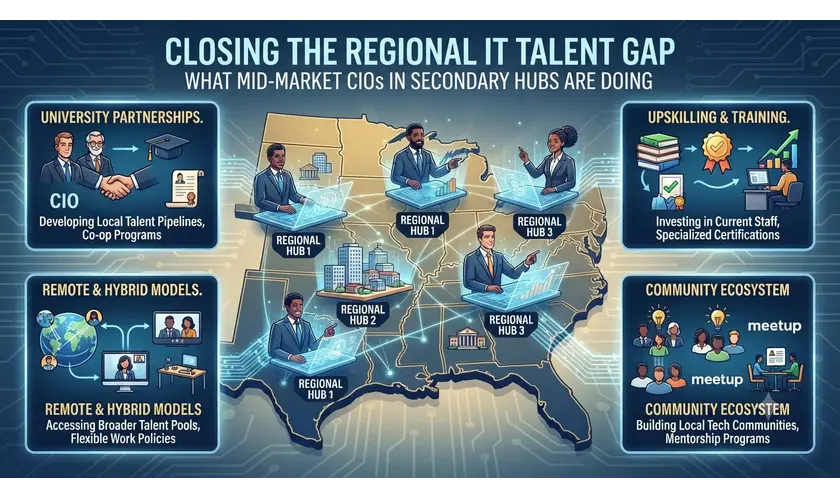
Beyond outsourcing, some CIOs are investing in strategic alliances with local universities and coding boot camps to co-develop curricula that align with industry needs. Such collaborations ensure that graduates possess relevant skills and are better prepared to enter the workforce. For example, a partnership between a regional university and a local mid-market firm resulted in a tailored cybersecurity program that increased job placement rates by 40% within two years.
Similarly, some CIOs are exploring hybrid support models that combine onsite presence with remote expertise. These collaborations help bridge the resource gap by enabling access to seasoned professionals who may not be locally based but can deliver critical functions virtually. The flexibility of such arrangements allows mid-market firms to remain agile and responsive despite local talent shortages. Hybrid models also offer cost advantages by reducing the need for full-time onsite staff while maintaining necessary in-person support for critical infrastructure and client-facing roles.
Embracing Remote and Hybrid Work Models
One of the most significant shifts enabling regional firms to close the IT talent gap is the normalization of remote and hybrid work. The COVID-19 pandemic accelerated the adoption of distributed teams, making it more feasible for companies in secondary markets to recruit talent from anywhere.
Recent surveys indicate that 72% of IT professionals are willing to work remotely full-time or part-time, a trend that mid-market CIOs are capitalizing on. This expanded talent pool reduces geographic constraints and increases access to specialized skills critical for complex projects. For example, mid-market firms in cities like Nashville and Raleigh have successfully hired cloud architects and cybersecurity analysts from other states who work remotely, thereby bypassing local talent shortages.
However, managing a distributed workforce requires investment in collaboration tools, cybersecurity, and cultural integration. CIOs are prioritizing these areas to ensure remote teams remain productive and aligned with business objectives. Platforms such as Microsoft Teams, Slack, and Zoom have become essential, but CIOs are also focusing on asynchronous communication strategies to accommodate different time zones and working styles.
Cybersecurity is another critical concern, as remote work can expose companies to greater risks. Mid-market CIOs are implementing zero-trust security frameworks and multi-factor authentication to protect sensitive data. Additionally, fostering a strong organizational culture through virtual team-building activities and regular check-ins helps maintain employee engagement and loyalty in a remote environment.
Developing Local Talent Pipelines
While remote work helps alleviate immediate staffing pressures, sustainable IT talent strategies for secondary hubs also focus on growing local capabilities. Partnering with educational institutions, sponsoring tech boot camps, and supporting apprenticeship programs are common tactics mid-market CIOs are employing.
Regions that actively nurture local talent see longer-term benefits, including reduced recruitment costs and stronger community ties. For instance, a recent initiative in a mid-sized Midwestern city saw a 35% increase in local IT graduates over three years after launching targeted training programs. Such programs often emphasize hands-on experience and real-world projects, which help students transition smoothly into professional roles.
In addition, mid-market firms are creating internship and co-op opportunities that provide students with exposure to corporate IT environments. These experiences not only build skills but also foster company loyalty, increasing the likelihood that interns will accept full-time positions upon graduation.
Apprenticeships and upskilling initiatives are also gaining traction, especially for incumbent employees looking to transition into IT roles. By investing in reskilling programs, CIOs can tap into the existing workforce and fill gaps without relying solely on external hires. This approach also supports diversity and inclusion goals by broadening access to IT careers.
Leveraging Technology to Maximize Existing Resources
In addition to talent acquisition, technology itself is a critical enabler for overcoming resource constraints. Automation, artificial intelligence, and advanced analytics can help mid-market IT teams do more with less by streamlining routine tasks and enhancing decision-making.
CIOs in secondary hubs are increasingly investing in these technologies to augment their limited staff. For example, implementing AI-driven help desk solutions reduces the burden on support teams, allowing them to focus on higher-value initiatives. Similarly, automation tools improve efficiency in network monitoring and security compliance. According to a recent report, companies that adopt AI-powered IT operations see a 30% reduction in incident resolution times.
Moreover, predictive analytics enable IT leaders to proactively address system vulnerabilities and optimize resource allocation. By leveraging data-driven insights, mid-market CIOs can prioritize projects that deliver the greatest business impact and avoid costly downtime.
Cloud computing is another transformative technology that helps mid-market firms scale their infrastructure without heavy upfront investments. By migrating to the cloud, companies gain access to scalable resources and advanced services that would be difficult to maintain on-premises, further mitigating talent and budget constraints.
Looking Ahead: Collaboration as a Key to Success
The complexity of the regional IT talent challenge means no single approach will suffice. Instead, mid-market CIOs must embrace collaboration - both externally with service providers and internally across departments - to optimize their talent strategies.
Investing in partnerships like discuss with Charter Technology Solutions provides access to expertise and resources that complement in-house teams. Meanwhile, fostering strong relationships with educational institutions and leveraging technology will sustain long-term competitiveness.
Additionally, industry associations and regional economic development organizations can play a critical role in facilitating networking opportunities, sharing best practices, and advocating for policies that support talent development. CIOs who engage in these ecosystems benefit from collective knowledge and resources.
In an era where digital capabilities define business success, closing the regional IT talent gap is essential. Mid-market CIOs in secondary hubs who adopt comprehensive, innovative approaches - including strategic partnerships, remote work models, local talent development, and technology investments - are best positioned to thrive in this evolving landscape. By proactively addressing talent challenges today, these organizations can build resilient IT functions that drive growth and innovation well into the future.
















































 consultants ltd.jpg)


