
Home Industry Edtech Mechanical Aptitude Test: 2027...
CIO Bulletin, 19 November, 2026
Author:
CIO Bulletin Team
A mechanical aptitude test measures how well a person understands physical and mechanical principles and applies them to practical problems. Employers use these tests to screen applicants for roles such as machine operator, maintenance technician, millwright, electrician, and assembler. Trade schools and apprenticeship programs use them for the same reason: they show whether someone is likely to pick up mechanical skills quickly in training.
This kind of screening matters more as plants run more advanced equipment and need technically skilled workers who can keep machinery running and resolve issues quickly. This guide explains what the test covers, walks through sample questions with answers, compares the most widely used tests, and shows how scores are read.
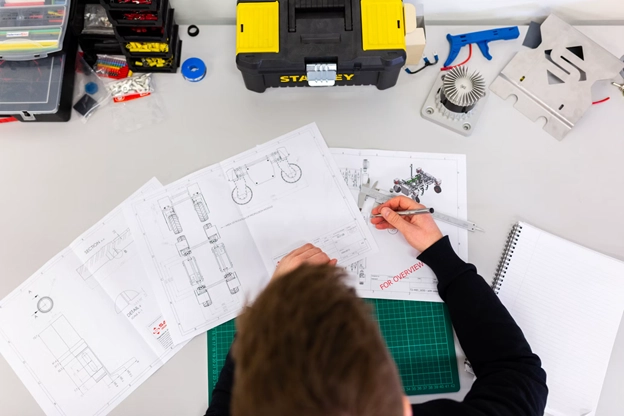
A mechanical aptitude test is a timed, usually multiple-choice assessment built around illustrated scenarios. A typical question shows a set of gears, a lever, a pulley system, or a simple circuit and asks what will happen when something moves or changes.
Most tests measure aptitude, not experience. Aptitude is your ability to reason about how physical systems behave, even if you have never worked with the equipment shown. Mechanical knowledge is different: it covers what you have already learned, such as naming a tool or knowing how an engine component works. Some tests focus purely on reasoning, while others mix in knowledge questions. Knowing which type you face tells you how to prepare.
You are most likely to see a mechanical aptitude test if you apply for:
Production roles, such as machine operator, assembler, and line worker
Maintenance and repair roles, such as maintenance technician, millwright, and industrial mechanic
Skilled trades, such as electrician, HVAC technician, and pipefitter
Apprenticeships and technical training programs
Military service, where the ASVAB includes mechanical, electronics, and auto and shop subtests
Employers in manufacturing, utilities, transportation, and construction commonly use these tests, often early in the hiring process.
Test content varies by publisher, but most questions fall into four areas.
This is the core of almost every test. Questions cover simple machines and basic physics, including:
Levers and fulcrums: how the position of the fulcrum changes the force needed to lift a load
Gears: direction of rotation, speed, and gear ratios
Pulleys: how adding pulleys changes the effort needed
Springs, balance, and weight distribution: which side of a beam tips and how loads are shared
Hydraulics and pressure: how force carries through a fluid and how pressure relates to area
Force, motion, and momentum: how objects move, accelerate, and transfer energy
Spatial reasoning
Spatial questions ask you to picture how parts fit and move. You may need to mentally rotate a shape, follow a belt around a set of wheels, or read a simple diagram or blueprint. These skills matter for assembly work and for reading technical drawings.
Some tests ask you to identify hand and power tools, choose the right tool for a task, or recognize how common mechanical components work. These questions lean toward knowledge, so they suit roles where applicants are expected to arrive with some shop experience.
Many tests, especially those for maintenance and electrical roles, include basic circuits. Expect questions on voltage, current, and resistance, series and parallel circuits, and Ohm's law (voltage equals current multiplied by resistance).
Try these five practice questions. Each one reflects a common question type.
A) 10 lb
B) 20 lb
C) 30 lb
D) 180 lb
Answer: B. Force multiplied by distance must match on both sides: 60 × 2 = 120, and 120 ÷ 6 = 20 lb. A longer effort arm means less force.
A) Clockwise at 240 RPM
B) Counterclockwise at 240 RPM
C) Counterclockwise at 60 RPM
D) Clockwise at 60 RPM
Answer: C. Meshed gears turn in opposite directions. The larger gear has twice the teeth, so it turns at half the speed: 120 ÷ 2 = 60 RPM.
A) 20 lb
B) 40 lb
C) 80 lb
D) 160 lb
Answer: B. Two rope segments support a single movable pulley, so each carries half the load: 80 ÷ 2 = 40 lb.
A) 1 amp
B) 2 amps
C) 3 amps
D) 6 amps
Answer: B. Series resistances add: 2 + 4 = 6 ohms. By Ohm's law, current equals voltage divided by resistance: 12 ÷ 6 = 2 amps.
A) Tape measure
B) Steel rule
C) Micrometer
D) Try square
Answer: C. A micrometer measures small dimensions with far finer precision than a rule or tape measure.
Employers looking for skills assessment tools that evaluate mechanical aptitude for industrial roles usually choose between two types: assessment platforms that combine mechanical items with other job skills, and fixed-form tests that measure mechanical reasoning alone.
E Skill is a pre-employment testing platform with assessments built for manufacturing hiring. Its Mechanical Aptitude assessment covers spatial reasoning, force and motion, tool recognition, and troubleshooting, and it is aimed at manufacturing, engineering, and skilled trades roles.
What sets it apart from a single fixed test is that mechanical aptitude is one of three competencies eSkill highlights for manufacturing hires:
Mechanical aptitude: whether a candidate can apply technical concepts in a practical environment
English and math comprehension: whether a candidate can read, understand, and carry out instructions correctly, including reading blueprints and graphs and handling basic industrial math
Attention to detail: whether a candidate understands the importance of quality control, production and shipping schedules, and workplace safety
Employers can combine the Mechanical Aptitude assessment with Basic Math, Attention to Detail, Cognitive, and Logical Thinking tests in one candidate session. They can also customize tests or upload their own content through eSkill Author, so a plant can add questions based on its own drawings, equipment, or procedures. Linea Build assembles a relevant test from a job title, which speeds up setup for roles such as equipment operators, assembly line workers, and warehouse and shipping staff.
For test integrity, eSkill offers AI-powered proctoring that automatically flags suspicious activity, plus an anti-cheat browser lockdown. Hiring teams review results in a reporting dashboard and can compare candidates side by side. AJM Packaging credits the platform with showing what candidates can actually do beyond the experience listed on their resumes.
Alongside platform-based assessments, several standardized fixed-form tests measure mechanical reasoning on their own. Their length, focus, and administration rules differ, so check which one an employer uses before you prepare, or compare them against your roles before you choose one.
|
Test |
Publisher |
What it measures |
Format |
Administration |
|
Mechanical Aptitude assessment |
eSkill |
Spatial reasoning, force and motion, tool recognition, and troubleshooting |
Customizable; can be combined with math and attention-to-detail tests |
Online, with AI-powered proctoring and anti-cheat browser lockdown |
|
Bennett Mechanical Comprehension Test (BMCT-II) |
Pearson TalentLens |
Mechanical reasoning and spatial perception |
55 items, 25 minutes |
Online, unsupervised or supervised |
|
Mechanical Aptitude Test (MAT-5) |
Ramsay Corporation |
Ability to learn production and maintenance job activities, at apprentice/entry level |
36 multiple-choice items, 20 minutes |
Must be proctored |
|
Criteria Mechanical Reasoning Assessment (CMRA) |
Criteria Corp |
Mechanical reasoning across gears, fulcrums, pressure, buoyancy, momentum, and related concepts |
Up to 30 questions, 15 minutes |
Online, mobile-friendly |
|
Mechanical Reasoning test |
TestGorilla |
Understanding of basic physical and mechanical concepts |
10 minutes, intermediate level |
Online |
|
ASVAB Mechanical Comprehension |
U.S. Department of Defense |
Mechanical principles, alongside Electronics Information and Auto and Shop Information subtests |
Part of a larger test battery |
Military enlistment testing |
A platform such as eSkill suits employers who want mechanical, math, and detail-checking results in one proctored assessment they can tailor to their own jobs. A fixed-form test suits those who want a single standardized measure of mechanical reasoning alone.
Most tests report two numbers.
Raw score: the number of questions you answered correctly. On the CMRA, for example, this is a score out of 30.
Percentile rank: how your result compares with a reference group of other test-takers. A 70th percentile means you scored higher than 70% of that group. It does not mean you answered 70% of the questions correctly.
There is rarely a universal passing score. Each employer decides what score fits the role, and the right cutoff for an entry-level assembler may differ from one for a maintenance technician. Ramsay, for instance, does not support customized cutting scores outside a formal local validation study. If you are an employer, treat any cutoff as something to confirm against your own jobs and records.
A mechanical aptitude score is useful evidence, but it should not be the only factor in a hiring decision. Combine it with structured interviews, work history, references, and, where possible, a short job-relevant task such as reading a gauge or following an assembly instruction sheet.
A few practical points keep testing fair and defensible:
Match the test to the job. The EEOC's 2007 fact sheet on employment tests says tests should be properly validated for the positions and purposes they are used for. A maintenance role may call for electrical items that an assembler test does not need.
Offer accommodations. The same fact sheet says employers must provide reasonable accommodations in testing unless doing so poses an undue hardship. The EEOC's 2003 guidance on job applicants and the ADA gives examples such as braille or audio versions of tests and adjusted testing time.
Check administration rules. Some tests must be proctored, while others can be taken unsupervised online. Plan for test security and candidate identity checks if you use unsupervised testing.
Review results over time. Compare scores with how new hires perform in training and on the floor, and revisit your test choice if strong scorers struggle with tasks the test never covered. Score patterns can also show which skills structured manufacturing training systems should focus on after hiring.
If you are a candidate, a few weeks of focused practice can make a real difference.
Find out which test you will take. Ask the employer or recruiter. Among the tests in this guide, time limits range from 10 to 25 minutes, and content differs from test to test.
Review simple machines. Levers, gears, pulleys, and inclined planes appear on almost every test. Learn the basic rule for each, such as "meshed gears turn in opposite directions."
Brush up on basic electrical rules if the role involves maintenance or electrical work. Ohm's law and series versus parallel circuits come up often.
Practice under time pressure. Many tests give you well under a minute per question. Timed practice helps you avoid getting stuck.
Read every diagram carefully. Small details, such as the direction of an arrow or the position of a fulcrum, often decide the answer.
Be careful with unofficial practice tests. Ramsay, for example, does not sell preparation materials and has not sanctioned any online practice tests. Use practice material to learn the concepts, not to memorize questions.




















































 consultants ltd.jpg)


Comments