
Home Platforms Others Will the Broadened UAE Visa on...
CIO Bulletin,
25 June, 2026
Author:
Sambhrant Das
How the expanded UAE visa on arrival policy removes rigid embassy bottlenecks to drive international passenger volume across regional transit hubs
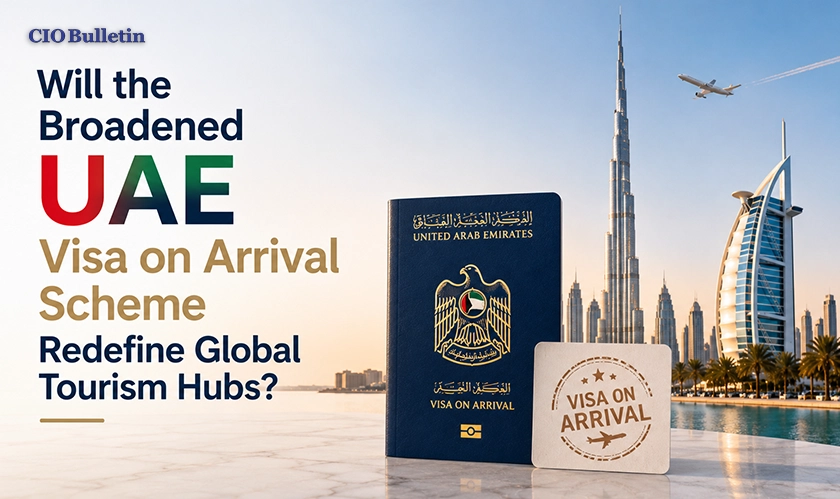
The United Arab Emirates is aggressively reworking its immigration setup to cement its reputation as a top world transit and tourism stop. Under a new regulatory system, the country has, in practice, broadened entry privileges so a wider group of international visitors can enter easily. This major policy update allows eligible citizens from Indonesia, Vietnam, Thailand, the Philippines, Kenya, and South Africa to secure their entry documents immediately upon touching down at national borders. By embedding the UAE visa on arrival mechanism deeper into its border management strategy, the state effectively eliminates prior bureaucratic friction and enhances its overall logistical appeal.
The updated immigration guidelines introduce a structured approach designed to accommodate diverse travel timelines while optimizing terminal processing workflows. Depending on specific administrative criteria and traveler classifications, the expanded scheme provides highly flexible stay durations tailored to modern international transit requirements.
Eligible international arrivals can now rapidly secure a standard 14-day entry authorization directly at immigration counters for a fee of Dh100. Tourism ministries also say the removal of pre-entry paperwork helps cut travel expenses, nudging visitors toward multi-city routes across the emirates, kind of faster.
Long-term visitors and business professionals can opt for a comprehensive 60-day stay format costing Dh250 to conduct extended regional engagements.
Unified digital immigration portals across all national airports ensure standardized processing times for incoming flights.
This systematic deregulation aligns directly with the nation's broader economic goals to maximize commercial aviation yields and support high-capacity hospitality investments. By removing the need for traditional, time-consuming pre-arranged embassy applications, the state positions its major carrier hubs as the preferred routing choice for global travelers.
These simplified entry routes seem aimed at those who book spontaneously for leisure and corporate professionals who want quick, flexible last-minute travel without having to pass through a maze of diplomatic steps.
By folding six additional high-activity nations into the immediate entry group, local hospitality providers are expecting a noticeable lift in baseline occupancy figures. Tourism ministries also say the removal of pre-entry paperwork helps cut travel expenses, encouraging visitors to plan multi-city tours across the emirates.
To be eligible, passport holders from the six specified countries must carry a valid residence permit or visa that was issued by the US, UK, EU, Singapore, Japan, South Korea, Australia, New Zealand, or Canada.
Self-service airport kiosks are being used more, which should reduce front-line immigration jams, during the busiest arrival hours.
If someone overstays, the penalty is fixed at Dh50 per day, to keep compliance steady while immigration lines stay relatively efficient.
The decision to widen access to immediate border clearances highlights a permanent shift toward frictionless international commerce and open-door economic diplomacy. Transitioning to highly automated, flexible border policies allows metropolitan centers to scale their visitor economies without placing undue burdens on administrative staff or slowing down terminal operations. According to CIO Bulletin, this development demonstrates how progressive immigration reforms can successfully transform traditional geopolitical boundaries into highly efficient channels for global financial and cultural exchange.
Everything you need to know about this news
Travelers from Indonesia, Vietnam, Thailand, the Philippines, Kenya, and South Africa can now get an entry visa when they arrive at UAE airports, as long as they meet the program’s required regulatory conditions tied to secondary international visas.
For the first entry stamp, holders of ordinary passports from these six nations must also have a valid visa or residence permit issued by the US, UK, EU countries, Singapore, Japan, South Korea, Australia, New Zealand, or Canada.
Eligible arrivals can take a short stay of 14 days for Dh100. Then they can renew once for a further 14 days at Dh250. They can also opt for a long stay, but it’s non-extendable, a 60-day visa upon arrival for Dh250.
The Federal Authority for Identity, Citizenship, Customs and Port Security enforces a strict daily fine of Dh50 for visitors who do not exit or renew their status before their entry window runs out.
The Ministry of Foreign Affairs rolled out this change to strengthen bilateral relations, boost tourism momentum, and make travel smoother, though. It also reinforces the UAE as a laid-back global business hub, because it removes that tense pre-trip visa friction that can turn into bottlenecks.





















 consultants ltd.jpg)


Comments