
Home Services & Solutions Smart infrastructure Edge AI Middle East Is Quietly...
CIO Bulletin, 20 November, 2026
Author:
Ravathi Sunil
From driverless cars to connected downtowns, Gulf nations are moving AI closer to where data is born, and the market is set to soar.
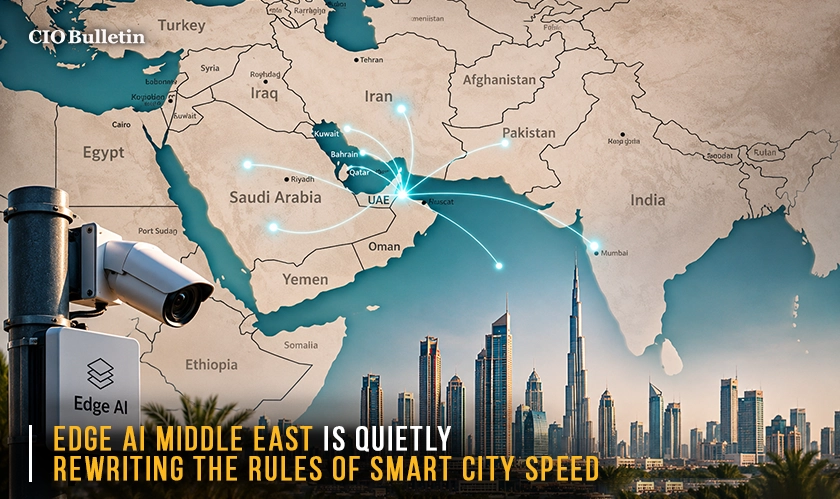
Edge AI Middle East is no longer a general idea. Across the Gulf, cities and companies are placing smart computing right next to where data is created, and the trend is picking up pace, according to W.Media. Get answers in a blink, not after a long trip to a faraway cloud.
Take driverless cars. Dubai wants 25 per cent of its transport to be autonomous by 2030, and a single self-driving car can produce up to 4 terabytes of data every day. Now picture that car waiting for a distant server to decide whether to brake. Scary, right? Edge AI solves this by running the thinking part close to the car, using edge servers and small computing nodes, so decisions arrive in milliseconds.
Priyanka Nagpal, Director of Data Center and Capital Markets at JLL Middle East, said these deployments mark the meeting point of the physical and digital worlds. Dr. Fadi Nasser, Chief Commercial Officer at MEEZA, highlighted its role in running smart cities, including Msheireb Downtown Doha in Qatar.
Fadwa AlBawardi, Founder and CEO of FSAB Consulting, explained that lightweight AI models running at the edge can cut response times to single-digit milliseconds, keeping operations steady even if the main cloud network fails.
The UAE and Saudi Arabia lead the region, with Grand View Horizon estimating:
UAE: US$342.1 million in 2025, rising to US$1.7 billion by 2033.
Saudi Arabia: US$376.9 million in 2025, reaching US$1.8 billion by 2033.
Growth rate: roughly 22 per cent a year in both countries.
So what happens to giant data centers? Himmath Mohammed, Chief Information Officer at Gulf Data Hub, expects big hyperscale sites to handle training and data gathering, while edge sites make the quick calls. Keeping sensitive data inside the country also helps meet national data residency laws. This shift is steering money toward small, modular micro-data centers that also save energy and cooling costs.
CIO Bulletin will keep tracking Edge AI Middle East as it reshapes the region.
News Source: ET Datacenters, https://datacenters.economictimes.indiatimes.com/
Everything you need to know about this news
It runs close to where data is created, such as near a road or a hospital, so answers arrive in milliseconds instead of after a long trip to a distant cloud.
Unlikely. A self-driving car can produce up to 4 terabytes of data daily and needs split-second decisions that faraway servers cannot always promise.
The UAE and Saudi Arabia, valued at US$342.1 million and US$376.9 million in 2025 respectively, and both are expected to grow near 22 per cent a year.
No. Hyperscale sites will train models and gather data, while edge sites make fast decisions.
Yes. Keeping sensitive workloads inside the country supports national data residency rules.


















































 consultants ltd.jpg)


Comments