
Home Technology Software How Revenue Teams Compare CRM ...
CIO Bulletin, 19 November, 2026
Author:
CIO Bulletin Team
Key points
Research on B2B software buying finds 86 percent of purchases stall somewhere in the process, and 81 percent of buyers end up dissatisfied with the provider they chose.
Buyers rank technical implementation and deployment assistance as their number one priority. Vendors rank the same item sixth.
Around 55 percent of CRM implementations fail to meet their objectives, with user adoption the dominant cause rather than any technical defect.
An evaluation that scores features predicts the demo. An evaluation that models real data predicts year two.
Eighty-one percent of B2B buyers end up dissatisfied with the provider they ultimately choose, and 86 percent of purchases stall somewhere in the buying process before a decision is reached. In a category as crowded and well-documented as customer relationship management, that combination is hard to explain by supply. There is no shortage of credible platforms, no shortage of published pricing, and no shortage of review data. The failure is happening inside the evaluation.
Pair that with implementation outcomes and the shape of the problem gets clearer. Roughly 55 percent of CRM implementations fail to meet their original objectives. Forrester research puts the range at 30 to 60 percent, and identifies user adoption rather than technical defect as the dominant cause. Average adoption among sales professionals sits at 72 percent, and 43 percent of users say their team uses less than half the features available. Teams are not buying bad software. They are running a selection process that measures the wrong things and then discovering it eighteen months later.
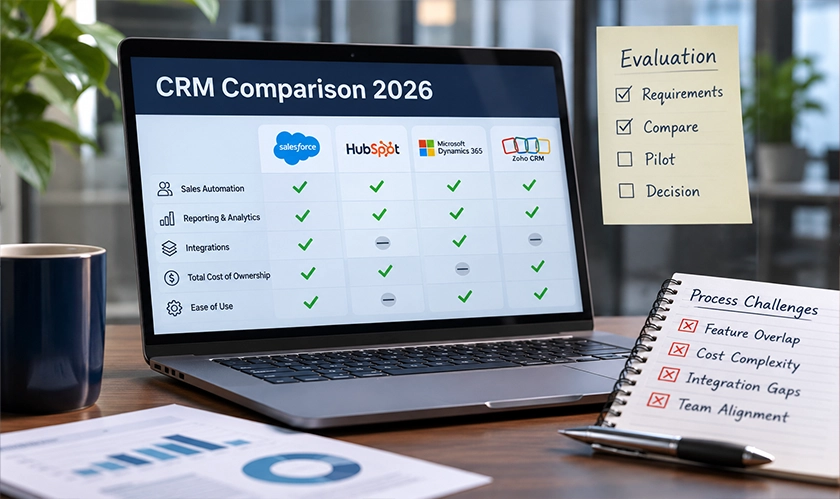
The standard process has four stages, and each one has a known failure mode.
|
Stage |
What it measures |
What it misses |
|
Requirements matrix |
Feature presence against a checklist |
Whether the platform can hold objects nobody listed |
|
Vendor demo |
Interface quality and salesperson competence |
Behavior on messy real data at volume |
|
Reference calls |
Outcomes at companies the vendor selected |
The companies that churned |
|
Pricing negotiation |
Cost at today's headcount |
Cost at three times today's headcount |
Every stage in that table scores the platform as it appears on the day of purchase, which is the one day the decision does not need to be right about.
The requirements matrix is the most deceptive of the four, because it feels rigorous. A spreadsheet of 120 features with weighted scores produces a number, and a number feels like a decision. But a checklist can only contain requirements someone already thought of, and the switching data says that is not where platforms fail. Over 40 percent of businesses abandoned a previous CRM because it lacked necessary features, and complexity drives 44 percent of switches. Those requirements existed in the business. They did not exist on the matrix, because the business had not yet grown the shape that produced them.
A vendor demo runs on a sanitized instance built to make the product look coherent. Records are complete, naming is consistent, the pipeline has sensible stages, and the reports render instantly on a few thousand rows.
Production data is nothing like that. Contacts are duplicated across three spellings of the same company. Half the opportunities have a close date in the past. Custom fields from a previous administrator contain values nobody can decode. The behavior that matters is how the platform handles that, and it is systematically not what gets tested.
The most quantified gap in the whole process is the one neither side talks about during selection. B2B software buyers rank technical implementation and deployment assistance as their number one priority. Vendors rank the same item sixth. That single mismatch explains a large share of the dissatisfaction rate, because the buyer is making a decision partly about a service the vendor has not prioritized and therefore does not describe accurately.
The useful reframing is to stop scoring the product and start testing the fit, using the trial period as a technical exercise rather than a familiarization tour.
Every business runs on at least one entity that is not a contact, a company or a deal. A retainer with a renewal date and a committed monthly scope. A campaign with a budget and an attribution window. A deliverable with an owner and an acceptance state. A partner agreement with a margin.
Build that object during the trial, with its real fields and its real relationships to the records around it. If it requires an administrator, an implementation partner or a plan upgrade, the evaluation has its answer, and that answer will not improve after signature. This single test substitutes for most of a requirements matrix, because it measures capacity for the requirements nobody has written down yet.
Import a genuine export rather than a cleaned sample. The duplicates and the malformed dates are the point. What matters is whether the platform surfaces them, what it does with a field it cannot parse, and whether reports stay accurate when a quarter of the records are incomplete.
Unfavorable pricing as a company grows into higher seat tiers accounts for roughly 23 percent of CRM replacements. That escalation is almost always visible on the published rate card at the time of purchase. It gets missed because the model is built at current headcount. Build it at three times current headcount, and include every module the business will plausibly need, because a module priced per seat and a module priced per workspace diverge sharply as a team grows.
A platform's own comparison surface is itself a signal worth reading during an evaluation, because what a vendor is willing to publish about its limits tells you something a demo will not.
Strkr publishes a direct comparison against Salesforce, HubSpot, Pipedrive, Monday and Zoho alongside a fully itemized rate card, and the itemization is the relevant part. Each tier states its hard numbers rather than describing them as generous: Starter at 29 dollars per seat per month covers 10 seats, 10,000 contacts, 500,000 API calls per month, 20GB of storage, 10,000 flow runs and up to five active flows. Pro at 59 dollars covers 50 seats, 100,000 contacts, three million API calls, 100GB, 100,000 flow runs and unlimited active flows, and adds custom objects, field-level permissions, AI forecasting and lead routing. Scale at 119 dollars covers 250 seats, 500,000 contacts, 10 million API calls and adds SSO and audit logs. Optional modules are priced flat per workspace rather than per seat, at 99 dollars for marketing, 79 for projects, 49 for products, 39 for docs and 29 for messaging.
Published numbers like those let a buyer model the three-times-headcount scenario during the trial rather than discovering it at renewal, which is the part of an evaluation that the standard process skips. Strkr CRM also includes custom objects with typed fields, validation and lookups on every tier rather than gating them to an enterprise plan, which makes the model-an-unanticipated-object test runnable inside the 14-day trial window, and the company states no charge is taken until day 14. On implementation, the gap buyers care most about, it publishes a setup window of one to three days with no implementation partner required, a two to seven day period running the old and new systems in parallel, and migration tooling from HubSpot, Pipedrive and Salesforce Essentials that carries contacts, companies, deals, pipelines, custom fields and workflow logic.
Whether those windows hold for a specific team depends entirely on how much schema has to be rebuilt by hand, which is precisely what the trial exercise is for.
Self-serve trials have quietly changed the balance of information in CRM buying. A buyer who can provision a workspace, import real data and build a custom object without talking to anyone is running an experiment, not reading a brochure, and that buyer is harder to mislead than any reference call can compensate for.
The stalling rate suggests the shift is incomplete. When 86 percent of purchases stall, part of what is happening is committees waiting for certainty that a demo structurally cannot provide. The teams that move fastest are usually the ones who stopped trying to be certain in advance and started proving one or two specific things in a sandbox instead.
Everything you need to know about this news
Around 55 percent fail to meet their original objectives, with Forrester putting the range at 30 to 60 percent and naming user adoption as the dominant cause rather than technical defect. Adoption failure usually traces back to a data model that does not match how the business actually works, which pushes reps into manual workarounds and spreadsheets alongside the system.
Three things: whether a real business object the vendor did not anticipate can be modeled without an administrator or an upgrade, how the platform behaves on a genuine data export including duplicates and malformed records, and what the total cost looks like at three times current headcount with every module the business will need.
Long enough to load real data and build one real object, which for self-serve platforms fits inside a standard 14-day trial. Extending beyond that rarely adds information, since 86 percent of B2B purchases stall and the additional time is usually spent seeking certainty a trial cannot produce rather than running further tests.
It matters more than the headline rate, because itemized limits on seats, contacts, API calls and automation runs are what let a buyer model cost at future headcount. Seat-tier escalation accounts for roughly 23 percent of CRM replacements, and it is almost always visible on the rate card before purchase.
A comparison process built on feature matrices, demos and reference calls produces a confident decision about a platform's condition on the day of signature. The outcome data says that is not the question. Thirty percent of deployments get replaced inside five years, more than half fail to meet their objectives, and 81 percent of buyers end up unhappy with a choice they made carefully.
The correction is unglamorous and cheap. Load the real data. Build the object nobody listed. Price the stack for the company you are planning to be. Those three tests take a few days inside a trial, and they answer the questions that the next two years will actually ask.



















































 consultants ltd.jpg)


Comments