
Home Technology Software The top global HR software pla...
CIO Bulletin
,
07 May, 2026
Author:
Guest
Picture being an HR manager in the mid ‘90s. PCs were seen as the pinnacle of technological advancement back then and email was a revolutionary way to manage global offices. For mid-market companies seeking to expand, the ability to communicate instantaneously with other offices around the world became the foundation for growth. Fast-forward to 2026 and that all feels ancient now.
What’s email capability compared to having dedicated HR software that can simultaneously run entire HR departments across multiple regions? Add in AI and the kind of automation available today, and modern HR departments can practically run themselves.
Against that backdrop, mid-market companies looking to expand globally have never been in a better position to do so. People management can now be done entirely by global HR software, with only minimal human oversight needed. However, that can only be achieved if the right solution is in place.
Making that choice requires insight into what the best global HR software can offer mid-market companies in 2026. The right platform should ideally provide seamless integration, functionality across everything from payroll to compliance, with scalability built-in at every step.
With this guide, we’ve done the heavy lifting for you. By extensively reviewing the best HR software providers for mid-market companies that want to expand, we settled on 6 options that can manage any modern HR need at scale, and more significantly, across borders.
Mid-market companies eyeing international expansion can leverage HR software to take care of virtually all important HR functions. The best HRMS solutions that cater to global companies are designed with regional flexibility and scaling in mind. Once things like budgets, specific requirements, and integration or automation needs are confirmed, there are a range of reasons why using an HRMS are now a must-have for any mid-market company that wants to grow.
For starters, the best HR software systems take care of all compliance headaches, regardless of how complex or stringent. This part alone can be huge in terms of saving on time and costs. Everything else, like accounting and payroll, talent management, and tax needs for employees across different regions, can all be accommodated for.
With the added incentive of stronger cybersecurity and data management all under one roof, HR software can mean the difference between a mid-market company going global or fading into obscurity.
By using objective criteria that evaluated all pertinent features and combining this with data from real user feedback, we’ve settled on a list of the 6 best HR software providers for 2026. These systems can be a game-changer for mid-market companies eyeing global expansion and we cover exactly why that is.
Here’s how the results tallied.
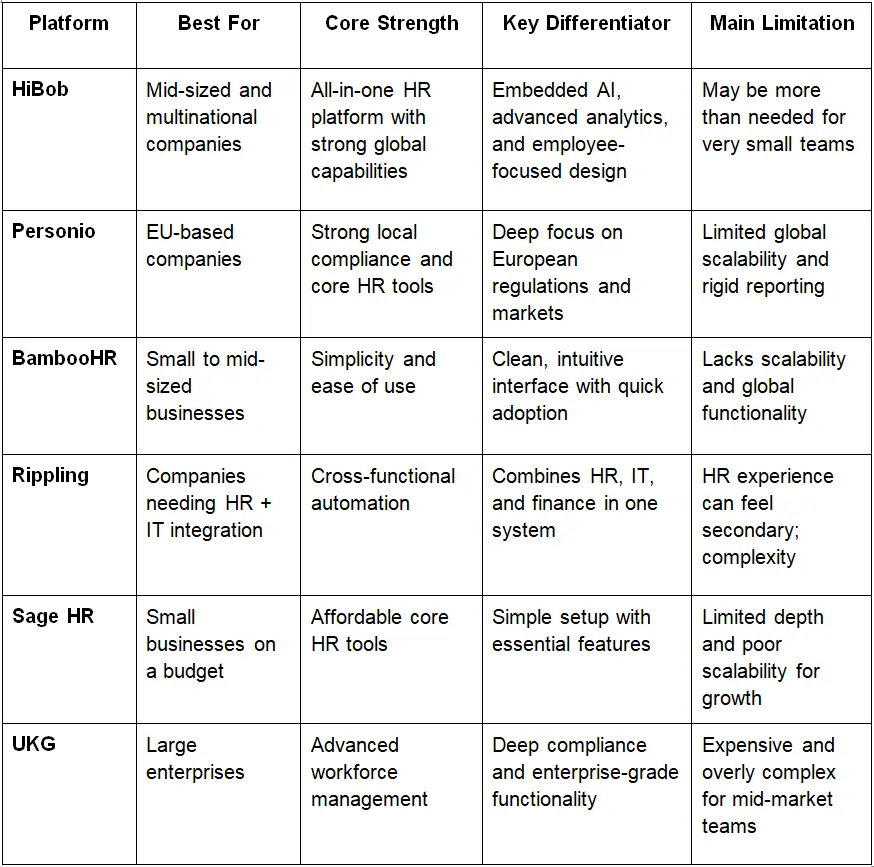
HiBob stood out instantly as the top choice. By blending AI capability directly into workflows, it’s a dream for modern HR leaders. It covers all the bases, from payroll and ATS to workforce planning and employee engagement. While ideally suited to mid-market companies, HiBob easily scales and across globally distributed workforces.
Humans make the final decisions but AI powers everyday use with insights, recommendations, and automation of multiple processes under one system. It has a great interface that is both intuitive and user-friendly, making it an all-in-one solution that delivers without fuss.
Best for: Mid-sized and multinational businesses with global and multi-site operations seeking a modern, intuitive user experience.
Consolidates HR, payroll, ATS, workforce planning, performance, and engagement tools
Deep localization for global teams including multi-country payroll integrations and compliance
Advanced analytics and reporting to empower HR leaders
Tools for engagement, recognition, and feedback that strengthen culture
Built-in artificial intelligence that supports decision-making without replacing human oversight
Balances HR efficiency with employee engagement
Highly customizable and flexible to adapt to each organization's structure
Loved by HR professionals, people managers, and employees alike
Agile and cost-effective compared to heavy enterprise systems
Enterprise-grade security and privacy safeguards for all artificial intelligence features
Personio is a well-known HR software provider, particularly in the European market. It offers a range of features designed to help businesses manage their HR processes.
Best for: European companies looking for local compliance features.
Core HR and payroll
Applicant tracking system
Time and attendance tracking
Strong local compliance features for European markets
Rapid market growth and continuous product updates
Weaker global coverage and localization outside its core European markets
Limited depth in advanced features like workforce planning
Users often report that the reporting capabilities are somewhat rigid
BambooHR is a popular choice for small and medium-sized businesses, known for its straightforward approach to HR management.
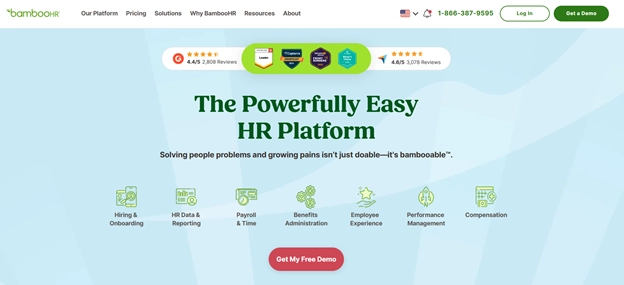
Best for: Small businesses needing a simple, easy-to-use interface.
Employee database and records
Applicant tracking system
Time-off management
Strong brand recognition in the SMB space
Competitive entry pricing
Very easy-to-use interface for basic tasks
Lacks the scalability needed by mid-sized and multinational companies
Limited customization options for complex workflows
Missing robust global capabilities for distributed teams
Rippling takes a unique approach by combining HR management with IT and finance operations, aiming to centralize employee data across multiple departments.
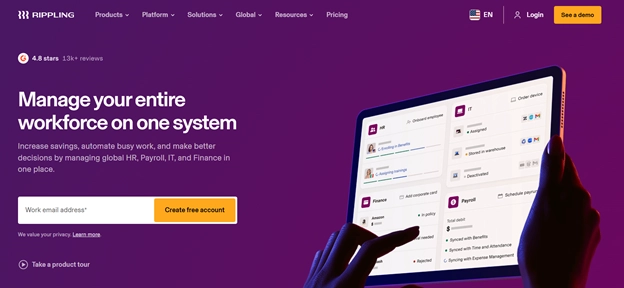
Best for: Companies looking to integrate HR with IT device management and app provisioning.
HR and payroll
IT device and app management
Workflow automation
Innovative crossover between HR, IT, and finance
Strong automation capabilities for onboarding and offboarding
Extensive integration ecosystem
HR functionality can feel secondary to the IT features
Less focus on employee experience and engagement tools
Users sometimes find the platform complex to navigate initially
Sage HR provides a suite of HR tools aimed at helping businesses manage their workforce more effectively, with a focus on affordability.
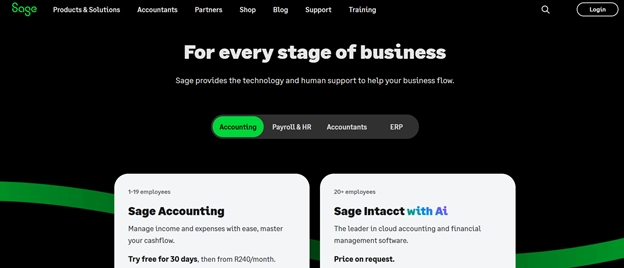
Best for: Smaller companies seeking basic, affordable HR tools.
Core HR and leave management
Performance management
Shift scheduling
Solid foothold in the SMB market
Simple and affordable pricing structure
Good basic tools for smaller teams
Limited in scope and advanced HR features
Fewer integrations compared to competitors
Not ideal for scaling businesses with global or multi-site operations
UKG is a major player in the HR software space, offering deep functionality designed primarily for large-scale operations and complex workforce management needs.
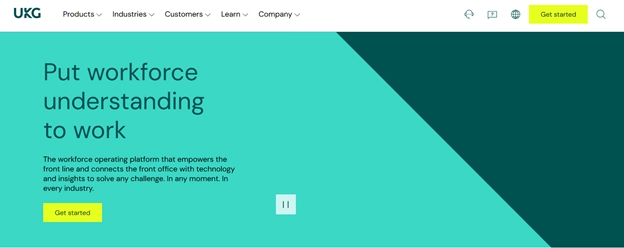
Best for: Large enterprises with complex workforce management and compliance requirements.
Advanced workforce management
Complex payroll and compliance tools
Talent management
Deep functionality for large-scale operations
Robust compliance tracking and reporting
Comprehensive suite of tools for enterprise needs
Enterprise-level complexity makes it overwhelming for mid-sized companies
High cost of implementation and maintenance
User experience is often seen as clunky and outdated by modern standards
If you want to choose global HR software options by ticking boxes, there are plenty of providers that fit the bill. However, modern HR systems shouldn’t just make life simpler but holistically integrate HR needs under a single solution, with scalability available when you need it. For mid-sized companies, cost, convenience, and the ability to be flexible across regional teams provide a huge advantage.
Many older platforms still deliver depth, but they often come with rigid structures and outdated interfaces that slow teams down. On the other end, lighter tools designed for smaller companies can fall short once operations expand and require more coordination.
For me, what made HiBob stand out as the most obvious choice is that it sits in between, combining flexibility, usability, and scale. It can automate routine processes, surface meaningful insights, and give employees a straightforward, engaging experience that fits naturally into their work.
For mid-market companies that have an eye on global expansion, it’s the ideal choice. Sophisticated enough to handle growth, while simple enough to not overwhelm teams across various regions.
Everything you need to know about this news
Global HR software are platforms designed to manage human resources processes across multiple countries and regions. It handles complex requirements like multi-country payroll, local compliance, and diverse cultural needs. When using a comprehensive platform like HiBob, companies can consolidate these global operations into a single, unified system.
Mid-market companies often outgrow basic HR tools but find enterprise systems too rigid and expensive. They need specialized software that offers scalability, advanced features like workforce planning, and global capabilities without sacrificing ease of use or agility.
Modern HR platforms include tools specifically designed to boost engagement, such as recognition programs, continuous feedback loops, and pulse surveys. For example, platforms like HiBob prioritize the employee experience, making it easy for team members to connect, collaborate, and feel valued regardless of their location.
Yes, advanced global HR software can integrate with various local payroll providers to streamline multi-country payroll processes. This ensures compliance with local tax laws and regulations while providing a centralized view of global compensation data.
A good user interface should be intuitive, modern, and accessible. It should require minimal training for employees to perform common tasks. A platform like HiBob is designed with a people-first approach, ensuring that HR professionals, managers, and employees all find the system easy and enjoyable to use.
















































 consultants ltd.jpg)


