
Home Industry Clean energy Solar Batteries Explained: Rea...
CIO Bulletin
,
20 October, 2026
Author:
Guest
Lawrence Berkeley National Laboratory found that 37% of new US residential solar systems installed in 2025 came with storage, and the median battery held 13.5kWh. That is about 180 times the energy in a 20,000mAh power bank, yet solar batteries and power banks are sold on the same handful of ratings.
If you're comparing batteries for solar, the spec sheet comes down to four ratings: capacity, depth of discharge, cycle life and round-trip efficiency. A1 SolarStore wrote this guide to explain each one in plain terms. It also compares LiFePO4 with AGM and answers common questions about lifespan, backup power and off-grid use.
Watt-hours equal volts times amp-hours. Every capacity figure in this guide comes from that one line.
The same math decides whether a power bank may ride in a carry-on: the FAA's standard cap is 100Wh per battery, and airlines can be stricter. It also scales from a gadget to a house.
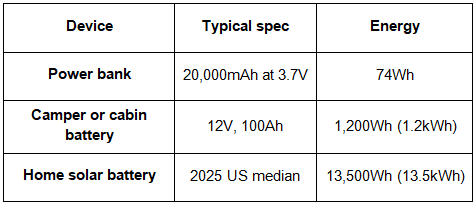
Scale is the only difference. In solar energy storage, panels fill the battery at midday and the house drains it after sunset, so the capacity figure tells you how many evening hours you're buying.
For context, the Energy Information Administration's 2024 figures work out to roughly 28kWh a day for the average US home. One 13.5kWh battery covers about half of that, which is why backup setups often protect only a handful of essential circuits.
Four numbers explain most of how solar storage batteries behave, and each one has a catch.
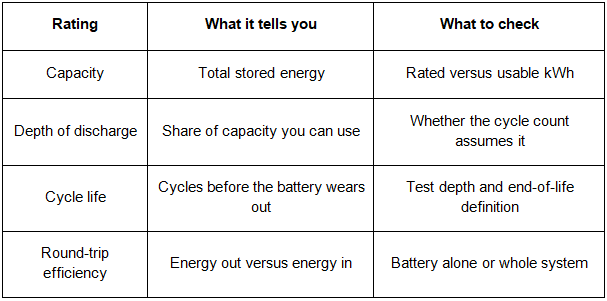
Solar battery capacity is quoted in kilowatt-hours, but the figure on the box is the rated total. What you can draw is that total multiplied by the depth of discharge, the share of capacity the chemistry tolerates using.
A 12V, 100Ah battery is rated at 1.2kWh.
Cycled to 50% depth of discharge, a lead-acid version delivers about 0.6kWh.
A LiFePO4 (lithium iron phosphate) version rated for 100% depth of discharge can deliver up to 1.2kWh.
Depth of discharge shapes both usable energy and lifespan, and the safe range differs by chemistry:
Pacific Northwest National Laboratory's lead-acid analysis assumes routine cycling somewhere between 50% and 80% of capacity.
Trojan advises staying between 20% and 50% for the longest life, though its batteries can go to 80%.
LiFePO4 spec sheets commonly rate 80% to 100%.
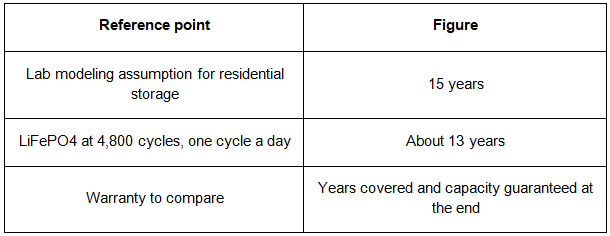
Cycle life counts how many full charge-and-discharge cycles a battery completes before it wears out, and the count shifts with depth of discharge. Lab data compiled by Pacific Northwest National Laboratory shows LiFePO4 reaching 4,800 cycles at 100% depth of discharge, 6,000 at 80% and 8,000 at 60%. At one cycle a day, the first figure works out to about 13 years.
Some LiFePO4 spec sheets list 3,000 to 5,000 cycles without saying what depth of discharge produced them. A cycle count without that detail is half a spec, and the lab tests define end of life as holding 60% of original energy, not zero.
Round-trip efficiency is the share of stored energy you get back. The National Laboratory of the Rockies (formerly NREL) uses 85% for lithium-ion in its residential storage assumptions, so 10kWh going in returns about 8.5kWh. Grid-scale studies put lead-acid at roughly 70% to 84%. Some sheets quote efficiency for the whole solar-to-home path, which is a different measurement from the battery alone.
A LiFePO4 lithium solar battery and a sealed AGM solar battery (absorbent glass mat, a lead-acid design) both count as deep cycle batteries, meaning they tolerate repeated deep discharges, unlike a car starter battery.
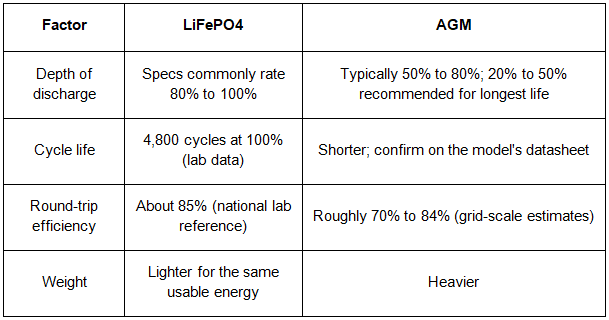
Neither wins everywhere. Compare price per usable kilowatt-hour over the cycles a battery will actually deliver, not the sticker price.
The same battery can be a bargain in one setup and a mistake in another, because the ratings that matter shift with how often it cycles.
For solar battery backup alone, the battery sits near full and rarely cycles, so capacity and warranty terms matter more than cycle life.
On a grid-tied system that shifts solar energy daily, one cycle a day makes cycle life at a stated depth of discharge, along with round-trip efficiency, the numbers that drive cost over time.
An off-grid solar battery in a cabin or RV sees routine deep discharges, and weight or mounting limits often apply. AGM can be mounted upright or on its side, and system voltage (12V, 24V or 48V) has to match the inverter.
Whatever the chemistry or the seller, three checks separate a lab rating from what the battery will do in your house:
Ask for three figures in writing: usable kilowatt-hours at a stated depth of discharge, a cycle count that names its depth of discharge and end-of-life definition, and round-trip efficiency measured on the battery alone.
Look for warranty terms that name retained capacity, not just years. The Tesla Powerwall 3's 10-year warranty, for example, guarantees 70% of its 13.5kWh rating at year 10.
Confirm system voltage, inverter compatibility and the paperwork local permitting requires, since batteries for solar panels have to match the rest of the system.
Sizing is the arithmetic-heavy part, and A1 SolarStore offers help from an in-house engineer who can turn a daily kilowatt-hour figure from a utility bill into a bank size. With that number and the three checks in hand, you can compare batteries on usable energy instead of box labels.
Solar battery lifespan depends on chemistry, depth of discharge and how often the battery cycles. The table gives reference points, and warranty terms set the practical floor.
Yes, with limits. The median among solar batteries for home use is 13.5kWh, roughly half of an average day's use, so whole-house backup usually means several units or a trimmed list of circuits. The kilowatt rating, which is separate from capacity, matters too because it sets how many appliances can run at once.
Start with daily use and divide by the depth of discharge the battery allows. A cabin that draws 5kWh a day from solar powered batteries needs about 5kWh of rated LiFePO4 if the spec permits 100% depth of discharge, or about 10kWh of lead-acid cycled to 50%.
Rated capacity = daily use ÷ depth of discharge, multiplied by the cloudy days you want to ride out.
Not exactly. Deep cycle describes a design that tolerates repeated deep discharges, while solar battery describes the job. Most solar power batteries are deep cycle designs. A car starter battery is not, and Trojan warns that it fails after only a few deep discharges.
Cost comes first, so compare price per usable kilowatt-hour over the battery's life. Capacity fades with use, and at 85% efficiency, 15% of the energy going in never comes back out. The federal residential clean energy credit no longer applies to systems placed in service after December 31, 2025, according to the IRS, so check state and utility programs separately.





















































 consultants ltd.jpg)


Comments