
Home Industry Defence technology Will Deep Tech Transfers Ancho...
CIO Bulletin
,
06 July, 2026
Author:
Sambhrant Das
Indonesia seeks a broader industrial defense partnership with India focused on technology transfers and supersonic missile co-production as PM Modi arrives in Jakarta.
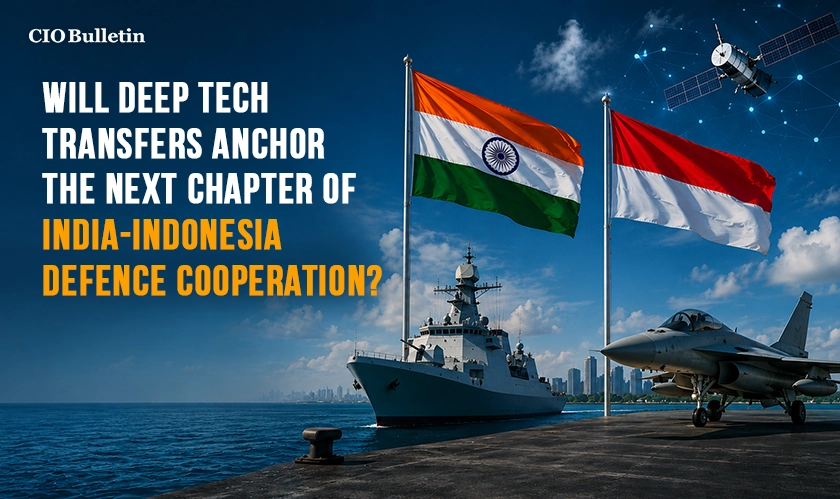
The changing geopolitical landscape of the Indo-Pacific region demands highly integrated, multi-layered security architectures capable of securing vital maritime chokepoints. Addressing this mutual sovereign necessity, Jakarta has expressed an explicit desire to heavily integrate New Delhi into its long-term military modernization roadmap ahead of Prime Minister Narendra Modi’s high-profile bilateral visit. This deep security alignment represents a historic shift toward India-Indonesia defence cooperation, transforming standard transactional purchases into deep industrial partnerships. Rather than navigating shifting regional dynamics as isolated actors, both developing democracies are intentionally consolidating their industrial defense strategies. This calculated realignment secures regional balance by embedding indigenous production capabilities across the Southeast Asian maritime theater.
Scaling localized military manufacturing infrastructure requires moving far past simple equipment procurement and adopting highly integrated industrial blueprints. For guaranteeing full logistical self-reliance and protecting sensitive seaborne sovereign frontiers, the joint security roadmap leans first on a handful of practical shared operational pillars:
The swift deployment of long-distance, shore-positioned supersonic missile batteries so coastal defense networks get reinforced and sovereign territorial waters stay secured.
The execution of joint, multi-domain military training programs alongside synchronized naval patrols designed to ensure free open sea lanes.
The formal establishment of deep technology transfer protocols that allow localized defense manufacturing centers to independently maintain advanced platforms.
Regional diplomatic envoys keep stressing that developing its own manufacturing facilities together with dependable democratic collaborators is crucial if the goal is strategic autonomy, not dependence on volatile supply chains. The impending diplomatic summit looks to finalize a multi-stage procurement blueprint that moves well beyond basic hardware sales.
“Indonesia is modernising its armed forces, and we welcome partners who can contribute through genuine cooperation, technology transfer, and co-production rather than transactions alone,” - Yudho Sasongko, Charge d'Affaires of Indonesia in Delhi.
Meanwhile, the increased operational density of outside naval task forces around the South China Sea has pushed neighboring archipelagic states to urgently harden their defensive coastal boundary lines. To cope with these pressing maritime pressures, regional security planners are focusing on a staged incorporation of India’s flight-tested BrahMos supersonic cruise missile ecosystem. This fast defensive platform acts as a credible maritime deterrent, so Jakarta can counter potential littoral intrusions with an extreme level of accuracy. Due to this, the whole security integration ends up serving as a protective barrier around trade lanes, insulating day to day commercial shipping activity from wider geopolitical friction.
The cross-border architectures governing defense manufacturing pipelines and shared maritime domain awareness frameworks will experience continuous strategic upgrades throughout the remainder of 2026. Both nations intend to consistently broaden their deep-tech sharing initiatives to safeguard valuable economic zones from sudden underwater and aerial disruptions. CIO Bulletin treats this shift as a strong signal that major maritime neighbors should systematically connect and strengthen their industrial defense bases, so open, rule-based regional governance remains intact and shared trade routes do not get squeezed by outside economic coercion.
Everything you need to know about this news
The ties lean heavily on co-production, technology handovers, and cooperative capacity building, trying to modernize Indonesia’s armed forces.
Those procurement talks are mostly centered on the gradual buy-in of the shore-based BrahMos supersonic cruise missile system.
This high-level engagement marks Prime Minister Narendra Modi’s fourth official visit to the archipelagic nation.
Jakarta wants to grow a domestic defense industry that is self-reliant by choosing long-term partnerships that include full technology access.
The strategic alignment backs ASEAN centrality and directly supports the larger Indo-Pacific stability framework.
















































 consultants ltd.jpg)


Comments