
Home Industry Healthcare 5 Best Healthcare Virtual Assi...
CIO Bulletin
,
22 October, 2026
Author:
Guest
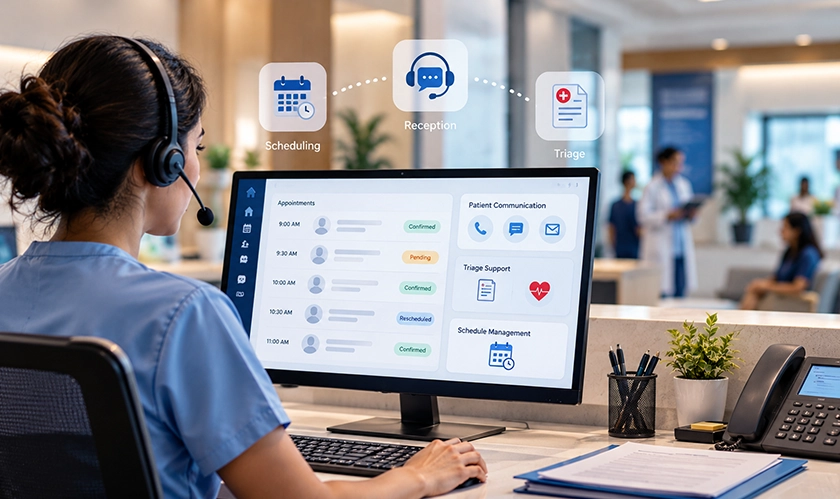
The best healthcare virtual assistant service for reception, scheduling and triage is one that works inside your systems, answers patients consistently and routes anything clinical to your staff.
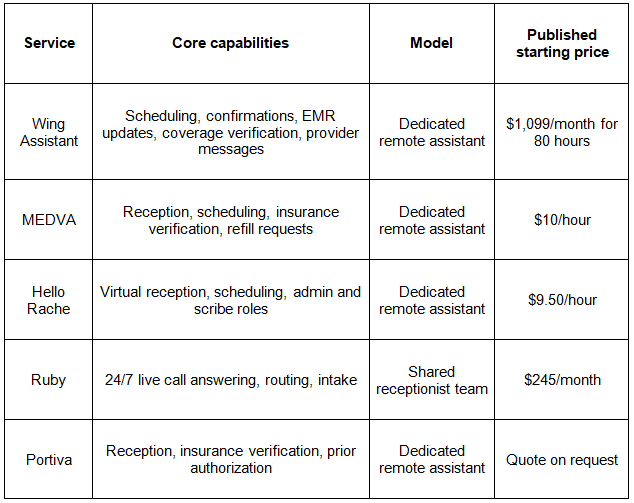
The five services below cover the main models: dedicated remote assistants, hourly assistants and shared live answering teams.
Published prices range from $9.50 an hour to monthly plans, so compare quotes against the same tasks and coverage hours.
A healthcare virtual assistant (VA) is a remote professional who handles a practice's front-desk work: answering calls, booking and confirming appointments, verifying coverage, updating records and routing messages. The best services integrate with your electronic medical record (EMR), cover the hours your phones are busiest and follow clear escalation rules for anything clinical.
Comparison below is based on each provider's published information as of October 21, 2026. Confirm current scope and pricing with each vendor.
Score every service on these:
Work inside your systems. The assistant should book, update and confirm directly in your EMR and scheduling tools, not just take messages for staff to re-enter.
Coverage that matches your phones. Check which hours are covered, how lunch breaks and absences are handled and what happens during Monday-morning surges.
Triage routing, not triage decisions. A good service follows routing rules your clinicians approve and hands symptoms, results and medication questions to qualified staff. "Handles everything" without a stated escalation path is a red flag.
Patient data safeguards. HIPAA compliance plus a signed Business Associate Agreement (BAA) is the floor. Look for individual logins, access logs and published security certifications.
Transparent pricing. Hourly, monthly or per-plan pricing are all fine. Compare quotes against the same tasks and hours.
These priorities matter because missed and mismanaged appointments are rising. In an August 2026 MGMA Stat poll, 32% of medical groups reported higher no-show rates than in 2025.
Best for: practices that want one dedicated assistant handling reception, scheduling and records work inside their own systems.
Wing Assistant matches practices with a dedicated healthcare assistant who manages patient schedules, confirms appointments and handles reschedule requests. Practices that also need documentation help can add the company's virtual medical scribe services from the same healthcare team.
Platform features:
Scheduling, confirmations and reschedule requests
EMR updates and intake form preparation
Patient coverage verification
Provider message management
Works in Epic, Athenahealth and Kareo
Differentiator: a dedicated assistant backed by a Customer Success Manager and free replacement if the fit isn't right. The healthcare page publishes HIPAA compliance, ISO 27001 compliance and SOC 2 certification.
Caveats:
The part-time plan works within designated time slots.
Clinical triage stays with your staff; the assistant routes symptom calls.
Pricing: $1,099 a month for 80 hours or $1,799 a month for 160 hours.
Best for: clinics that want a dedicated remote assistant working the clinic's own hours at a flat hourly rate.
MEDVA places a medical virtual assistant who works with the same clinic every day and learns its workflow. Tasks include medical reception, appointment scheduling, insurance verification and refill requests.
Platform features:
Phone reception and appointment management
Insurance verification
Medication refill requests
Medical records management
Billing and collections support
Differentiator: the same professional works your clinic's hours daily, with a secured facility option for EMR access such as Epic.
Caveats:
Your office trains the assistant on its own processes upfront.
Secured facility access is an add-on tier.
Pricing: from $10 an hour.
Best for: budget-conscious practices that want hourly remote support with no minimums.
Hello Rache places HIPAA-trained assistants based in the Philippines with medical, dental, veterinary and optometry practices. Roles include virtual receptionist, administrative assistant and medical scribe.
Platform features:
Virtual reception for patient calls
Appointment scheduling
Administrative support
Medical scribe roles
Practices choose the assistants they work with regularly
Differentiator: low hourly pricing with no minimum hours, no contract and no setup fee.
Caveats:
Its published BAA arrangements vary by page, so confirm who signs before go-live.
Confirm coverage across your US office hours.
Pricing: $9.50 an hour.
Best for: practices whose main gap is round-the-clock call answering rather than back-office work.
Ruby's US-based virtual receptionists answer and route calls, collect intake details and answer non-medical questions 24/7/365.
Platform features:
Live answering around the clock
Call routing and message delivery
Intake information capture
English and Spanish receptionists
Secure app and online portal
Differentiator: HIPAA-compliant service at no extra charge on top of continuous live coverage.
Caveats:
Under HIPAA service, receptionists book only in a compliant scheduling tool they can reach without a login.
EMR updates and coverage checks aren't part of the core service.
Pricing: from $245 a month.
Best for: practices that want reception combined with insurance and prior authorization support.
Portiva, founded in 2009, offers virtual medical receptionists alongside insurance verification, prior authorization and scribing. It serves medical, dental and veterinary practices.
Platform features:
Medical virtual receptionist
Insurance verification
Prior authorization support
Administrative assistance
Remote medical scribing
Differentiator: one vendor covering front-desk and back-office work, with HIPAA-trained and certified assistants.
Caveats:
Scribing is its best-known service, so confirm your assistant's reception experience.
Pricing isn't published.
Pricing: quote on request.
Healthcare virtual assistants sit inside a broader shift toward digital patient access, part of what many leaders see as the future of digital healthcare. Practices are outsourcing front-desk work because the phones, schedules and records still depend on a handful of staff.
Why the category exists. Every call, confirmation and coverage check competes for the same front-desk time. When a receptionist is checking patients in, calls go to voicemail and appointments slip. Rising no-show rates add pressure, since confirmations and reminders are among the first tasks to fall behind.
Two structural shifts shaped today's shortlist:
Triage stays clinical. The best services route calls by rules clinicians approve and never judge urgency, interpret results or give medical advice. That boundary protects patients and keeps practices on the right side of their own clinical policies.
Everything you need to know about this news
For most practices, a dedicated assistant who works inside your EMR and follows clinician-approved routing rules covers all three. Our top pick leads this guide on that combination, while Ruby suits practices that mainly need 24/7 call answering.
Published rates in this guide run from $9.50 an hour to $1,799 a month for a full-time dedicated assistant. Shared answering services start lower but don't usually update records or verify coverage.
Only the routing side. An assistant can capture the patient's concern and pass it to qualified staff using your rules, but deciding urgency or giving medical advice must stay with clinicians.
Many services publish HIPAA compliance, but BAA arrangements vary. Ask each vendor who signs the BAA and how assistants' access is controlled and logged.
Some can. Several providers in this guide offer scribe roles alongside reception, but confirm the scope, hours and pricing for each role separately.



















































 consultants ltd.jpg)


Comments