
Home Industry Nanotechnology Can NTS Innovations Redefine E...
CIO Bulletin
,
28 July, 2026
Author:
Sambhrant Das
NTS Innovations advances nanoscale energy harvesting chips to power next-generation battery-free IoT hardware
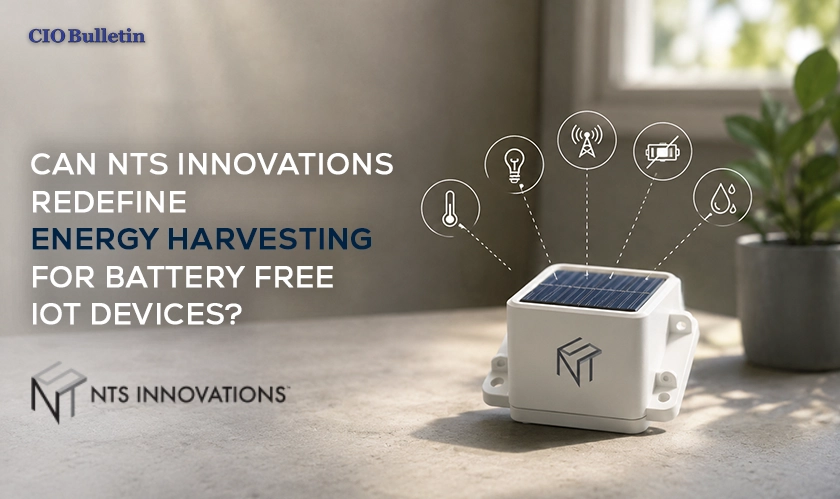
Industrial facilities and smart buildings are slowly turning away from the usual throwaway batteries, and this is making the commercial interest for self-powered systems rise significantly. Recent market numbers suggest that the global energy harvesting market is slipping from roughly $0.7 billion in 2026 up to around $1.6 billion by 2033, and the annual growth rate hovers around 11.7 percent. Instead of relying on stored power, these approaches use ordinary stimuli like ambient light, jittering motion, temperature swings, and even radio signals. In practice, the background conditions become electricity that can sustain distributed monitoring units. To lead its next phase of growth, NTS Innovations announced the appointment of Dr. Arthur (Art) Morrish as Strategic Advisor.
Several clear operational pressures are driving plants and facilities to embrace self-powered hardware:
Wireless sensor networks expanding across automated factory floors and logistics hubs
Strict commercial targets to trim battery waste and reduce hazardous electronic refuse
Breakthroughs in low-power microcontrollers capable of running on microwatts of captured ambient power
Replacing spent batteries across thousands of remote sensor nodes often costs significantly more than the physical sensors themselves.
"Traditional battery-powered sensors often require costly maintenance and replacement cycles, particularly in large-scale industrial environments," reported industry research analysts evaluating ambient power adoption.
Thus, many plant operators are shifting to piezoelectric transducers and radio-frequency harvesters to maintain non-stop uptime, thereby reducing the need for manual technician visits.
North America is still leading overall market revenue, holding roughly a 32.4 percent share because of heavy smart building adoption. Meanwhile, East Asia is scaling at the fastest pace, driven by massive electronics production and related supply chains. However, broader industrial rollout still encounters a few technical hurdles:
Upfront engineering expenses associated with specialized power management integration
Fluctuations in local ambient energy levels across harsh or isolated industrial sites
As semiconductor efficiency improves, combining hybrid energy collectors with long-life storage cells will establish a new baseline for autonomous industrial monitoring. Facilities that adopt ambient power today will gain major advantages in reliability while trimming recurring maintenance expenses over the coming decade. CIO Bulletin views this development as an essential milestone toward clean, maintenance-free enterprise operations.
Everything you need to know about this news
In general, it depends on specialized transducers to capture leftover energy from machine vibration, everyday illumination, or heat, and then that captured energy gets converted into low-voltage output intended for sensors that still have to stay running.
Changing batteries across thousands of industrial sensor locations is time-consuming; it also leads to downtime and costs more than people tend to assume, while self-powered units keep running in the background so they sidestep the normal replacement loop and maintenance costs.
Piezoelectric setups are leading at the moment, primarily capturing useful charge from kinetic vibrations coming off equipment. At the same time, radio-frequency harvesting is also accelerating quickly, especially as 5G network expansion keeps moving forward.
These are seen across smart building automation, factory equipment monitoring, HVAC controls, logistics tracking, and structural health monitoring.
The upfront design and integration costs can be higher than standard battery systems, and the energy output is not constant - it varies with the local conditions at each site.




















































 consultants ltd.jpg)


Comments