
Home Platforms News Who Do You Contact to Sponsor ...
News
CIO Bulletin,
25 June, 2026
Author:
Guest
Most brands exploring Formula 1 sponsorship assume their biggest challenge is finding the right person inside a team.
In reality, the companies that achieve the greatest value from Formula 1 often spend more time developing their sponsorship strategy than identifying who to call. This is one reason many organisations begin their journey with a Formula 1 sponsorship agency before approaching teams directly.
While knowing who to contact to sponsor an F1 team is important, it is only one part of a much larger process. Successful sponsorships depend on strategic planning, commercial alignment, activation and measurable business outcomes.
So, who should brands contact, and why do so many choose expert guidance before entering sponsorship discussions?
Every Formula 1 team has a commercial department responsible for partnerships and sponsorship agreements. Depending on the organisation, discussions are typically managed by commercial directors, partnership leaders or business development teams.
For companies researching how to sponsor a Formula 1 team, these are usually the decision-makers responsible for evaluating opportunities and assessing whether a partnership aligns with the team's commercial objectives.
However, securing a conversation is only the beginning. Teams are looking for partners that can contribute long-term value, not simply brands looking for logo placement.
Many organisations believe that once they know who to contact to sponsor an F1 team, the rest of the process becomes straightforward.
The reality is far more complex.
Before entering discussions, brands should be able to answer several key questions:
What business objectives will the sponsorship support?
Which audiences are they trying to reach?
How will the partnership be activated?
What outcomes will define success?
How will sponsorship ROI be measured?
Without clear answers, even promising opportunities can struggle to deliver value.
This is why executives asking whether you need an agency to sponsor F1 are often trying to solve a broader challenge: how to turn sponsorship into a strategic business investment rather than a marketing expense.
One of the biggest misconceptions in Formula 1 sponsorship is that success comes primarily from visibility.
In reality, many high-performing partnerships generate value through customer engagement, executive hospitality, networking opportunities and business development initiatives.
The strongest sponsors do not simply buy exposure. They create programmes designed to support wider commercial goals.
Understanding this distinction is essential when evaluating how to sponsor a Formula 1 team effectively. Sponsorship works best when it supports long-term business objectives rather than short-term branding ambitions.
Formula 1 sponsorship has evolved significantly in recent years.
Today, organisations use sponsorships to support:
Market expansion
Lead generation
Customer acquisition
Stakeholder engagement
Executive hospitality
Brand positioning
As sponsorship opportunities become more sophisticated, brands increasingly evaluate them using the same standards applied to other major marketing investments.
This shift has increased the importance of sponsorship strategy, activation planning and measurable ROI.
Understanding how to sponsor a Formula 1 team requires a structured approach.
Whether the goal is customer acquisition, lead generation or market expansion, sponsorship decisions should always be guided by business objectives.
Not every sponsorship asset provides the same value. Hospitality rights, content opportunities and business networking benefits may be more valuable than visibility alone.
The most successful sponsorships are activated across marketing, sales and customer engagement programmes. Clear KPIs help organisations measure performance and optimise results over time.
When evaluating F1 sponsorship through an agency vs direct, organisations should consider the expertise and resources available internally.
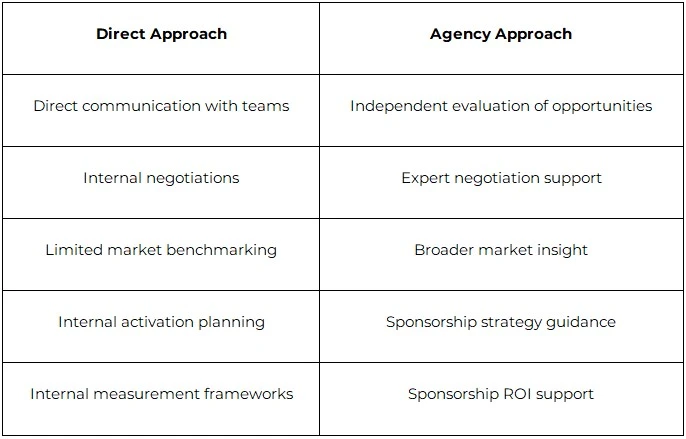
A direct approach may suit organisations with significant sponsorship experience.
However, many companies comparing F1 sponsorship through an agency vs direct find that external expertise helps reduce risk and improve decision-making throughout the sponsorship process.
One of the most overlooked aspects of sponsorship planning is understanding the difference between a seller's perspective and a buyer's perspective.
Teams are naturally focused on selling sponsorship inventory.
Brands are focused on achieving business outcomes.
While those goals often align, they are not always identical.
Independent advisors help organisations evaluate opportunities based on commercial relevance, audience alignment, activation potential and long-term strategic value. This helps ensure sponsorship investments support broader business objectives rather than simply securing exposure.
A specialist F1 sponsorship agency guides throughout the sponsorship lifecycle, from strategy development and opportunity evaluation to activation planning and performance measurement.
For organisations entering Formula 1 for the first time, a specialist F1 sponsorship agency can provide valuable market knowledge, commercial insight and negotiation support.
This is one reason the question do you need an agency to sponsor F1 has become increasingly common among marketing leaders. As sponsorship agreements become more sophisticated, many organisations recognise the value of expert guidance before committing significant resources.
For organisations wondering who to contact to sponsor an F1 team, the technical answer is relatively simple: sponsorship discussions are generally handled by a team's commercial and partnership departments.
The strategic answer is more important.
Whether evaluating F1 sponsorship through an agency vs direct or determining the best approach to sponsorship investment, success depends on much more than securing an introduction.
The strongest Formula 1 partnerships are built around clear objectives, effective activation and measurable business outcomes. Ultimately, organisations that approach sponsorship strategically are far more likely to transform a Formula 1 partnership into a valuable long-term business asset.
















 consultants ltd.jpg)


Comments