
Home Technology Data analytics Chinese Firm Claims it Analyze...
CIO Bulletin
,
13 April, 2026
Author:
Sambhrant Das
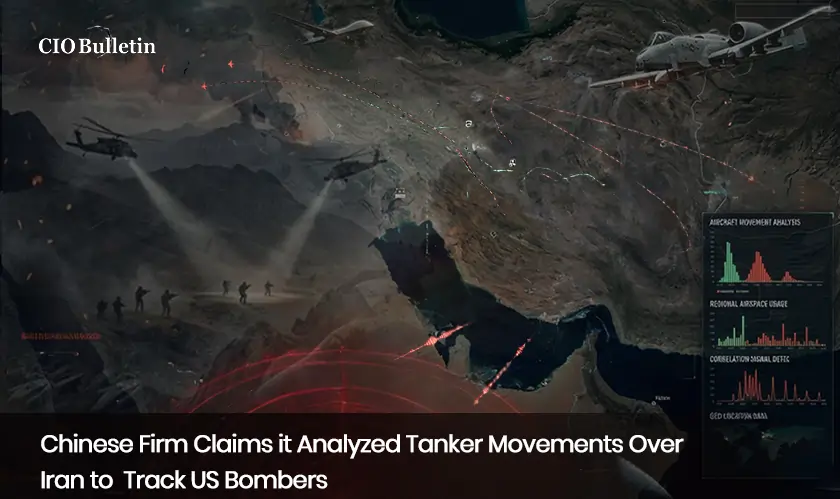
Chinese intelligence firm MizarVision claims to have tracked US bombers over Iran by analyzing public aerial refueling data and flight patterns.
A Chinese geospatial intelligence company, MizarVision, recently claimed that it had tracked the movement patterns of US bombers operating over Iran by deploying data analytics while studying their aerial refueling missions. These findings were presented in a report released earlier this month, focusing on the bombers’ movements during Operation Epic Fury. This demonstrates how sensitive operational details are susceptible to being revealed through indirect data sources.
Furthermore, the Chinese firm MizarVision’s report notes that the movements of US KC-135 and KC-46 aerial refueling aircrafts were analyzed to identify correlations between their flight paths and subsequent targeted strikes on Iranian assets. These routes can closely indicate where strike missions are likely to take place since tanker aircraft often operate in coordination with bombers. Thus, otherwise hidden bomber activity could be ascertained by mapping these tanker positions. Automatic Dependent Surveillance-Broadcast signals, a system used to track aircraft positions in real time, formed the crux of the analysis. Since tankers are among the most prominently visible military aircraft on such systems, the firm combined publicly available tracking data with other intelligence inputs to reconstruct confidential strike patterns.
However, what remains unclear is how central AI was to the tracking methodology, without which it is difficult to confirm bomber locations and correlate them with tanker movements. How much automation has been used in comparison to manual analysis is left unexplained. Additionally, the AI models or techniques used have also not been enumerated. Notwithstanding these limitations, CIO Bulletin views this development as highlighting the extent to which private entities can conduct intelligence-style assessments, once lying in the exclusive domain of governments using advanced commercial satellite technology and data analytics.




















































 consultants ltd.jpg)


